
Best Refurbished Laptops Online for Work and Budget Buyers

For most buyers, a Grade A certified refurbished business laptop from a trusted refurbisher is the best value available right now. Certified refurbished laptops typically save you 30%–60% compared with equivalent new models, and business-grade machines from Dell, Lenovo, and HP routinely outlast new consumer laptops because they were built to a higher standard from the start.
Quick picks for 2026:
- Best business ultrabook: Lenovo ThinkPad X1 Carbon (refurbished, Grade A) — thin, repairable, and built to MIL-STD durability specs
- Best mainstream work laptop: Dell Latitude 5000 series (refurbished) — widely available, easy to service, and priced well under $400 in most Grade B listings
- Best vetted seller: Devicegiant — 25-point TrueGrade inspection, disclosed cosmetic grading, and a 90-day return policy
Table of Contents
- Which brands and models should you target when buying refurbished?
- Where to buy refurbished laptops online and what each seller type guarantees
- Key factors to check when evaluating a refurbished listing
- What to test when your refurbished laptop arrives
- How reputable refurbishers inspect devices: the TrueGrade 25-point overview
- Warranty expectations, return timelines, and typical pricing for U.S. buyers
- Which refurbished laptop fits your actual needs?
- Key Takeaways
- Why certified refurbishers are the right call for most buyers
- Devicegiant: a vetted, low-risk path to affordable refurbished devices
- Research sources and next steps
Which brands and models should you target when buying refurbished?
Not every refurbished laptop is worth your time. The model families that consistently deliver are the ones originally built for corporate fleets, where durability and repairability were requirements, not afterthoughts.
Lenovo ThinkPad (T, X, and E series)
- Keyboards are among the best in the business; the T-series is especially repairable, with service manuals and modular parts widely available
- Enterprise lines like ThinkPad were built to higher durability standards and use modular components, including removable batteries and standard NVMe slots, that make future repairs inexpensive
- Typical refurbished price: $150–$450 depending on generation and grade
- Watch out for: older 8th-gen units being sold as “recent” — aim for 11th-gen Intel Core or AMD Ryzen 5000 at minimum in 2026
Dell Latitude and XPS
- Latitude is the corporate workhorse: standardized parts, long BIOS support cycles, and abundant spare parts on the secondary market
- XPS refurbished units offer premium displays, but are harder to repair and pricier; Latitude is the smarter refurb buy for most people
- Typical refurbished price: $200–$600
HP EliteBook
- Built to similar enterprise standards as ThinkPad and Latitude; strong keyboard, good display options, and solid port selection
- Slightly less repairable than ThinkPad but still far ahead of consumer HP Pavilion or Envy lines
- Typical refurbished price: $180–$500
Apple MacBook (Air and Pro)
- Grade A refurbished MacBooks hold value well and the Apple Refurbished Store sells them with a one-year warranty and new battery/outer shell
- M1 and M2 MacBook Air units are the sweet spot: fast, fanless, and widely available refurbished for $700–$950
- Downside: limited repairability and no user-serviceable parts on most models
Minimum specs to target in 2026: 11th-gen Intel Core i5 or AMD Ryzen 5 5000 series (or Apple M1), 16 GB RAM, 256 GB NVMe SSD, and a 1080p display. Anything below 8 GB RAM will feel constrained within a year.
Pro Tip: Refurbished enterprise hardware often shows lower initial failure rates than new consumer laptops because corporate fleet returns have already passed burn-in and IT maintenance cycles. Prioritize ex-corporate stock over refurbished consumer models whenever the price is similar.
Where to buy refurbished laptops online and what each seller type guarantees
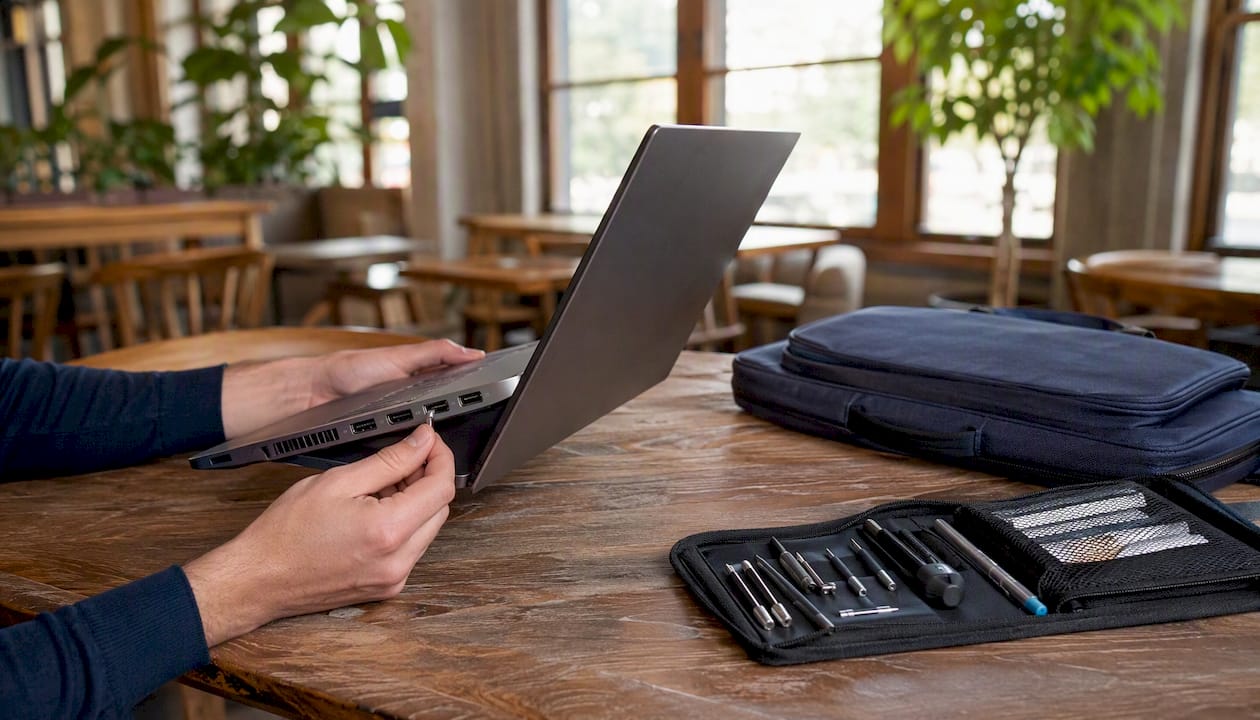
Seller type matters as much as the laptop itself. The same ThinkPad T14 can come with a 12-month warranty from one seller and a 30-day “as-is” policy from another.
| Seller Type | Grading Consistency | Warranty | Return Window | Risk Level |
|---|---|---|---|---|
| Manufacturer-certified (Apple, Dell) | Highest | 1 year | 14–30 days | Lowest |
| Certified refurbisher (Devicegiant, etc.) | High, published process | 90 days–1 year | 30–90 days | Low |
| Marketplace (Amazon Renewed, Back Market) | Moderate, varies by seller | 90 days–1 year on select tiers | 30 days | Moderate |
| Big-retailer outlet (Best Buy Outlet) | Moderate | Varies | 30 days | Moderate |
| Peer-to-peer / auction (eBay individual) | Low, self-reported | None or seller-defined | Buyer protection only | Higher |
Grading labels vary significantly across platforms; manufacturer-certified units typically carry the lowest risk and most consistent warranties, while marketplaces rely on third-party refurbishers whose standards differ widely. Back Market and Amazon Renewed publish minimum battery health thresholds, often 80%–85%, and offer standardized money-back periods on qualifying listings. That floor is useful, but it is not the same as a published inspection process.
Pro Tip: A reputable refurbisher publishes its inspection process, lists a physical address, states warranty terms in plain language, and ideally holds Microsoft Registered Refurbisher status. If a seller’s “about” page is a single paragraph with no specifics, keep scrolling. Check the difference between refurbished, renewed, and used before committing to any listing.
Key factors to check when evaluating a refurbished listing
The five things that matter most: warranty length, battery health evidence, MDM/Activation Lock clearance, return window, and disclosed condition grade. Everything else is secondary.
What to verify before you buy:
- Condition grade: Grade A means minimal cosmetic wear; Grade B means visible scratches but full function; Grade C means heavy wear. Never accept a listing with no grade disclosed.
- Battery health: Ask for a screenshot of the battery report showing current capacity vs. design capacity. Anything below 80% is a red flag unless the price reflects it.
- MDM and Activation Lock: Ex-corporate laptops can carry residual device management enrollment or BIOS passwords if not fully wiped. Get written confirmation these are cleared before purchase.
- SSD health: Check TBW (Total Bytes Written); drives near or over 80% of rated TBW are approaching end of reliable life, and reallocated or pending sectors indicate serious problems.
- Seller trust signals: Verified reviews, a published return policy, and a clear warranty statement in writing.
Savings callout: Certified refurbished laptops save buyers 30%–60% versus new. On a $1,200 new ThinkPad X1 Carbon, that means paying $480–$840 for equivalent performance.
Quick checklist to copy when messaging a seller:
- What is the current battery capacity vs. design capacity?
- Is MDM, Autopilot, or Activation Lock fully removed? Can you confirm in writing?
- What is the SSD’s TBW usage and SMART status?
- What is the exact condition grade and cosmetic description?
- What is the full return window after I complete setup?
What to test when your refurbished laptop arrives
Open the box and start testing immediately. Your return window starts on delivery, not on first use, so every day you wait is a day of protection you are burning.
First 24–72 hours checklist:
- Power cycle three times — shut down fully and restart to catch boot instability or firmware errors.
-
Run a battery report — on Windows, open Command Prompt and type
powercfg /batteryreport; on macOS, hold Option and click the battery icon. Confirm capacity matches what the seller stated. - Check setup path — if the laptop forces you into a corporate Microsoft or Apple Business Manager enrollment screen, stop and contact the seller immediately. That is an MDM lock.
- Access BIOS/firmware — confirm no password is set and Secure Boot is configured correctly for your OS.
- Test every port — plug something into each USB-A, USB-C, HDMI, and headphone jack.
- Inspect the display — open a solid white image and a solid black image full-screen to check for dead pixels, backlight bleed, and yellowing.
- Test keyboard and trackpad — use an online keyboard tester to confirm every key registers.
- Connect to Wi-Fi and Bluetooth — verify both connect and hold a stable signal.
- Test camera and microphone — open a video call app or the built-in camera app.
- Run a quick SSD health check — use CrystalDiskInfo (Windows) or DriveDx (macOS) to pull SMART data.
Any failure on items 2, 3, or 4 is grounds for an immediate return request. Items 5–10 are grounds for return if the seller’s listing did not disclose the defect.
Pro Tip: Record a short screen-capture video of your first boot and every port test. If a dispute arises, timestamped video evidence resolves seller disagreements faster than any written description.
How reputable refurbishers inspect devices: the TrueGrade 25-point overview
A trustworthy refurbisher does not just power on a laptop and call it done. Devicegiant’s TrueGrade inspection covers ten functional areas before any device ships.
| Inspection Area | What Gets Checked |
|---|---|
| Power system | Charging circuit, power button, battery charge/discharge cycle |
| Battery health | Current capacity vs. design capacity, cycle count |
| Storage health | SSD TBW usage, SMART data, reallocated/pending sectors |
| Ports and connectivity | All USB, video-out, audio, and card reader ports |
| Display | Dead pixels, backlight uniformity, color accuracy |
| Keyboard and trackpad | Every key, click zones, multi-touch response |
| Firmware and BIOS | No passwords set, Secure Boot configured, no MDM enrollment |
| Security locks | MDM, Autopilot, and Activation Lock confirmed cleared |
| Thermal performance | Fan operation, thermal throttling under load |
| Cosmetic grade | Assigned A–D grade with documented defect notes |
- Battery capacity, SSD health percentage, and MDM clearance confirmation should be available in writing from any certified refurbisher before you buy.
- If a seller cannot provide a battery report or SMART data on request, treat that as a disqualifying signal.
Pro Tip: Ask the seller specifically: “Can you send me the battery health report and SSD SMART data for this unit?” A refurbisher with a real inspection process will answer in minutes. One without a process will stall or deflect.
Warranty expectations, return timelines, and typical pricing for U.S. buyers
Expect a 90-day warranty as the floor from any reputable certified refurbisher in the U.S. Manufacturer-certified programs (Apple Refurbished Store, Dell Certified Refurbished) typically offer a full year. Marketplace sellers on Amazon Renewed offer 90 days on Renewed Premium listings; standard Renewed listings vary.
Return processing for U.S. buyers typically runs 5–10 business days once the seller receives the unit. Repair turnaround under warranty is usually 7–14 business days, though manufacturer-certified programs can be faster through their own service networks.
Savings snapshot: Certified refurbished laptops save buyers 30%–60% versus new. Manufacturer-certified programs typically offer savings at the lower end because they carry longer warranties and tighter grading. Independent certified refurbishers often offer higher savings.
Typical U.S. refurbished price bands:
- Business ultrabooks (ThinkPad X1, EliteBook 840, Latitude 7000): $300–$700 refurbished vs. $1,000–$1,800 new
- Mainstream business laptops (ThinkPad T-series, Latitude 5000, EliteBook 800): $150–$450 refurbished vs. $700–$1,200 new
- Consumer ultrabooks (MacBook Air M1/M2, refurbished): $650–$950 vs. $1,099–$1,299 new
- Gaming/workstation (refurbished): $500–$1,200 vs. $1,500–$2,500+ new; note that refurbished units are optimal for productivity but new laptops remain preferable for buyers who need the latest on-device AI NPUs and cutting-edge GPU performance
Which refurbished laptop fits your actual needs?
| Use Case | Recommended Category | Minimum Specs | Best Model Families |
|---|---|---|---|
| Work / general office | Business laptop | Core i5 11th-gen, 16 GB RAM, 256 GB SSD, 1080p | ThinkPad T14, Latitude 5420, EliteBook 840 |
| Student | Mainstream business | Core i5 10th-gen, 8 GB RAM, 256 GB SSD | ThinkPad E14, any Grade B |
| Light creative / photo editing | Business ultrabook | Core i7 11th-gen, 16 GB RAM, 256 GB SSD, color-accurate display | MacBook Air M1, ThinkPad X1 Carbon |
| Travel / ultra-portable | Thin business ultrabook | Core i5 11th-gen, 16 GB RAM, 256 GB SSD, under 3 lbs | ThinkPad X1 Carbon, EliteBook 840 G8 |
For work and general office use, a refurbished ThinkPad T14 or Dell Latitude 5420 with 16 GB RAM hits the sweet spot of price and longevity. Students who mostly browse, write, and video-call can save more by accepting a Grade B unit with 8 GB RAM, though 16 GB is worth the small premium if the budget allows. Light photo editing needs a display that covers at least 90% of sRGB — check the spec sheet before buying, since not every business laptop meets that bar. For travel, weight matters as much as specs; the ThinkPad X1 Carbon at under 2.5 lbs is hard to beat refurbished.

Key Takeaways
Certified refurbished business laptops from trusted sellers save buyers a notable amount versus new while delivering enterprise-grade durability that consumer laptops rarely match.
| Point | Details |
|---|---|
| Target business-grade families | ThinkPad, Latitude, and EliteBook outlast consumer models and are far easier to repair. |
| Verify battery, SSD, and MDM in writing | Ask for battery capacity report, SMART data, and written MDM clearance before paying. |
| Match seller type to your risk tolerance | Manufacturer-certified carries the lowest risk; certified refurbishers offer the best savings-to-warranty ratio. |
| Savings of 30%–60% vs. new | Certified refurbished pricing consistently delivers this range; manufacturer-certified programs sit at the lower end. |
| Devicegiant as vetted seller | Devicegiant’s TrueGrade 25-point inspection, A–D cosmetic grading, and 90-day return policy make it a low-risk buying option. |
Why certified refurbishers are the right call for most buyers
The conventional wisdom says “buy manufacturer-certified for safety.” That advice is not wrong, but it leaves money on the table. Manufacturer-certified programs offer tight grading and long warranties, but their savings are typically at the lower end of the 30%–60% range, and their inventory is limited to their own brand.
A certified independent refurbisher with a published inspection process, a physical address, and a real return policy often provides savings at the higher end of the 30%–60% range and access to every major brand. The key word is published. Any refurbisher worth trusting will show you exactly what they check, not just claim they “thoroughly test” devices.
Devicegiant’s TrueGrade 25-point inspection does exactly that: ten functional areas, disclosed cosmetic grades from A to D, and a 90-day return policy backed by 99.8% positive eBay feedback. That feedback score is not a marketing claim; it is a public, verifiable record. There is also an environmental argument worth making plainly: buying refurbished keeps a working device out of a landfill. For a buyer who is already price-conscious, the fact that it is also the greener choice costs nothing extra.
Devicegiant: a vetted, low-risk path to affordable refurbished devices
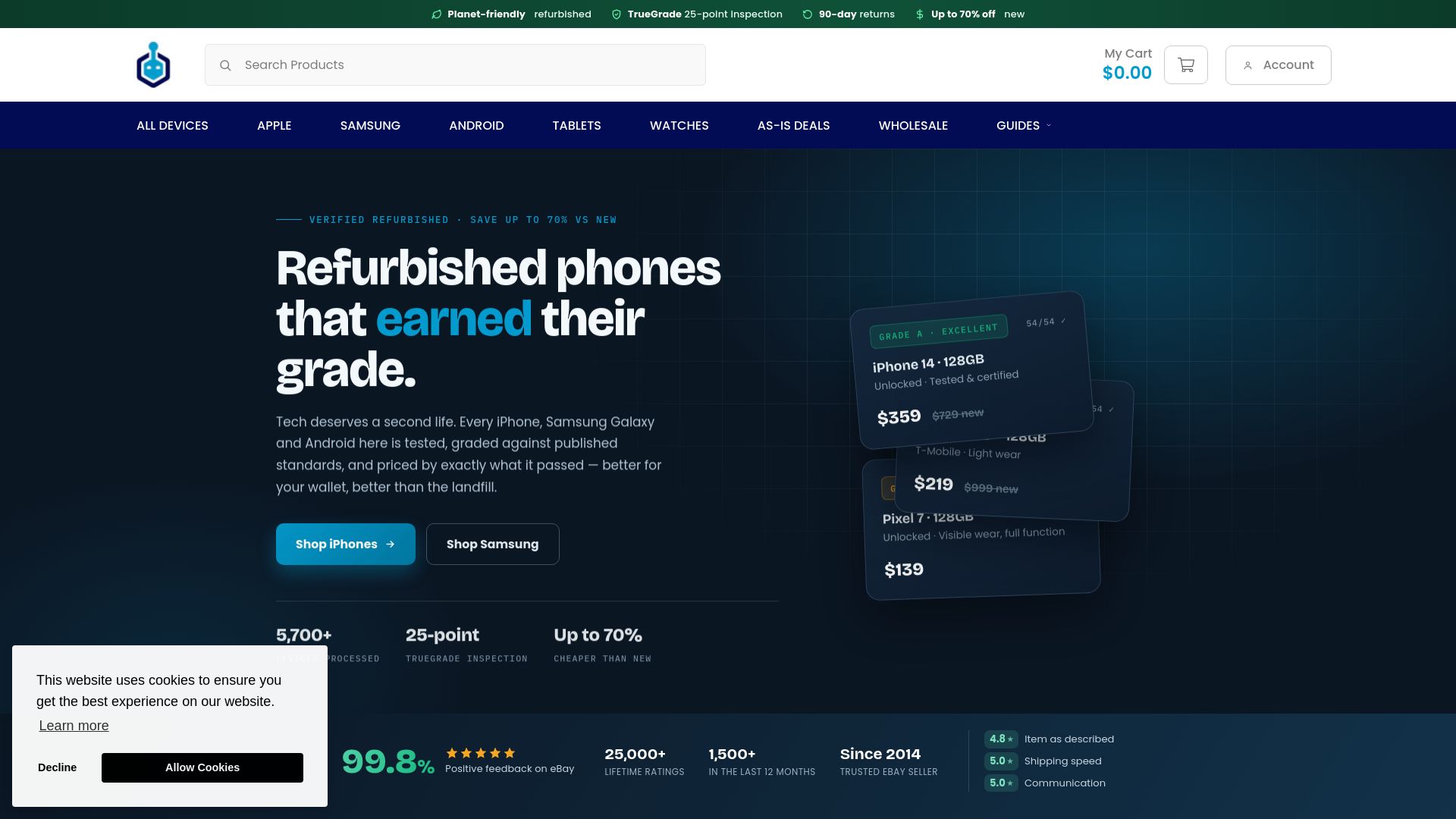
If you want the savings of a certified refurbisher without the guesswork of an unknown eBay seller, Devicegiant is worth a direct look. Every device goes through the TrueGrade 25-point inspection before it ships, cosmetic condition is graded A through D with no vague language, and the 90-day return policy gives you real time to test thoroughly.
Why buyers choose Devicegiant:
- TrueGrade 25-point functional inspection on every device
- Disclosed cosmetic grading (A–D) so you know exactly what arrives
- 90-day return policy — one of the longest in the certified refurbisher category
- 99.8% positive feedback on eBay, publicly verifiable
- Wholesale bulk options for resellers and small businesses
Browse Devicegiant’s refurbished inventory to compare current listings, check condition grades, and confirm the return policy before you buy.
Research sources and next steps
Sources used in this guide:
- Is a Refurbished Laptop Worth Buying in 2026? (Laptop Advisor Online) — enterprise hardware failure rates, repairability, and MDM risks
- Refurbished vs New Laptop (Nogire) — 30%–60% savings data and use-case guidance
- Buy a Refurbished Laptop in 2026: Full Checklist (Easyb) — buyer checklist: battery report, MDM clearance, return policy
- Refurbished Laptop Buying Guide (Gadget Scout) — SSD TBW and SMART health checks
- Should I Buy a Refurbished Laptop or a New One? (Newegg Insider) — grading consistency and warranty differences by seller type
Your next three steps:
- Pick two listings for the same model (e.g., ThinkPad T14 Gen 2) from different seller types and compare grade, warranty, and price side by side
- Message each seller with the five-question checklist from the decision factors section above and judge response quality
- Once the laptop arrives, run the 10-step arrival checklist within 24 hours and keep your video evidence until the return window closes


