
Best Back Market Alternatives for Verified Refurbished Phones

If you want a verified refurbished phone with a real inspection process and a return window you can actually use, Devicegiant is the strongest Back Market alternative for U.S. buyers. Every device goes through a thorough TrueGrade inspection, ships with disclosed cosmetic grading, and comes backed by a generous return policy. For sellers, the picture splits three ways: peer-to-peer marketplaces (like Swappa) pay more but demand more effort; buyback and reseller services (like Decluttr, Gazelle, and BuyBackWorld) pay less but close fast; and instant kiosk services (like ecoATM) trade convenience for the lowest payout.
Buyers get the best protection from verified refurbishers. Sellers who prioritize speed over price should lean toward buyback services.

Table of Contents
- How do the main Back Market alternatives compare?
- What should you expect from each type of marketplace?
- How do you pick the right option for buying or selling?
- Why does refurbishment transparency actually change outcomes?
- Key Takeaways
- The case for prioritizing inspection over price
- Devicegiant: verified refurbished phones with a real inspection process
- Useful sources and tools for further reading
How do the main Back Market alternatives compare?
| Category | Best For | Pricing / Payout Shape | Warranty / Return Window | Inspection Transparency | Marketplace Model | Shipping & Payment | Timeline | Buyer Protections | U.S. Available |
|---|---|---|---|---|---|---|---|---|---|
| Verified refurbisher (e.g., Devicegiant) | Buyers wanting inspection proof + warranty | Up to 70% off new; fixed retail price | 90-day return; graded warranty | 25-point checklist, cosmetic grade A–D disclosed | Direct reseller / certified refurbisher | Standard shipping; card/PayPal | — | 90-day returns, IMEI/unlock disclosed | Yes |
| Manufacturer / retailer certified (e.g., Amazon Renewed, Best Buy Geek Squad Certified, Apple/Samsung CPO) | Buyers who want brand-backed parts and local support | Moderate discount vs. new; fixed price | 1-year warranty typical | Manufacturer programs use first-party parts; documented process | Certified refurbisher (brand-direct or retailer) | Prime/in-store options; card | 1–5 days delivery | Manufacturer guarantee; in-store returns possible | Yes |
| Peer-to-peer marketplace (e.g., Swappa, eBay Certified Refurbished) | Sellers wanting top dollar; buyers hunting deals | Variable; often competitive for buyers | Varies by seller; eBay Certified offers 1-year | Seller-dependent; actual device photos often required | Peer-to-peer / third-party seller | Seller ships; PayPal/card | 1–5 days payout; payout after sale | Buyer protection programs; dispute resolution | Yes |
| Buyback / reseller service (e.g., Decluttr, Gazelle, BuyBackWorld) | Sellers wanting fast, hassle-free payout | Below-market payout; fixed quote | 30-day return window typical | Limited disclosure; stock images common | Reseller (buys from public, resells) | Free shipping label; check/PayPal/Venmo | Payout in 1–5 business days | 30-day return for buyers | Yes |
| Instant kiosk / auto-buy (e.g., ecoATM) | Sellers wanting same-day cash | Lowest payout of all categories | No warranty for sellers | None | Automated kiosk | In-person; cash/Venmo | Instant | N/A for sellers | Yes (nationwide) |

Quick wins and risks at a glance: Verified refurbishers and manufacturer programs offer the strongest buyer protections but less room to negotiate price. Peer-to-peer platforms can surface the best deals and the worst ones, often on the same page. Buyback services are the path of least resistance for sellers, but payout speed comes at a cost in dollars received. Kiosks are for emergencies, not optimization.
What should you expect from each type of marketplace?
The refurbished device market has no single governing standard. Consumer Reports notes that industry experts describe the seller-refurbished space as a “Wild West,” where the word “refurbished” can mean anything from a factory reset to a full component replacement. What separates a trustworthy option from a risky one is what the seller actually publishes about their process.
Verified refurbishers
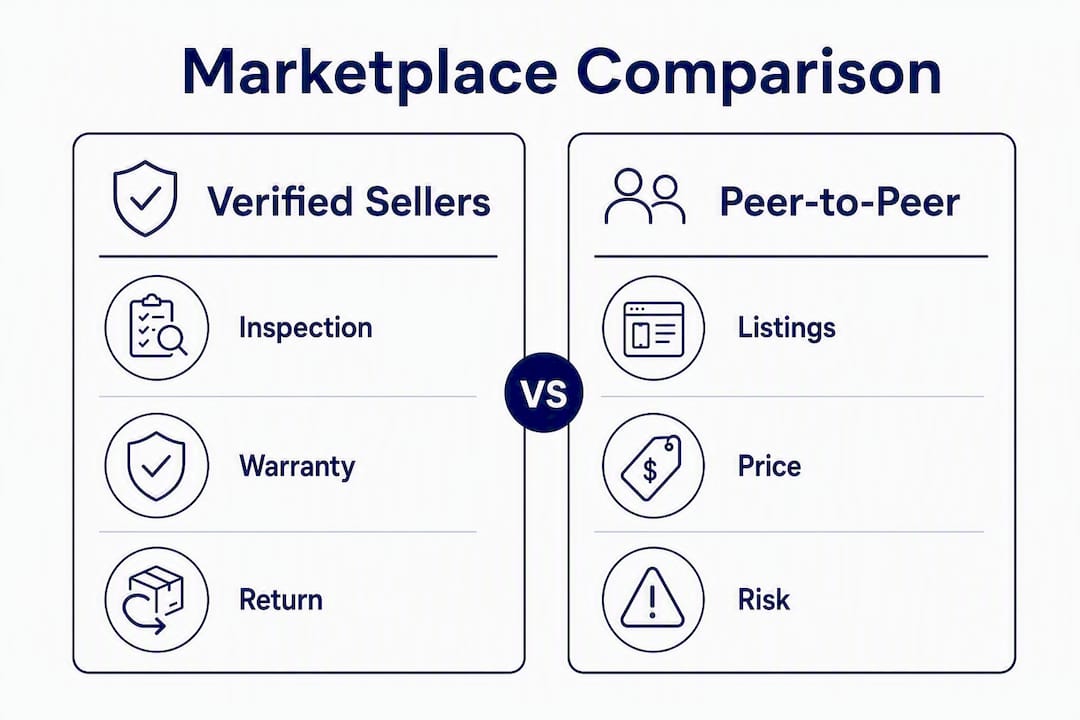
Devicegiant and similar direct refurbishers buy devices, inspect them against a published checklist (Devicegiant’s TrueGrade covers 25 functional points), assign a cosmetic grade (A through D), and sell at a fixed price with a stated return window. You know exactly what you’re getting before you pay. The difference between “refurbished,” “renewed,” and “used” matters here: a verified refurbisher discloses what was tested and what was replaced; a “renewed” label on a large marketplace often means far less.
- Pros: Inspection proof, clear grading, predictable warranty, IMEI and unlock status disclosed
- Cons: Smaller inventory than mega-marketplaces; fixed pricing (no negotiation)
Manufacturer and retailer certified programs
Apple Certified Pre-Owned, Samsung Certified Re-Newed, Amazon Renewed, and Best Buy’s Geek Squad Certified Refurbished all sit in this tier. Manufacturer programs typically include 1-year warranties and use first-party replacement parts, which matters for battery and screen longevity. Best Buy adds the option of in-store returns and Geek Squad support, which is genuinely useful if you prefer not to ship a device back. Prices run higher than third-party refurbishers, but the brand-backed guarantee reduces risk for buyers who are less comfortable evaluating condition themselves.
- Pros: First-party parts, strong warranties, local return options for retail programs
- Cons: Higher price point; limited to brands that run their own programs
Peer-to-peer marketplaces
Swappa and eBay’s Certified Refurbished listings are the two main peer-to-peer options in the U.S. Swappa requires sellers to post photos of the actual device and discloses IMEI status before listing. Actual device photos correlate with fewer post-sale disputes compared with stock images and vague condition labels. eBay Certified Refurbished is a separate tier from standard eBay listings: those devices carry a 1-year warranty and a 30-day return window backed by eBay, not just the individual seller.
- Pros: Competitive pricing; real device photos on better platforms; seller competition keeps prices honest
- Cons: Quality varies sharply by seller; buyer protection depends on the platform tier; more research required
Pro Tip: On any peer-to-peer platform, filter specifically for listings that include actual device photos, not stock images. A seller who photographs their own device is signaling accountability.
Buyback and reseller services
Decluttr, Gazelle, and BuyBackWorld all work the same way: you get an instant quote online, ship the device for free, and receive payment after inspection. Payout lands in 1–5 business days via PayPal, check, or Venmo depending on the service. The tradeoff is straightforward: you’ll receive less than you would selling peer-to-peer, but you skip the listing, negotiation, and shipping logistics entirely. For buyers, these platforms resell the devices they’ve purchased, often with a 30-day return window and limited inspection disclosure.
- Pros: Fast, predictable seller payout; no listing effort; free shipping
- Cons: Below-market payouts; limited inspection transparency for buyers; short return windows
Instant kiosk services
ecoATM operates kiosks in grocery stores and retail locations nationwide. You walk in, the machine evaluates your device, and you walk out with cash or a Venmo transfer. Payouts are the lowest in any category, and there’s no warranty or buyer-side transaction. The environmental angle is real: ecoATM diverts devices from landfills, which aligns with an eco-aware seller’s values even when the payout stings.
How do you pick the right option for buying or selling?
The right platform depends on what you’re optimizing for. Here’s how to think through it.
For buyers
- Inspection transparency first: Look for a published checklist (25-point or similar) and a cosmetic grade with photos of the actual device. Vague terms like “good condition” with a stock image are a red flag.
- Minimum 30-day return window: A 30-day return window is the baseline; 90 days give you time to catch issues that don’t surface immediately.
- IMEI and activation lock status: Confirm the device is not blacklisted before you pay. Free tools like IMEI.info and paid services like CheckMEND both work. Devicegiant’s guide on how to check IMEI walks through the process step by step.
- Battery health disclosure: Ask or check whether the seller states battery capacity. Anything below 80% is a short-term device. Verify the claim yourself using the iOS battery menu or an app like AccuBattery within your return window.
- Unlock status: Confirm the device is unlocked or compatible with your carrier before checkout. A locked device at a great price is only great if you’re on that carrier.
- Accessories: Many sellers substitute third-party chargers. Prioritize listings that explicitly state original or manufacturer-certified accessories are included.
For sellers
- Payout speed vs. payout amount: Buyback services pay in days; peer-to-peer can take weeks but typically returns more money. Decide which matters more before you list.
- Fees: Peer-to-peer platforms charge listing or transaction fees. Factor those in before comparing quotes.
- Condition honesty: Overstating condition leads to returns and disputes. Grade your device accurately using the platform’s own scale.
- Wholesale volume: If you’re clearing multiple devices, Devicegiant offers bulk wholesale options for resellers and repair shops, which can simplify the process considerably.
Red flags to avoid: No cosmetic grading photos, no stated return window, vague testing claims (“fully tested” with no specifics), missing IMEI or unlock details, and sellers who can’t confirm whether a device has been iCloud or Google account unlocked.
Pro Tip: Check activation lock status the moment a device arrives, before you do anything else. An iOS device with an active iCloud lock is a paperweight regardless of how good it looks. Run an IMEI check immediately on receipt to confirm it’s not blacklisted.
Why does refurbishment transparency actually change outcomes?
The short answer: a published inspection process and a clear warranty are the two strongest predictors of a refurb that lasts. Without them, you’re buying on trust alone.
The environmental case for refurbished tech only holds when the device actually lasts. A low-quality refurb that fails in three months doesn’t reduce e-waste; it adds to it. Eco-minded buyers realize environmental benefit only when refurbs last, which means durability and inspection quality are sustainability issues, not just consumer-protection ones.
Battery health is the most commonly misrepresented spec. Third-party tools like AccuBattery can confirm capacity, and some sellers claim 80%+ without any verification behind that number. A published point-check inspection that specifically covers battery testing is a meaningful signal, not just a marketing claim.
Devicegiant’s TrueGrade 25-point inspection and 90-day return policy align directly with what buyer guides consistently recommend as the minimum standard for lower-risk refurbished purchases. That’s not a coincidence; it’s the baseline any serious refurbisher should meet.
Key Takeaways
Verified refurbishers with published inspection checklists, clear cosmetic grading, and at least a 90-day return window offer the strongest protection for U.S. buyers of refurbished electronics.
| Point | Details |
|---|---|
| Top pick for buyers | Devicegiant offers a 25-point TrueGrade inspection, grades A–D, and a 90-day return policy. |
| Warranty baseline | Look for at least a 30-day return window; 90 days or a 1-year warranty signals a stronger program. |
| IMEI and activation lock | Check IMEI status and activation lock immediately on receipt, before the return window closes. |
| Battery health | Verify battery capacity with the OS or AccuBattery within the return window; don’t rely on seller claims alone. |
| Eco-conscious note | Choose durability over the lowest price: a refurb that fails early adds to e-waste rather than reducing it. |
The case for prioritizing inspection over price
The refurbished phone market rewards patience and skepticism in equal measure. Most buyers fixate on price, which is understandable, but the real variable is inspection quality. A $50 savings on a device with no stated return window and a vague “tested and working” claim is not a deal; it’s a gamble. The platforms and sellers that publish their process, name what they tested, and stand behind the device with a real return window are the ones worth your time.
Peer-to-peer platforms can surface genuine value, but they require you to do the due diligence that a verified refurbisher has already done. For most buyers, that tradeoff isn’t worth it unless you’re experienced enough to evaluate a listing critically and comfortable enough to navigate a dispute if something goes wrong.
For eco-aware buyers specifically, the sustainability argument for refurbished tech collapses if the device fails in six months. A slightly higher price for a device that’s been properly inspected and carries a 90-day return window is almost always the better environmental choice, not just the safer financial one.
Devicegiant: verified refurbished phones with a real inspection process
Devicegiant sells verified refurbished smartphones, tablets, smartwatches, and select laptops at up to 70% off new pricing. Every device goes through the TrueGrade 25-point functional inspection, ships with a disclosed cosmetic grade (A through D), and is covered by a 90-day return policy. Unlocked and carrier-specific options are both available, and wholesale bulk lots are an option for resellers and repair shops.
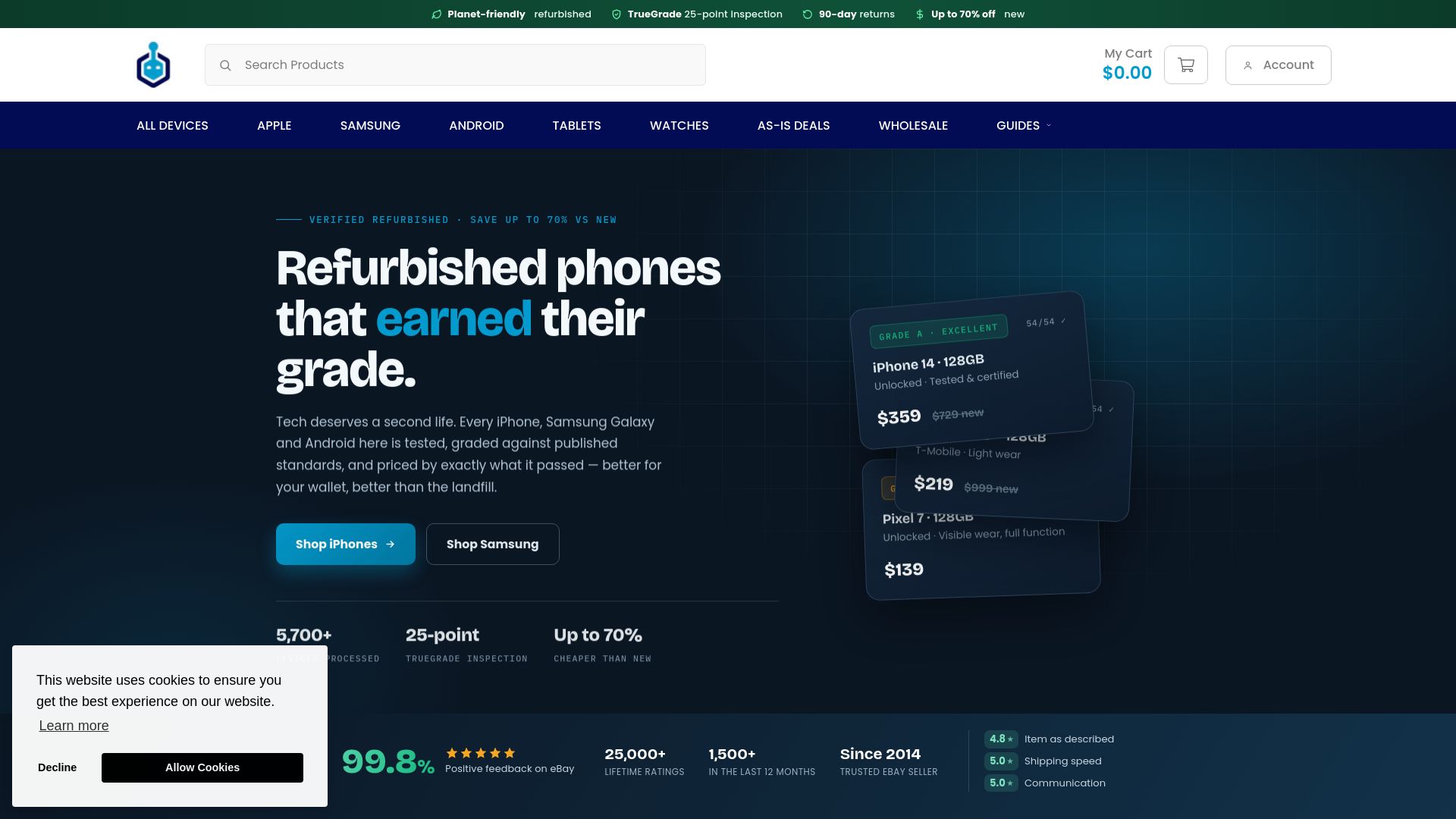
To get started: browse the inventory by device type or budget, filter by grade to match your condition preference, check the IMEI and activation notes on the listing, and check out. Shipping is standard, and the 90-day return window starts on delivery. For resellers, the wholesale section covers bulk pricing and lot options. Browse refurbished phones up to 70% off and find a verified device that fits your budget today.
Useful sources and tools for further reading
Before you finalize any refurbished purchase, bookmark these resources. An IMEI check and a battery verification take five minutes and can save you a costly return.
- How to check IMEI before buying a used phone — Devicegiant’s step-by-step guide to IMEI and activation lock checks
- Refurbished vs. renewed vs. used phones explained — Devicegiant’s breakdown of condition labels and what they actually mean
- Are refurbished phones worth it? — Devicegiant’s analysis of cost vs. longevity for refurbished devices
- Should You Buy Refurbished Electronics? — Consumer Reports — authoritative consumer-protection perspective on the refurbished market
- The Earth911 Guide to Buying Refurbished Electronics — sustainability-focused buying guide with return window and warranty benchmarks
- 5 Things to Check Before Buying a Refurbished Phone — Digit.in — battery health, accessories, and activation lock verification steps
- IMEI.info — free IMEI lookup tool to check blacklist and carrier status before purchase


