
Wholesale iPhones Suppliers: A Buyer's Checklist for Resellers

Yes, you can buy wholesale iPhones reliably right now. The fastest, lowest-risk path is a small test order from a refurbishment-first U.S. wholesaler or a verified refurbisher like Devicegiant, where grading is documented and IMEI reporting is standard. Before you commit to any supplier, two things matter most on first contact:
- Verifiable business registration and EIN — confirm the legal entity matches the name on the invoice and the bank account receiving payment.
- Per-shipment IMEI/blacklist report — every unit should be individually traceable before it ships.
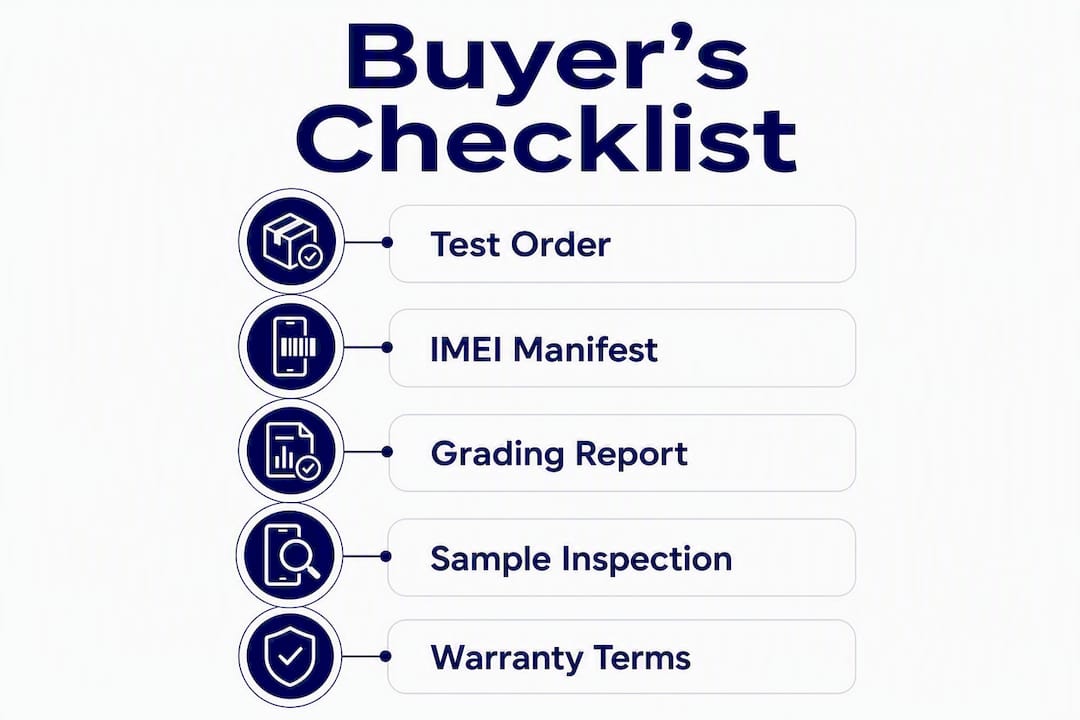
Start with 10–25 units. Request an IMEI manifest, a grading report, and a sample inspection checklist. That single test order tells you more about a supplier’s discipline than any sales call.
Pro Tip: If you source from auction or liquidation channels rather than certified refurbishers, budget a portion of your unit cost for inspection labor and spare parts. That overhead disappears when you buy from a supplier with a published grading standard.

Table of Contents
- What do wholesale iPhone suppliers actually sell?
- How does grading work and what proof should you demand?
- What should you expect to pay and how does ordering work?
- How do you verify a U.S. wholesale iPhone supplier before committing?
- What shipping, customs, and IMEI checks do U.S. buyers need to handle?
- What warranty and DOA terms should you insist on?
- What payment terms are safe and what red flags should disqualify a supplier?
- Key Takeaways
- The mistake most resellers make when sourcing iPhones in bulk
- Devicegiant wholesale: verified iPhones with the documentation resellers need
- Useful sources for your first wholesale iPhone order
What do wholesale iPhone suppliers actually sell?
There is no direct Apple wholesale program for small resellers. Credible supply flows through four channels, each with different tradeoffs:
- Authorized distributors — new sealed devices, but PO minimums often run high, typically suited to enterprise buyers rather than small resellers. Suited to enterprise buyers, not small resellers.
- Refurbishment-first wholesalers — sell Grade A/B/C stock with published inspection standards. Best fit for most small-to-midsize buyers.
- Auction/liquidation platforms — large lots (100–500+ units), lowest entry price, highest QA overhead. Only viable if you have internal inspection capacity.
- B2B trading platforms — flexible MOQs (as low as 5–25 units), mixed sourcing quality; vet each seller individually.
On the model side, the iPhone 12 through 15 series drives the bulk of wholesale volume today. iPhone 13 and 14 models are the most consistently available; iPhone 15 supply is growing but still commands a premium. Older models like the 12 Mini appear at lower price points and suit budget-focused resale channels.
Condition categories matter as much as model. New sealed and factory-unlocked units carry the highest resale value but the tightest supply. Refurbished grades run A+ (near-flawless) through D (heavy wear, functional). Grade A is the sweet spot for most resellers: cosmetically clean, fully functional, and priced competitively. Carrier-locked inventory is cheaper but limits your buyer pool significantly. U.S.-spec factory-unlocked devices are almost always worth the modest premium over international SKUs, which can have regional firmware or band limitations that create activation headaches.
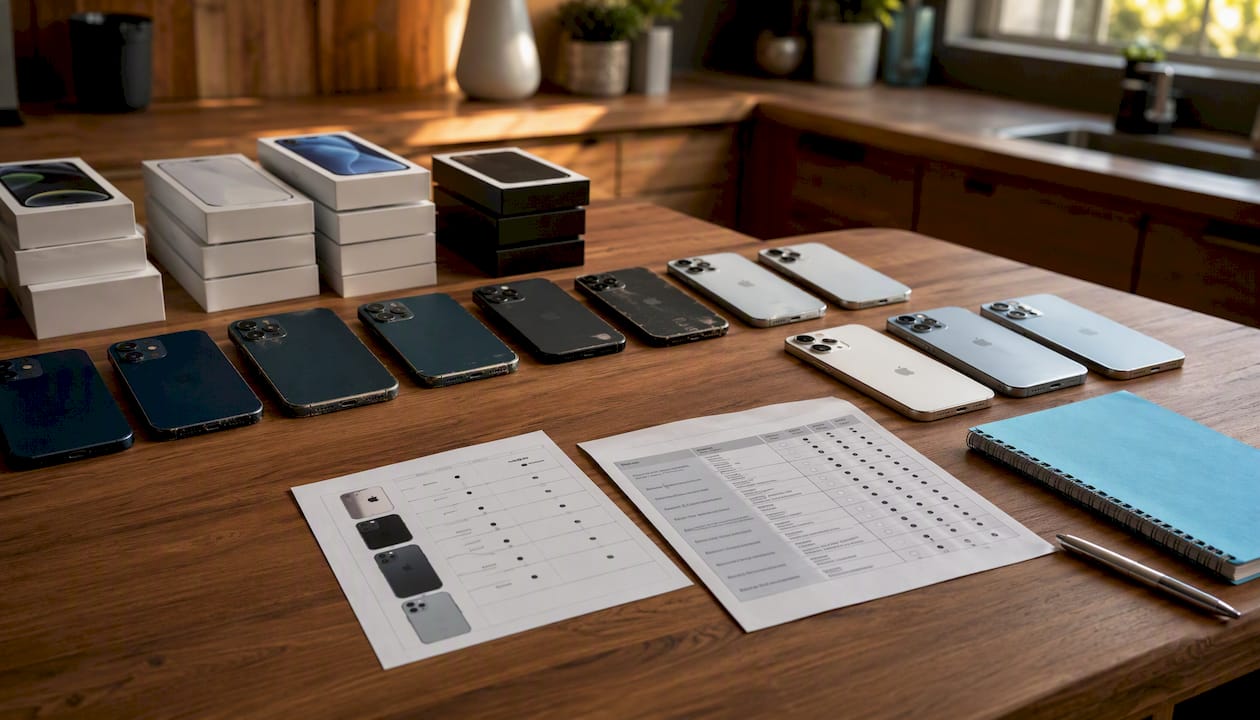
Pro Tip: Refurbishment-first U.S. suppliers give most resellers the best balance of consistency and lower downstream QA costs. The small unit-price premium over auction lots typically pays for itself in reduced returns and labor.
How does grading work and what proof should you demand?
Grade labels without documentation are just marketing. Here is what each tier actually implies in a wholesale context:
- Grade A/A+: Fully functional, minimal cosmetic wear, battery health typically 80%+. Suitable for retail resale with minimal reconditioning.
- Grade B: Light scratches or scuffs, fully functional. Works for value-channel resale or repair-shop inventory.
- Grade C/D: Visible wear, possible minor functional issues. Priced for parts or heavy reconditioning — not direct retail.
The inspection standard is what separates a trustworthy supplier from a risky one. A 25-point or 45-point inspection checklist covers screen and digitizer function, battery health, logic-board diagnostics, camera, speaker, microphone, charging port, and critically, activation lock and iCloud status. Battery health and logic-board integrity drive returns far more than cosmetic defects, so confirm those two items are explicitly tested.
Per-shipment documentation to require: per-IMEI inspection logs, photos of representative units from the lot, and a declared DOA rate with the supplier’s repair or replacement policy in writing.
Practical validation step: Ask for three recent IMEIs from a completed shipment and run them through Apple’s Coverage checker and a GSMA blacklist service before you send any payment. A supplier that hesitates on this request is telling you something.
What should you expect to pay and how does ordering work?
MOQs vary sharply by channel. Refurbishers typically start at medium-sized orders; authorized distributors require large POs; B2B trading platforms often allow smaller unit orders. Auction lots typically involve large quantities and are sold as-is.
On pricing, Q2 2024 benchmarks put Price benchmarks vary by model and grade, with shipping costs depending on speed and destination. These are illustrative benchmarks, not guaranteed current prices — treat them as a negotiating reference, not a floor.
Larger lots unlock per-unit discounts, but mixed-grade pricing (where the supplier blends A and B stock) can obscure your actual margin. Always negotiate for guaranteed-grade pricing on your first few orders, even if it costs slightly more per unit.
The ordering paperwork sequence: submit a purchase order specifying model, storage, grade, and carrier status; receive a pro-forma invoice with the supplier’s EIN; confirm the per-IMEI manifest before final payment; and keep the commercial invoice for tax treatment. For first orders, pay by credit card or escrow. Net-30 terms are reasonable to negotiate after two successful shipments with clean documentation.
How do you verify a U.S. wholesale iPhone supplier before committing?
- Verify legal identity. Look up the supplier’s name in the relevant state’s Secretary of State business registry. Confirm their EIN and check that the physical street address is real, not a P.O. box.
- Request sourcing proof. Ask for R2 or ISO certification if they claim to be a certified refurbisher, plus sample inspection checklists and IMEI manifests from recent shipments.
- Call their references. Ask for two or three current customers and actually call them. Request sample IMEIs from a recent shipment and run Apple Coverage and GSMA blacklist checks yourself.
- Use secure payment for first orders. Credit card, escrow, or letter of credit only. Avoid wire-only instructions, especially to accounts that don’t match the supplier’s registered name.
- Place a 10–25 unit test order. Validate grading accuracy, shipping speed, and how the supplier handles an RMA before you scale.
Pro Tip: A mismatch between the supplier name on the purchase order and the bank account receiving your payment is the single biggest red flag in wholesale electronics. Never send funds to a personal account or a third-party processor that doesn’t match the legal entity on the invoice.
What shipping, customs, and IMEI checks do U.S. buyers need to handle?
Domestic U.S. refurbishers typically ship within 2–5 business days via FedEx or UPS, with tracking tied to the IMEI manifest. International importers add customs clearance time, usually 5–14 business days depending on origin and broker efficiency.
For imports, the commercial invoice must include the supplier’s EIN, a full packing list, and declared unit values. FCC compliance is required for devices sold in the U.S. market — confirm that international SKUs carry the correct FCC ID before ordering. As the importer of record, you are responsible for duties and compliance, so work with a licensed customs broker on your first international shipment.
IMEI verification workflow: run every sample IMEI through Apple’s Coverage checker (checks activation lock and warranty status) and a GSMA-registered blacklist service before payment. On receipt, spot-check at least 10% of the lot. An acceptable low DOA rate is expected from certified refurbishers; anything higher warrants a conversation before you accept the shipment.
Ask suppliers to include prepaid return labels for the DOA window. It reduces friction and signals that the supplier stands behind their grading.
What warranty and DOA terms should you insist on?
Common warranty lengths from refurbishers run 30–180 days. Devicegiant’s standard is 90 days, covering functional defects on all graded units. That’s a reasonable benchmark to hold other suppliers to.
DOA windows typically run 7–30 days from delivery. The key contract terms to nail down: who pays return shipping (it should be the supplier for confirmed DOAs), turnaround time for replacement or credit (10 business days is reasonable), and whether the warranty covers battery degradation below the stated health threshold.
Watch for exclusions around water damage indicators, unauthorized repairs, and IMEI or activation-related issues. A supplier that voids warranty the moment a device shows any sign of prior repair is passing their QA risk to you.
Longer warranties reduce your downstream costs and improve resale confidence. A supplier offering 90 days with a clear RMA SLA is worth a modest price premium over one offering 30 days with vague terms.
What payment terms are safe and what red flags should disqualify a supplier?
- Safe for first orders: credit card, escrow, or letter of credit for large international POs.
- Escalate to Net-30 only after two successful shipments with correct paperwork.
- Avoid immediately: crypto payments, gift cards, Zelle to personal accounts, or wire-only instructions to an account that doesn’t match the supplier’s registered legal name.
Red flags that should end the conversation: refusal to provide per-IMEI reports, pressure to pay before documentation is complete, unusually deep discounts (30–40% below market), and payment account names that don’t match the supplier’s legal entity. Reputable suppliers expect professional buyers to perform due diligence — any supplier that pushes back on that is telling you the risk is real.
Pro Tip: Require escrow or a partial card hold on first orders. Escalate to Net-30 only after two clean ships with correct IMEI manifests and commercial invoices.
Key Takeaways
Reliable wholesale iPhone sourcing comes down to three non-negotiables: verified supplier identity, documented grading with per-IMEI reporting, and a test order before you scale.
| Point | Details |
|---|---|
| Start with a test order | Place 10–25 units first; require per-IMEI logs and Apple Coverage checks before scaling. |
| Budget for QA overhead | Auction/liquidation lots require budgeting for inspection labor and spare parts. |
| Prefer refurbishment-first suppliers | Published grading standards reduce RMA rates and downstream QA costs versus auction lots. |
| Verify legal identity first | Confirm Secretary of State registration, EIN, and physical address before any payment. |
| Devicegiant wholesale option | Devicegiant’s inspection process, return policy, and positive customer feedback make it a low-risk starting point for resellers. |
The mistake most resellers make when sourcing iPhones in bulk
The most common error isn’t paying too much. It’s chasing the cheapest lot and then absorbing the real cost in labor, returns, and lost resale margin downstream.
Buyers who skip IMEI checks before payment, ignore bank-account mismatches, and under-budget for QA labor are essentially funding their own losses. The math is straightforward: a Grade A iPhone at $285–$315 from a supplier with a 25-point inspection and a 90-day warranty almost always beats a $270 unit from an auction lot that arrives with 15% DOA and no documentation to support a claim.
The operational habits that actually protect margin: log every IMEI into an inventory MDM system on receipt, maintain a 10% spare-parts budget, and run a quarterly supplier audit — not just when something goes wrong. Crosslisting accuracy matters too; grading errors that slip through to your listings create returns that compound fast across multiple marketplaces.
Devicegiant’s TrueGrade 25-point inspection and 90-day return policy address most of the operational headaches that resellers encounter when sourcing from less disciplined channels. That’s not a coincidence — it’s what a grading standard is supposed to do.
Devicegiant wholesale: verified iPhones with the documentation resellers need
Resellers who want predictable inventory without building an internal QA lab have a direct option. Devicegiant offers refurbished iPhones graded A through D, each passing a 25-point TrueGrade functional inspection before it ships. The 90-day return policy and 99.8% positive eBay feedback aren’t marketing claims — they’re the output of a grading process that documents what you’re actually buying.
Wholesale buyers can start with a 10–25 unit sample lot, request a per-IMEI manifest and grading report upfront, and confirm carrier or unlocked status before the order ships. Devicegiant carries unlocked and carrier-specific refurbished iPhones across current-demand models, with documentation suited to U.S. resellers: commercial invoices with EIN, packing lists, and disclosed cosmetic grades. After two successful shipments, Net-30 terms are available for qualified accounts.
To get started, visit Devicegiant’s wholesale catalog, submit your EIN and resale certificate, and request a sample lot with a grading report. The process takes one conversation.
Useful sources for your first wholesale iPhone order
Before placing any order, run these checks and consult these resources:
- Apple Coverage checker — verify activation lock status and warranty eligibility on sample IMEIs.
- GSMA blacklist / IMEI check — screen for reported stolen or blacklisted devices.
- Secretary of State business registry — confirm supplier registration and legal standing in their home state.
- Alibaba wholesale buyer’s guide — practical overview of iPhone wholesale channels and channel tradeoffs for U.S. buyers.
- Devicegiant refurbished iPhone catalog — browse graded inventory, review TrueGrade inspection details, and contact wholesale sales for sample lot pricing.


