
Grade D Phones Meaning: What Heavy Cosmetic Wear Looks Like

Grade D is the lowest cosmetic grade on most refurbished phone scales. It means heavy visible wear: deep scratches, dents, chips and, depending on the seller’s scale, cracks in the cover glass. It is a rating of appearance. It doesn’t say, on its own, how well the phone works. This guide explains what Grade D covers, where seller definitions differ, and what to confirm in a listing so the phone you get is the phone you expected.
TL;DR
- Grade D describes the worst cosmetic condition a seller will list, not the quality of the electronics.
- Definitions are not universal. One standard allows cover-lens cracks, another says Grade D is never cracked, so read the seller’s own rubric.
- A cosmetic grade doesn’t cover battery health, carrier lock status or whether a phone is reported lost or stolen. Confirm those separately.
- Look for real photos, a written grade definition, IMEI details and a clear return window before you order.
- Grade D suits buyers who care about price and function more than looks: work phones, backups, kids’ phones, parts-ready stock and resale lots.
Table of Contents
- What Grade D means on a phone
- The two main definitions you will run into
- What cosmetic damage to expect
- What Grade D does not tell you
- Why the same grade differs from seller to seller
- Is a Grade D phone a good buy?
- A short checklist before you buy a Grade D phone
- Our perspective on Grade D
- Where to find graded phones
- How Grade D compares with the other grades
- Common mistakes when buying a lower-grade phone
- FAQ
- Sources
What Grade D means on a phone
A phone grade is shorthand for how the device looks. Grade A is close to new. Grade B shows light scuffs and scratches. Grade C is visibly worn but still working. Phonecheck’s guide to refurbished grades describes the A to C steps in just those terms. Grade D sits below them, as the tier for the heaviest wear.

Some sellers never use a D. Others stop at C, or use labels like Excellent, Good and Fair instead of letters. Where a D exists, it is the end of the scale: the phone has been used hard, and it shows.
The key point is that Grade D is about the outside. A scuffed, dented phone can have a healthy battery, a sharp display and a fully tested set of components. A pristine-looking phone can have problems no grade will reveal. That is why the better question is not “Is D bad?” but “What exactly does this seller mean by D, and what else do they check?”
If you want the same breakdown for the top of the scale, our phone grades explained guide for A, B and C covers it.
The two main definitions you will run into
There is no single law or universal standard for grading. But two reference documents show how the industry thinks about Grade D, and they disagree on one important detail.
The CTIA scale: cracks allowed
The wireless industry association CTIA publishes grading criteria for used and refurbished devices. In its Wireless Device Grading Scales document, version 5.0 from July 2025, Grade D is defined as heavy cosmetic damage with cover lens cracks. The device has excessive damage on multiple surface areas, and the cracks are on the cover lens rather than in the internal display structure. The same document lists missing small parts as possible at this grade, including items such as side keys, a fingerprint sensor, speakers, a front camera or camera and flash lenses. The externally visible liquid damage indicator can be triggered, but with no corrosion.
That is a broad description. Under this scale, a Grade D phone could have a cracked front glass and a missing small component, and still qualify.
The UGP scale: heavy wear, never cracked
The Universal Grading Protocol (UGP) takes a different approach. Its Acceptable (Grade D) specification defines Grade D as heavy cosmetic wear, including deep scratches, dents and chips, on a working device that is never cracked. It gets specific:
- At arm’s length, about 18 inches (45 cm), the heavy wear is obvious.
- A fingernail catches and stops on some scratches on the body.
- The screen has scratches you can see and some you can feel, but none that stop a fingernail.
- The device is fully functional, with no cracks and no triggered liquid indicator.
- Battery health is at least 80%.
- There is no account or management lock, the data has been sanitized, and the device is not reported lost or stolen.
So the same letter can mean a phone with a cracked cover lens and a missing speaker, or a phone with a dinged frame and a scratched but intact screen that holds 80% battery. The letter alone can’t tell you which.
What cosmetic damage to expect
Across seller scales, Grade D usually includes some mix of the following:
- Deep scratches on the body or frame. You can feel them with a fingertip, and a fingernail may catch.
- Dents and chips. Usually on corners, edges and the camera island, where drops land.
- Screen scratches. Visible in normal light, often noticeable when the screen is off.
- Discoloration or marks. Some graders note faint shadows or uneven areas on LCD screens.
- Cover-lens cracks. Allowed by some scales, excluded by others.
- Worn or missing minor parts. Again scale-dependent, and the reason to read the listing’s wording.
None of these affect how a text message sends or how a call sounds. They do affect resale value, how the phone feels in your hand, and how well a screen protector or case will sit.
What Grade D does not tell you
This is where buyers get caught. Phonecheck notes that grades rate cosmetic condition only, not battery health, unlocked status or whether a phone has been reported stolen, and it recommends asking for a device history report or the IMEI. Some sellers do fold battery thresholds or internal testing into their grades. Many don’t. Treat the letter as one fact about the phone, and look for the other facts separately.
The items a grade label can leave open:
| Question | Why the grade doesn’t answer it | What to look for |
|---|---|---|
| Does everything work? | Grades describe appearance | A stated functional inspection, with the checklist or test count |
| How is the battery? | Not part of many scales | A stated battery health percentage or minimum |
| Will it work on my carrier? | Lock status and band support are separate | Carrier compatibility in the listing, plus an IMEI check |
| Is it clean? | Blocklist status isn’t visible | IMEI or serial number shared before purchase |
| Can I return it? | Policy belongs to the seller | A written return window |
| Will it get updates? | Software support depends on model age | The manufacturer’s support status for that model |
Our guide on IMEI checks before buying a used phone is not the right link for that, so here is the proper one: the walkthrough at how to check an IMEI shows how to find the number and what a check reveals. For U.S. carrier questions specifically, see our piece on visible compatibility before a refurb purchase.
Why the same grade differs from seller to seller
Sellers pick their own labels. Phonecheck’s overview points out that some use A, B and C, others use Excellent, Good and Fair, and others use descriptive tiers such as Pristine, Superb, Excellent, Good and Slightly Imperfect. Large retail marketplaces add another layer. Engadget’s September 2026 report on refurbished iPhone programs at a major retailer describes premium and standard refurbished tiers with Like New, Good and Fair labels, alongside a pre-owned marketplace where inspections vary more and refurbishment isn’t required.
The practical effects:
- A Fair or Acceptable label may be a Grade D by another name. Engadget notes that the lowest tier at that retailer can show noticeable wear, visible scratches and marks you can feel.
- A Grade C at one seller can look like a Grade D at another. Compare photos, not letters.
- Who sells it matters. On a marketplace, the real seller and their return policy decide what happens if the phone arrives not as described.
The fix is simple: ask for the rubric. A seller who publishes what each grade means has done the hard part of the comparison for you.
Is a Grade D phone a good buy?
For the right buyer, yes. Cosmetic wear is the cheapest kind of flaw to live with, and it is the reason lower grades cost less. A Grade D phone makes sense when:
- You will put it in a case from day one, so scratches and dents never show.
- You need a reliable second phone, a travel phone or a spare for a drawer.
- You are equipping staff or a small team and want working devices at the lowest sensible price.
- You are buying for a child or teenager who will probably add their own dings within a month.
- You resell or repair, and cosmetics matter less than function and cost per unit.
- You care about e-waste, and would rather keep a working phone out of the landfill than pay extra for a flawless shell.
It is a weaker fit if you want a phone that looks like new, or if you are buying as a gift where the unboxing matters. In those cases, step up a grade. Our comparison of Grade A and Grade B phones walks through the checks that matter beyond the label, and the same logic applies when you decide how far down the scale to go.
A short checklist before you buy a Grade D phone
Use this whether you buy from us or anyone else. It takes five minutes.
- Read the written grade definition. Does Grade D allow cracks? Missing parts? If the seller doesn’t say, that is the first thing to find out.
- Look at photos of the actual phone. Stock images tell you nothing about wear. Check all sides, corners, the camera area and the screen.
- Find the battery information. Look for a stated health percentage or a minimum. Swelling is a physical warning sign: a battery pushing the screen or back panel out of place is a reason to stop.
- Confirm the exact model, storage and carrier status. Unlocked and carrier-specific phones are not interchangeable.
- Get the IMEI or serial number and run a check. This confirms the phone isn’t reported lost or stolen and isn’t blocked. Our IMEI red flags section lists what to watch for, and the guide to verifying a phone is refurbished covers the tools.
- Check the return policy in writing. A longer window gives you time to test calls, cameras, charging, Wi-Fi, cellular data and every button.
- Check software support. Older models stop receiving manufacturer updates eventually. Make sure the model you choose still does.
When the phone arrives, inspect it the same day. Run your finger along the edges, run a fingernail across the screen, look at the ports for debris, test the camera and speakers, and put in your SIM. If something doesn’t match the listing, you want to know inside the return window, not after it.
Our perspective on Grade D
We grade every phone twice. First comes a functional check: our TrueGrade inspection runs each device through a 25-point checklist. Then comes a cosmetic grade, assigned on its own, because how a phone looks and how a phone works are different questions and buyers deserve a straight answer to each.
That separation is why we don’t think of the lower grades as leftovers. A phone with heavy wear that passes the functional check is a working phone at a lower price. For many people, that is the smarter purchase: a case hides the scuffs, the savings are real, and the device stays out of the waste stream.
What we care about most is that you know what you are getting before you pay. We list the cosmetic grade, we state the condition and compatibility, and we back orders with a 90-day return policy. Our eBay history of 99.8% positive feedback comes from that habit: describe the phone accurately, and the buyer is rarely surprised.
If you aren’t sure which grade fits, think about the case. If it will live in one, a lower grade can be the best value in the store. If you want a phone that looks fresh out of the box, go up a grade.
Saad
Where to find graded phones
At Device Giant, you can browse refurbished phones, tablets and smartwatches with the cosmetic grade disclosed up front, and every device goes through the TrueGrade 25-point functional check. Orders are covered by a 90-day return policy, and the store carries both unlocked and carrier-specific devices.
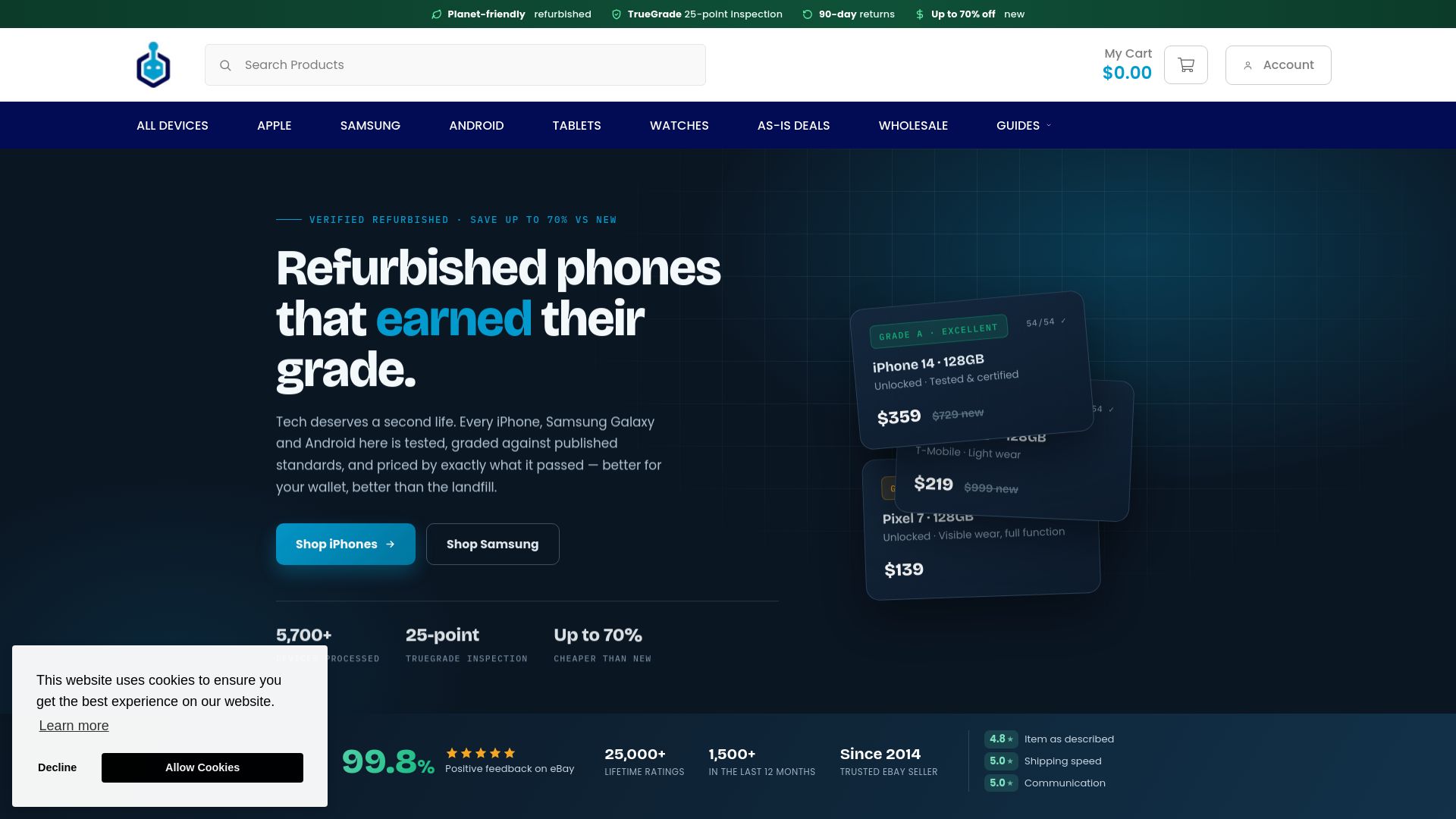
Start with the refurbished iPhones and iPads, the Samsung Galaxy phones or the refurbished Android phones. Resellers and repair shops can also buy in bulk through Wholesale & Bulk, and the store’s AS-IS Deals section is there for buyers who are comfortable with a lower bar on condition. See the full store for everything on offer.
How Grade D compares with the other grades
Use this as a rough map. Exact wording varies by seller, so always confirm against the listing.
| Grade | Typical appearance | Best for |
|---|---|---|
| A | Almost like new, minimal marks | Buyers who want a near-new look |
| B | Light scuffs and scratches | Everyday users who want a balance of price and looks |
| C | Visibly worn, still working | Cost-focused buyers who will use a case |
| D | Heavy wear: deep scratches, dents, chips, and on some scales cover-lens cracks | Backup phones, work fleets, kids’ phones, resale and repair stock |
The step between grades is price as much as appearance. If you are choosing between two grades, compare the photos of the specific phones, not the letters, and weigh the saving against how much the look matters to you day to day.
Common mistakes when buying a lower-grade phone
Assuming D means broken. On the UGP scale, a Grade D phone is fully functional, and the label refers to appearance. It is the cracks, missing parts and unknown history that you need to rule out in a listing, not the grade itself.
Assuming D means the same everywhere. As shown above, one scale allows cover-lens cracks and another excludes them entirely. Always read the definition attached to the listing.
Skipping the IMEI check. It takes a minute, and it is the single most useful step for any used or refurbished phone. Our guide on where to find the IMEI makes it quick.
Ignoring carrier compatibility. A phone that is cosmetically perfect but locked to the wrong network is no use to you. Match the model and carrier status to your plan before you order.
Buying without a return window. If a seller doesn’t give you time to test the phone, the grade doesn’t matter, because you can’t act on what you find.

FAQ
What does Grade D mean on a refurbished phone?
It means the phone has heavy cosmetic wear, such as deep scratches, dents and chips. Some scales also allow cracks in the cover lens, while others require an uncracked device. The grade describes looks, so check the seller’s definition and functional testing separately.
Does a Grade D phone still work properly?
Often yes, but the grade alone doesn’t promise it. Under the UGP definition, a Grade D device is fully functional with at least 80% battery health. Under other scales the label covers appearance only, so look for a stated functional inspection and battery information.
Is Grade D the same as “Fair” or “Acceptable”?
Usually it is the same tier under a different name. Sellers use letters, descriptive words or both, and the lowest tier is often called Fair or Acceptable. Compare photos and written definitions rather than the labels.
Should I buy a Grade D phone?
It is a good fit if you will use a case and want the lowest price for a working phone: a backup, a work device, a phone for a child or stock for resale. If you want a like-new look, choose Grade A or B instead.
What should I check before ordering?
Read the grade definition, look at photos of the actual phone, confirm battery information and carrier status, run an IMEI check, and read the return policy. Then inspect and test the phone as soon as it arrives.
Sources
- CTIA Wireless Device Grading Scales Criteria and Definitions, Version 5.0 (July 2025)
- Universal Grading Protocol: Acceptable (grade D)
- Phonecheck: Understanding Refurbished Phone Grades
- Engadget: Is It Safe To Buy A Refurbished iPhone From Walmart?


