
GSM vs CDMA: What U.S. Buyers Need to Know

For most U.S. phone buyers in 2026, GSM vs CDMA is a solved problem. The major carriers have retired their 2G and 3G networks, and every modern smartphone runs on LTE or 5G with SIM or eSIM authentication regardless of which legacy camp it once belonged to. The practical question is no longer “GSM or CDMA?” but rather: does this phone support VoLTE, the right LTE/5G bands, and is it unlocked?
As Boost Mobile’s guidance puts it, the GSM vs CDMA debate is now mainly historical, and buyers should prioritize VoLTE and 5G readiness when choosing devices. That said, understanding what these technologies were, and why they mattered, still helps you make sense of carrier marketing, refurbished phone listings, and the occasional compatibility warning you’ll see on older devices.
Key Takeaways
GSM vs CDMA is a legacy distinction that no longer drives buying decisions for U.S. consumers; what matters now is VoLTE support, correct LTE/5G bands, and unlocked status.
| Point | Details |
|---|---|
| GSM vs CDMA is legacy | Both standards are retired on major U.S. networks; LTE and 5G replaced them entirely. |
| Run three checks before buying | Verify IMEI status, VoLTE support, and carrier band compatibility before any purchase. |
| Unlocked status is non-negotiable | A locked phone limits carrier options immediately and reduces resale value. |
| Refurbished phones need extra vetting | Confirm IMEI is clean, VoLTE is active, and no MDM profile remains before paying. |
| Devicegiant inspects before shipping | Every device passes a 25-point TrueGrade check covering radios, IMEI, and unlocked status, with a 90-day return policy. |
Table of Contents
- What GSM and CDMA actually are
- How the GSM/CDMA split shaped U.S. carriers
- Why the GSM vs CDMA distinction barely matters now
- How to check whether a phone will work on your carrier
- What to prioritize when buying a phone instead of asking “GSM or CDMA?”
- What to ask when buying a refurbished phone
- Sources
What GSM and CDMA actually are
GSM (Global System for Mobile Communications) and CDMA (Code Division Multiple Access) are two competing standards for 2G and 3G cellular networks. They differ in how they identify subscribers and how they divide radio spectrum among users.
GSM authenticates the subscriber through a SIM card. Pull the SIM, put it in another GSM phone, and your number and account move with it. That portability made GSM the global default: it became the standard in Europe, Asia, and most of the world. T-Mobile’s technical overview explains that GSM uses SIM cards for subscriber authentication, while CDMA relied on device-registered identifiers instead.
CDMA ties the subscriber identity to the device itself, using a hardware identifier called an MEID or ESN. No SIM required for authentication. The carrier’s network had to recognize and provision your specific device. Swapping phones meant calling customer service, not just moving a card. CDMA’s radio approach spreads each call across a wide frequency band using unique codes, which gave it some capacity and signal-penetration advantages in dense or rural environments during the 3G era.
| Dimension | GSM | CDMA |
|---|---|---|
| Authentication method | SIM card (subscriber-based) | Device MEID/ESN (network-registered) |
| Roaming and SIM portability | Easy: swap SIM to change phones or roam internationally | Limited: carrier must provision each device; no SIM swap |
| Historical U.S. carrier usage | AT&T, T-Mobile | Verizon, Sprint, US Cellular |
| Current relevance | Legacy 2G/3G standard; retired in U.S. | Legacy 2G/3G standard; fully retired in U.S. |
| Buying impact today | Irrelevant for LTE/5G phones; check bands and VoLTE | Irrelevant for LTE/5G phones; check bands and VoLTE |
How the GSM/CDMA split shaped U.S. carriers
The U.S. was one of the few markets where both standards competed side by side for decades, which created a fragmented device ecosystem that frustrated consumers and resellers alike.
AT&T and T-Mobile ran GSM networks. Their customers could swap SIM cards freely, buy unlocked phones from overseas, and roam internationally with relative ease. Verizon and Sprint built their networks on CDMA. US Cellular, a regional carrier, also operated on CDMA infrastructure across its Midwest and rural footprint.
The practical consequences were real and often annoying:
- A Verizon CDMA phone physically could not be activated on AT&T, even if both carriers covered your area.
- Buying a used or refurbished phone meant confirming it was provisioned for your specific carrier, not just any carrier.
- International travel on a CDMA phone required a separate international plan or a second device, since most foreign networks ran GSM.
- Resale value for CDMA-only phones was lower because the buyer pool was smaller.
- Refurbished CDMA devices sometimes carried activation blocks or blacklisted MEIDs that were harder to detect than a blacklisted IMEI on a GSM phone.
Sprint’s eventual merger with T-Mobile in 2020 accelerated the end of CDMA in the U.S., since T-Mobile had no reason to maintain a second network standard.
Why the GSM vs CDMA distinction barely matters now
LTE changed everything. When carriers built out 4G LTE networks starting around 2010, they adopted a unified standard that uses SIM-based authentication regardless of whether the carrier’s 3G layer was GSM or CDMA. Voice calls over LTE (VoLTE) and over 5G (VoNR) are IP-based, removing the old radio-access incompatibility entirely. A phone that supports the right LTE bands and VoLTE works on any carrier that accepts it, full stop.
The carriers formalized this shift by shutting down their legacy 2G and 3G networks entirely. PCMag’s technical overview confirms that since carrier migrations to LTE and 5G, the practical importance of GSM vs CDMA has sharply declined, and older 2G/3G phones should be upgraded. AndroidPolice’s reporting documents that major U.S. CDMA consumer networks were functionally decommissioned by early 2024.
| Carrier | Legacy network retired | Key consequence |
|---|---|---|
| AT&T | February 2022 (3G) | Non-VoLTE devices lost voice and text |
| Verizon | 2022 (CDMA/3G) | CDMA devices lost all service; new CDMA activations blocked |
| Sprint (T-Mobile) | 2022 (3G CDMA) | Sprint CDMA network folded into T-Mobile LTE |
| T-Mobile | July 2022 (2G/3G GSM) | Legacy GSM/UMTS devices lost service |
| US Cellular | Ongoing LTE migration | Regional CDMA service retired in phases |
Verizon’s official CDMA retirement documentation details the operational steps: new activations of legacy CDMA devices were blocked, troubleshooting support was discontinued, and enterprise and IoT customers received migration incentives to move to LTE-based hardware.
The FCC issued consumer guidance advising people to plan for 3G shutdowns and noting that carriers were repurposing older spectrum for newer technologies. That guidance is still worth reading if you manage IoT devices or M2M equipment on legacy networks.
Who still needs to care: If you run older IoT sensors, fleet trackers, or medical monitoring devices on 3G/CDMA connections, those need hardware upgrades now. For consumer smartphone buyers, the legacy distinction is irrelevant on any phone made after roughly 2017.
How to check whether a phone will work on your carrier
This is the checklist that actually matters in 2026. Run through it in order before you buy.
-
Find the exact model number and variant. The same phone name can ship in multiple hardware variants with different band support. A Samsung Galaxy S22 sold in Europe may lack the mmWave 5G bands used by Verizon. Check the model number (e.g., SM-S906U for U.S. unlocked) against your carrier’s approved device list.
-
Run the IMEI through your carrier’s compatibility checker. AT&T, T-Mobile, and Verizon each offer a free online IMEI check. Enter the 15-digit IMEI (found in Settings > About Phone, or by dialing *#06#) and the tool will confirm whether the device is approved, unlocked, and not reported stolen or lost.
-
Confirm VoLTE support. Without VoLTE, a phone cannot make voice calls on a modern U.S. network. Check the manufacturer’s spec sheet or your carrier’s VoLTE-compatible device list. For refurbished phones, ask the seller to confirm VoLTE is enabled in the firmware, not just supported in hardware.
-
Verify the LTE and 5G bands. Each carrier uses specific frequency bands. T-Mobile’s mid-band 5G runs on Band n41 (2.5 GHz); Verizon’s C-band 5G uses n77/n78; AT&T’s LTE anchor is Band 17/12. A phone missing your carrier’s primary bands will connect but with weaker coverage. The Samsung Galaxy A15 5G buyer’s guide on Devicegiant walks through exactly this kind of band check for a popular mid-range 5G model.
-
Confirm the device is fully unlocked. A carrier-locked phone will reject another carrier’s SIM. Ask for written confirmation or check the IMEI tool result, which typically states lock status. “Factory unlocked” and “carrier unlocked” mean the same thing for this purpose.
-
Check eSIM support if you need it. eSIM lets you activate a carrier plan without a physical SIM, which matters for travel and for carriers like T-Mobile that push eSIM-first activations. Confirm the phone supports eSIM and that the eSIM slot hasn’t been previously locked to another carrier.
Pro Tip: *Dial #06# on any Android phone to display the IMEI instantly. Screenshot it before you hand over payment, especially for in-person purchases.
What to prioritize when buying a phone instead of asking “GSM or CDMA?”
The right question in 2026 is not which radio standard a phone uses. It’s whether the phone will work well on your carrier for the next three to four years. Here’s what to check, in order of importance:
Unlocked status comes first. A locked phone limits your options immediately and at resale. Always prefer unlocked.
VoLTE support is non-negotiable. No VoLTE means no calls on any major U.S. carrier. Verify it in the spec sheet and confirm it’s active in the firmware, not just listed as a hardware feature.
Band compatibility determines real-world coverage. Mid-band 5G (n41, n77, n78) delivers the speeds carriers advertise. A phone that only supports low-band 5G will connect but rarely hit those speeds.
eSIM support future-proofs the device. Most flagship and mid-range phones released after 2021 support eSIM. It’s increasingly the default activation method.
Firmware and carrier locks can survive a factory reset. Ask the seller whether the bootloader is locked and whether any carrier-specific firmware is installed that could block VoLTE on a different network.
Return policy and warranty matter especially for refurbished purchases. A 90-day return window gives you enough time to test real-world call quality, data speeds, and battery performance under normal use.
Pro Tip: When buying refurbished, ask the seller to confirm the IMEI is clean (not reported lost, stolen, or under a payment plan), that VoLTE is active on the specific carrier you plan to use, and that the device has been fully reset with no MDM or enterprise enrollment profile remaining.
What to ask when buying a refurbished phone
Refurbished phones add a layer of due diligence that new-phone buyers skip. A phone that passed a factory test two years ago may have since been reported lost, enrolled in a corporate MDM, or had its IMEI flagged. Here’s what to verify before you commit:
- IMEI status: Confirm it’s not blacklisted, not under a carrier payment plan, and not reported stolen. Use a free IMEI checker or ask the seller for documentation.
- Unlocked status: Get written confirmation, not just a verbal assurance.
- VoLTE and 5G support: Ask which carriers the seller has tested the device on, not just which bands the spec sheet lists.
- Battery health: Request the battery health percentage. On iPhones, this is in Settings > Battery. On Android, some models expose it natively; others require a diagnostic app.
- Cosmetic grade: A reputable seller grades cosmetic condition (A, B, C, or equivalent) and discloses it before purchase. Ask what the grade means specifically for that seller.
- Return policy: Confirm the window and whether it covers “doesn’t work on my carrier” as a return reason.
- Activation history: Ask whether the phone was previously enrolled in a corporate or school MDM profile. These can survive resets and block carrier activation.
A verified refurbisher runs functional tests across cell radios, Wi-Fi, Bluetooth, cameras, speaker, microphone, and battery before grading a device. They also confirm unlocked status and check the IMEI against carrier and theft databases. That process is what separates a graded refurbished phone from a used phone sold “as-is.” For a deeper look at what those grading distinctions mean in practice, Devicegiant’s refurbished vs renewed vs used guide breaks down the differences clearly.
Pro Tip: Document the IMEI before you pay. If a dispute arises later about the phone’s status, you’ll need that number to file a report or initiate a return.
The case for buying refurbished in a post-CDMA world
The retirement of CDMA networks actually made the refurbished market cleaner for buyers. Pre-2022, a used Verizon CDMA phone was often a dead end: it couldn’t move to AT&T, its resale pool was narrow, and its MEID-based identity made compatibility checks harder. Today, every phone worth buying is LTE/5G with a SIM or eSIM, and compatibility comes down to bands and VoLTE, not which legacy standard the carrier once ran.
That shift means a well-inspected refurbished phone from 2021 or later is genuinely portable across carriers in a way that CDMA-era devices never were. The compatibility checks are standardized, the IMEI system is universal, and the risk of buying a phone that “just won’t work” on your carrier is lower than it’s ever been, provided you run the checks above.
Devicegiant’s 25-point TrueGrade inspection covers cell radio function, VoLTE activation, unlocked status, and IMEI verification before any device ships. The 90-day return policy means if something doesn’t work on your carrier, you have a real remedy. For buyers who’ve been burned by “as-is” used phones before, that inspection record is the meaningful difference.
Verified refurbished phones at Devicegiant
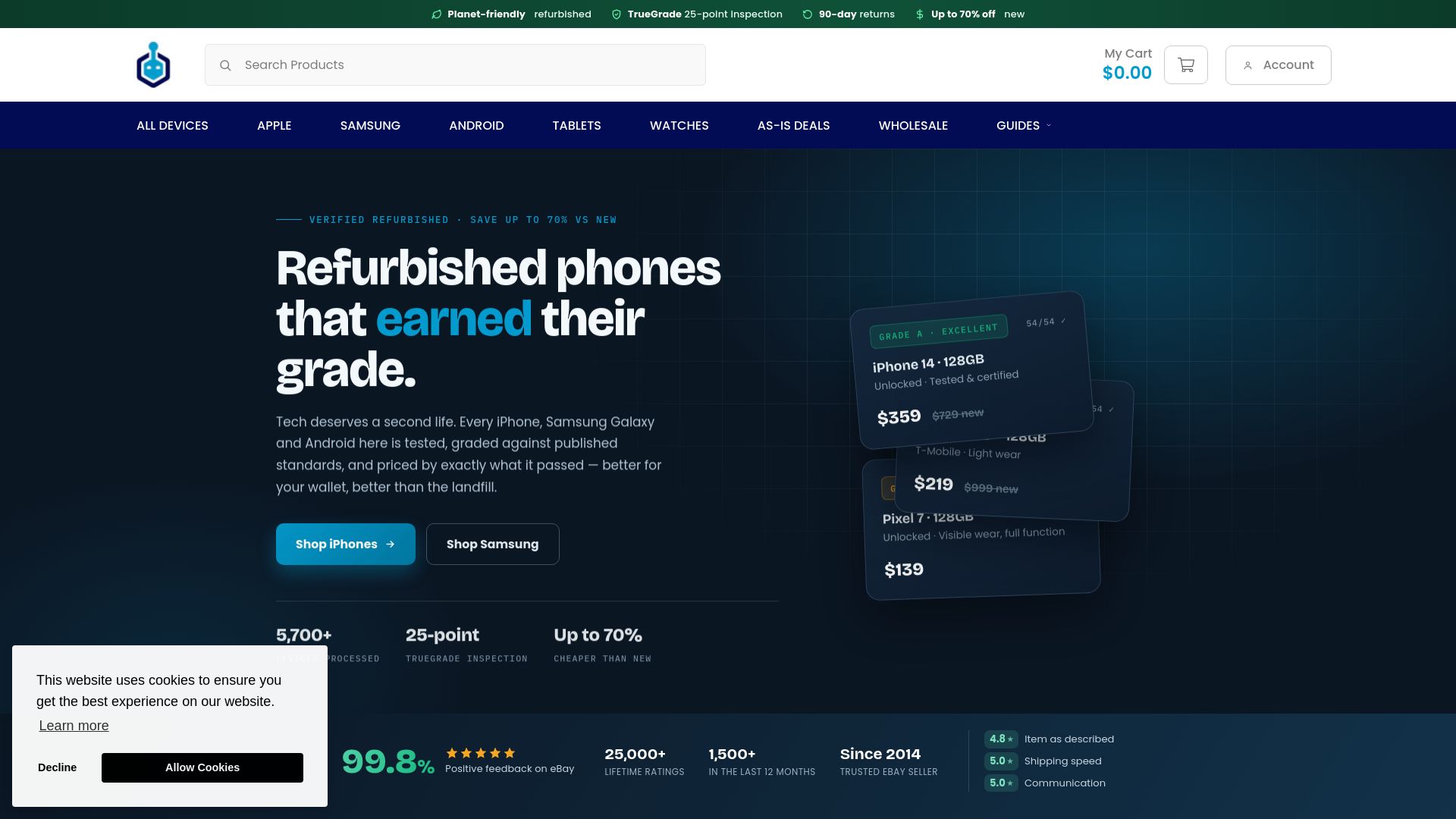
Devicegiant stocks verified refurbished smartphones that have passed a 25-point functional inspection, including cell radio and VoLTE testing, IMEI verification, and confirmed unlocked status. Every device is cosmetically graded and ships with a 90-day return policy. You’re not guessing whether the phone works on your carrier; the inspection confirms it before it leaves the warehouse.
Options range from budget-friendly picks like the Samsung Galaxy A14 5G unlocked to mid-range performers like the OnePlus 12R 5G from $265. Browse the full refurbished phone catalog at Devicegiant and filter by carrier compatibility or unlocked status to find a device that matches the checklist above.
Sources
- GSM vs CDMA: What You Need To Know About Phone Bands | T-Mobile
- GSM vs CDMA: Which Is Better, and How to Switch Carriers | Boost Mobile
- Plan ahead: Phase-out of 3G cellular networks and service | FCC
- CDMA vs GSM: What’s the difference? | PCMag
- What happened to CDMA networks? | AndroidPolice


