
What Refurbished iPad Grades Actually Mean for Buyers

Refurbished iPad grades describe cosmetic condition, not whether the device works. A Grade A, B, or C label tells you how many scratches to expect, and functional testing is a separate process that should have already happened before the listing went live. The most important move you can make is buying from a seller who publishes their grading criteria, discloses a battery policy, and backs the sale with a real warranty. Apple Certified Refurbished devices set the benchmark here, since Apple replaces the battery and outer shell as needed and includes a one-year limited warranty.
Before you buy anything labeled “refurbished,” check three things:
- Grading rubric: does the seller explain what A/B/C actually looks like, with photos or specific wear descriptions?
- Battery policy: will they disclose battery health percentage or replace it below a certain threshold?
- Warranty window: is it 30 days, 90 days, or a full year, and is it in writing?
Quick reference: Grade A/Excellent usually means near-mint with marks visible only under close inspection. Grade B/Good means light scuffs you’ll notice at certain angles. Grade C/Fair means visible scratches or dings that don’t affect performance. One detail worth knowing: Apple’s refurbished program replaces the outer shell and battery on units that need it, a level of parts replacement most third-party grading scales don’t guarantee at any tier.
Key Takeaways
Refurbished iPad grades describe cosmetic wear, not functional reliability, and the strongest predictor of a good purchase is seller transparency around battery policy, grading rubric, and warranty terms.
| Point | Details |
|---|---|
| Grades measure looks, not function | Grade A/B/C describes visible wear; functional testing should already be complete on any listed unit. |
| OEM refurbished costs more, risks less | Apple Certified Refurbished replaces batteries and shells as needed and includes a one-year warranty. |
| Discounts vary by seller tier | OEM programs discount roughly 10 to 20 percent, while third-party grades often run 30 to 60 percent off. |
| Run the checklist before buying | Verify battery health, IMEI/Activation Lock status, warranty terms, and included accessories in writing. |
| Devicegiant backs its grades with testing | Devicegiant’s TrueGrade 25-point inspection and 90-day return policy give buyers a documented way to verify condition claims. |
Table of Contents
- What Do Refurbished iPad Condition Grades Mean?
- Who Decides the Grade, and What Does “Certified” Mean?
- How Much Should You Expect to Save on Each Grade?
- What Should You Check Before Buying a Refurbished iPad?
- Where Can You Buy a Refurbished iPad, and What Should You Expect?
- How Does Devicegiant’s TrueGrade Inspection Reduce Buyer Risk?
- What Actually Matters When You’re Shopping Refurbished
- Get a Verified Refurbished iPad Without the Guesswork
- Frequently Asked Questions About Refurbished iPad Grades
- Sources
What Do Refurbished iPad Condition Grades Mean?
Grading systems exist because “refurbished” by itself tells you nothing about what you’re getting. There’s no legal definition of the word, which means each seller writes their own rulebook. That’s not necessarily a red flag, but it does mean the letter grade only matters in the context of who assigned it.
Grade A (sometimes called Excellent or Premium) is the closest you’ll get to a new iPad without paying new prices. Expect no visible scratches under normal viewing distance, an unmarked screen, and a body that looks freshly unboxed. Some sellers reserve this tier for units with fewer than 5 hours of prior use.
Grade B (Good) is where most refurbished iPad sales actually happen. You’ll see light scuffing on the aluminum back, maybe a faint hairline mark near the edges, visible mostly when you tilt the device under direct light. None of it interferes with the screen, cameras, or buttons. This is the sweet spot for buyers who plan to use a case anyway.
Grade C (Fair) carries noticeable wear: scratches you can see without hunting for them, small dents on corners, maybe a worn edge where a case used to sit. Refurbisher grading guides consistently describe Grade C units as fully functional despite the cosmetic damage. The screen still works. The battery still charges. You’re just trading looks for a lower price tag.
Here’s the part that trips people up: one seller’s “Good” is another seller’s “Fair.” A marketplace aggregator standardizing these labels found that warranty terms alone range from 30 days to a full year depending on who’s selling, even when the cosmetic grade descriptions read almost identically. Cross-reference the actual photos and written condition notes in a listing rather than trusting the grade letter on its own.
- Some sellers use “Premium” instead of “A”
- “Acceptable” often maps to what others call “C” or “Fair”
- A handful of platforms add a “Grade D” tier for heavily worn units still sold as functional
Statistic to remember: Apple’s own refurbished program replaces the outer shell and battery when needed on every certified unit, which is a level of guaranteed parts replacement that most graded third-party listings simply don’t offer at any cosmetic tier.
Who Decides the Grade, and What Does “Certified” Mean?
Not all refurbishing is created equal, and the word “certified” gets stretched to cover very different processes depending on who’s using it.
Manufacturer/OEM programs like Apple Certified Refurbished represent the gold standard. Apple tests each unit, swaps in a new outer shell and battery when the old ones don’t meet spec, and ships it in new packaging with a full year of warranty coverage. You’re paying for that assurance, not just a lower price.
Carrier and big-box certified pre-owned programs sit in the middle. The inspection tends to be shallower than Apple’s own process, but you still typically get a meaningful warranty and a store you can walk into if something goes wrong.
Third-party marketplaces and independent shops are the wild card. Grading standards vary enormously from one seller to the next, so the checklist they publish matters more than the badge they slap on the listing. Some run genuinely rigorous multi-point inspections. Others do a visual check and call it done.
- OEM refurbished: new shell/battery as needed, 1-year warranty, highest price floor
- Carrier/retailer certified: moderate inspection depth, workable warranty, mid-range pricing
- Independent/marketplace sellers: widest quality variance, always check their published test criteria first
Because there’s no legal standard behind the term, the seller’s transparency is doing all the work your grade label can’t.
How Much Should You Expect to Save on Each Grade?
Discount size tracks seller tier more than it tracks grade alone. OEM-certified refurbished iPads from Apple typically run about 10 to 20 percent below the price of a new equivalent, which reflects the cost of full parts replacement and a proper one-year warranty baked into the price.
Third-party sellers play a different game entirely. Because they’re not swapping shells and batteries on every unit, discounts on independent and marketplace listings often land between 30 and 60 percent off depending on the specific grade and iPad generation. A Grade C iPad from a third-party refurbisher can cost dramatically less than the same model in Grade A condition, and the performance difference between them is usually zero.
So when does the cheaper grade make sense? If you’re buying a case anyway, cosmetic wear on the back or edges becomes irrelevant within a week of ownership. The math favors Grade B or C buyers who:
- Plan to cover the device in a case immediately
- Care more about storage size or chip generation than cosmetic polish
- Are buying for a kid, a classroom, or a secondary device where scuffs don’t matter
One thing grade doesn’t tell you: how many more years of iPadOS updates the model will receive. A pristine Grade A iPad running an older chip can be a worse long-term buy than a scuffed Grade B unit one generation newer. Check the model year before you check the cosmetic grade.
Something worth flagging: Apple’s own coverage checker lets you verify a specific unit’s warranty status by serial number, a step almost nobody runs before buying, and it can catch listings where the seller’s warranty claim doesn’t match Apple’s own records.
What Should You Check Before Buying a Refurbished iPad?
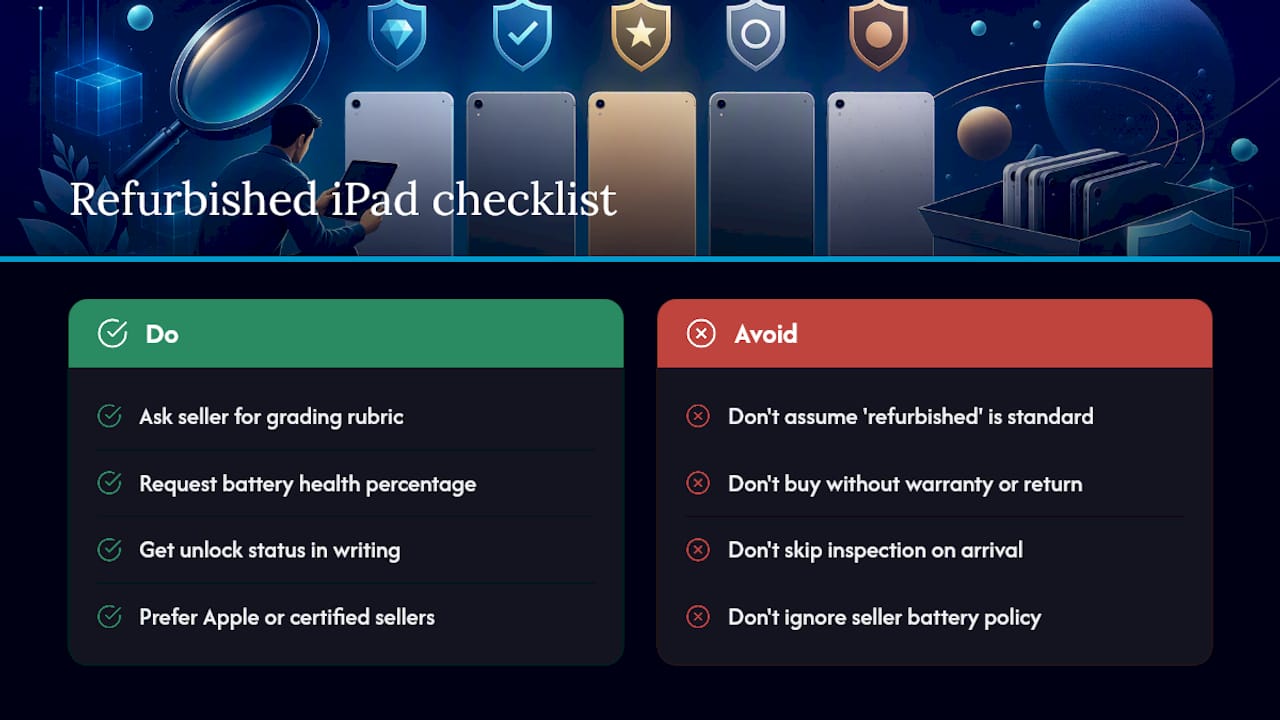
Run through this list before you check out on any refurbished iPad listing, regardless of grade or seller:
- Ask for the battery health percentage or replacement policy. A seller who won’t disclose battery condition, or won’t say at what threshold they replace batteries, is a seller to skip.
- Verify the IMEI or serial number and confirm the device isn’t tied to an active Activation Lock. This single check prevents the most common refurbished-device horror story: an iPad that’s functionally a paperweight because someone else’s Apple ID is still attached.
- Confirm carrier status if you need an unlocked device. Cellular iPads sold as “unlocked” should say so explicitly, not just “compatible.”
- Get the warranty and return window in writing. Thirty days is thin coverage. Ninety days gives you real room to test the device under normal use.
- Check what’s included. Original box, charging cable, and any documentation should be listed clearly, and a missing charger should show up as a line-item deduction from the price, not a surprise after delivery.
- Look for a published grading rubric and test checklist. If the seller shows you exactly what they check, cosmetically and functionally, trust the listing more than one that just says “Grade B, works great.”
Pro Tip: Screenshot the listing’s stated grade, battery policy, and warranty terms before you buy. If a dispute comes up later, having the seller’s own written claims saves you the argument.
Where Can You Buy a Refurbished iPad, and What Should You Expect?
Your source matters as much as the grade you pick, because the same letter grade means different things depending on who’s assigning it.
Apple Certified Refurbished remains the benchmark for risk reduction. Full functional testing, replaced batteries and shells where needed, new packaging, and a one-year warranty make this the safest starting point for cautious buyers, especially first-time refurbished buyers who want the fewest surprises.
Carrier and big-box certified programs land in the middle of the price and confidence spectrum. Expect a real warranty, usually shorter than Apple’s year, with an inspection process that’s typically less exhaustive.
Large refurbished marketplaces offer the deepest discounts, but grading terms and warranty windows vary by seller within the same platform. Read the individual listing’s policy, not just the platform’s general marketing.
- Apple Certified: highest price, lowest risk, full parts replacement
- Carrier/big-box: mid-price, mid-risk, moderate warranty
- Marketplaces: lowest price, variable risk, always check individual seller terms
- Local shops/individual sellers: highest variance, run your own IMEI and Activation Lock check every time
How Does Devicegiant’s TrueGrade Inspection Reduce Buyer Risk?
Devicegiant runs every device through a TrueGrade 25-point functional inspection before it’s listed, covering power performance, display quality, touch response, camera function, port integrity, wireless radios, and battery capacity.
- Ask any refurbisher: “What’s tested beyond the cosmetic grade?”
- Request documentation on battery capacity and replacement thresholds
- Confirm the return window in writing before you buy
Pro Tip: A seller who volunteers their inspection checklist before you ask is usually more trustworthy than one who only answers when pressed.
What Actually Matters When You’re Shopping Refurbished
Most guides treat the grade letter like it’s the whole story. It isn’t. The research behind this piece points somewhere else: the letter grade is the least useful signal in the entire listing, and the seller’s willingness to show their work is the most useful one.
Here’s what gets overlooked. A Grade C iPad from a refurbisher who publishes a real inspection checklist and stands behind a 90-day return window is a safer bet than a Grade A iPad from a seller who won’t tell you their battery policy. Cosmetic wear is temporary and mostly cosmetic. A vague warranty is a real liability that shows up months later.
If you take one thing from this article, prioritize documentation over appearance. Ask for the battery percentage. Ask what “certified” actually means to that specific seller. A slightly scuffed iPad backed by a written 90-day policy beats a pristine one backed by nothing but a product photo.

Get a Verified Refurbished iPad Without the Guesswork
Everything in this guide points to one conclusion: the grade letter matters less than what stands behind it. Devicegiant backs every listing with a TrueGrade 25-point functional inspection, disclosed cosmetic grading from A through D, and a 90-day return window, so you’re not relying on a single letter to tell you whether a device actually works.
That combination matters most for buyers who got burned before, or who simply don’t want to gamble $300 on a vague listing. Devicegiant’s refurbished device catalog shows the grade, the battery condition, and the warranty terms right on the product page, the same transparency this guide recommends you demand from any seller. Browse current listings and check the disclosed condition notes before you decide, and if an iPad isn’t in stock, the same inspection and return policy apply across Devicegiant’s full lineup of refurbished phones and tablets.
Frequently Asked Questions About Refurbished iPad Grades
Does a Grade C iPad still work as well as a Grade A one? Yes, in almost every case. Grade C refers to cosmetic wear like scratches or dings, not reduced function. A properly refurbished Grade C unit should pass the same functional tests as a Grade A unit; you’re paying less for looks, not performance.
Do refurbished iPads come with a new battery? It depends entirely on the seller. Apple Certified Refurbished units get a new battery when the original doesn’t meet spec. Third-party refurbishers vary widely, so always ask for the specific battery health percentage or replacement threshold before buying.
What’s the difference between refurbished and used iPad conditions? “Used” typically means sold as-is with no testing or guarantee. “Refurbished” implies the seller ran some functional inspection and cosmetic grading process, though the depth of that process differs by seller since there’s no legal standard behind the term.
How do I check if a refurbished iPad is unlocked? Ask the seller directly and confirm it in writing, or check the device settings once it arrives under Settings > General > About, where carrier lock status is listed. Devices sold explicitly as “unlocked” should work across compatible carriers.
Is it safe to buy a refurbished iPad from a marketplace instead of Apple directly? It can be, provided the seller discloses their grading rubric, battery policy, and warranty terms clearly. Buying directly from Apple remains the lowest-risk option, but certified sellers with transparent testing and a solid return window, like Devicegiant’s 90-day policy, offer a reasonable middle ground at a lower price.


