
Refurbished Phone Prices in 2026: What to Expect to Pay

In the United States in 2026, most refurbished phones cost between $80 and $700. Where you land depends mainly on the phone’s age and condition grade. Older fair-grade phones sit at the bottom of that range, and one- to two-year-old premium models sit at the top. Savings against new run from roughly 40% to 75% by tier. Below you’ll find the tiers, real model examples, the factors that move a price, and a checklist for buying well.
TL;DR
- Fair-grade, older phones (3 to 5 years old) run about $80 to $180. Standard-grade phones (2 to 3 years old) run $180 to $350. Premium certified phones (1 to 2 years old) run $400 to $700.
- Condition grade, battery health, storage and unlocked status move the price more than the brand name does.
- Samsung’s current certified Galaxy lineup spans $489 to $1,029, so a phone from the last two generations is not a bargain-bin purchase.
- Compare the warranty and return window, not just the sticker price. A longer return window is worth real money.
- Buying refurbished also cuts a phone’s manufacturing footprint, which is a bonus on top of the savings.
Table of Contents
- What refurbished phones cost in the US in 2026
- What actually sets the price
- Real model prices you can use as benchmarks
- Price is only half the comparison: warranty, battery and returns
- Our view on refurbished pricing
- Does a refurbished phone hold up over time?
- The environmental side of the price
- Where to buy: our refurbished range
- A short checklist before you buy
- FAQ
- Sources
What refurbished phones cost in the US in 2026
A May 2026 IndexBox report on the US refurbished smartphone market breaks retail prices into three tiers. They give a useful map for setting a budget.
| Tier | Typical age | Typical price | Discount vs. new |
|---|---|---|---|
| Fair grade | 3 to 5 years | $80 to $180 | 60% to 75% |
| Standard grade | 2 to 3 years | $180 to $350 | 50% to 65% |
| Premium, certified | 1 to 2 years | $400 to $700 | 40% to 55% |
The same report says premium-grade devices (cosmetic grade A or A-, battery health above 85%, no screen burn-in) account for 45% to 50% of units sold but 60% to 65% of the market’s value. Buyers pay more per phone for clean, well-documented units. Standard-grade devices, with visible wear and battery health of 70% to 85%, make up 30% to 35% of volume.
That gives you a simple rule of thumb. If your budget is under $200, shop older flagships and mid-range models in good working order. Between $200 and $350 you get into phones that are two to three years old. Past $400 you’re buying something close to the current generation.

What actually sets the price
Two phones with the same name can sell for very different amounts. TechBloat’s May 2026 breakdown of used iPhone value lists the same factors that shape refurbished retail prices.
Model and generation
Newer models, and Pro or Ultra versions, hold their value best. The IndexBox report puts the drop at 15% to 25% of refurbished value for each year of age beyond the first two. A phone that is four years old costs much less than one that is two, and the older phone often does everyday jobs just as well.
Storage
More storage raises the price, but the step up is usually smaller than the original retail upgrade cost. Going from 128GB to 256GB on a refurbished phone is often cheaper than it was when the phone was new. If you keep lots of photos and video, that upgrade is often the best value in the listing.
Cosmetic condition
A phone with no cracks and only light wear sells for far more than one with dents or deep scratches. Our grading runs from A to D, with refurbished variants, and we disclose it on the listing so you know what you’re paying for. A cosmetic-only drop in grade can save money without touching how the phone works, because the same functional inspection applies to every grade.
Battery health
TechBloat describes a battery at 90% or higher as strong, 85% to 89% as acceptable, and 80% to 84% as the range where buyers start to negotiate. Below 80%, Apple considers the battery significantly degraded. When you compare two listings, look at the battery figure before you look at the price gap.
Unlocked or carrier-specific
An unlocked phone normally sells for more because it works with more buyers. A carrier-specific phone has a smaller market, which means a lower price. If you already know your carrier and plan to stay with it, a carrier-specific unit can be the cheapest way to get a newer model.
Real model prices you can use as benchmarks
Published prices on specific models show where each tier lands in practice.
Samsung Galaxy. In November 2026, Android Authority reported that Samsung’s certified refurbished program offers 14 Galaxy phones across two generations. Prices start at $489 for the Galaxy S24 FE (128GB) and reach $1,029 for the Galaxy S25 Ultra (512GB). The Galaxy S24 (256GB) is $549, which is $310 below its original $859 retail price. That makes the S24 a strong example of how a premium-tier phone can still save a lot.
iPhone. NerdWallet’s guide to buying used phones reports that the iPhone 14 and 13 topped the best-selling used iPhone list in May 2026, with an average selling price of $281 in July. It also notes that you can save 60% or more against a new iPhone 17 by going with a used iPhone 14. At the top of the iPhone range, the cheapest model in a manufacturer-run refurbished store at the time of writing was an iPhone 16 Plus with 128GB, at $699.
Put those together and the pattern is clear. Last-generation flagships cost $489 and up through the manufacturer-certified channel. Two- to three-year-old models cluster around $250 to $350 on the open market. Anything older drops quickly toward the $80 to $180 band.

Price is only half the comparison: warranty, battery and returns
Two listings at the same price can differ a lot in what protects you afterward. Before you decide, line up four things.
- Battery. Manufacturer-certified Galaxy phones come with a fresh battery, according to Android Authority’s report, which also notes a one-year warranty, genuine replacement parts, a new IMEI and Samsung Care+ eligibility. Ask any seller what battery standard applies.
- Warranty length. A longer warranty is part of the price you pay. Compare it in months, and check who stands behind it.
- Return window. We offer a 90-day return policy, which is longer than most sellers give. That window lets you live with the phone through a full billing cycle and a few charging cycles before you commit.
- Software support. Check how many years of security updates your specific model still has. A cheaper phone with two years of updates left may cost more per year than a pricier one with four.
If you buy an iPhone 15 or later, you’ll also be using USB-C. That affects the cables and power banks you already own, and it’s worth reading about iPhone USB-C charging changes before you pick accessories. We sell chargers alongside our phones, so you can add one to the same order.
Our view on refurbished pricing
We built Device Giant around one idea: a lower price should never mean a guess about what’s in the box.
Every phone we sell goes through our TrueGrade inspection, a 25-point functional check, and then gets its own cosmetic grade. You see the grade on the listing, from A to D plus refurbished variants, so a price difference between two units always has a reason you can read.
We think that is the honest way to talk about refurbished prices. A shopper who knows what a grade B costs against a grade A can choose where to spend and where to save. Our customers are often cost-conscious, small business owners kitting out a team, or people who simply don’t want to pay new prices for a phone that works exactly the same.
We back that up with a 90-day return policy and a record of 99.8% positive feedback on eBay. Our promise is that the phone you receive matches the listing, and that if it doesn’t suit you, you have three months to send it back.
Saad
Does a refurbished phone hold up over time?
The main long-term question is how much value is left once the phone ages. IndexBox puts the refurbished value drop at 15% to 25% per year past the second year. For buyers, that works in your favor: the steepest drop happens before you buy. A phone that has already taken its biggest hit costs less to own per month, and it can be resold later at a predictable price.
Most phones fail slowly rather than suddenly, and the part that wears first is the battery. That’s why battery health shows up in every price tier above. When you shop, prefer listings that state a battery standard, and treat a fresh battery as part of the value, not an extra.
A few practical pairings work well:
- Under $200: an older flagship in a good cosmetic grade. Our guide to the refurbished iPhone 11 covers what that model does well in 2026.
- $200 to $350: a two- to three-year-old flagship. Our guides to the refurbished iPhone 14 and the refurbished Galaxy S23 are good places to start.
- Budget Android: the Galaxy A54 5G comparison with new shows how much you save on a capable mid-ranger, and our guide to the refurbished Galaxy S22 covers an older Samsung flagship.
- Foldables: the refurbished Galaxy Z Fold 4 guide explains what to look for when you want a book-style screen.
If you’re set on an iPhone, our explainer on the Apple warranty on refurbished iPhones walks through what coverage means in practice.
The environmental side of the price
A lower price is not the only thing you save. Environment America’s refurbished technology factsheet states that buying refurbished cuts the environmental impact of a device purchase by 77% to 91%. It puts the figure for a new smartphone at 56 kg of CO2, against 11 kg for a refurbished one, a saving of 45 kg on average. It also says smartphones contribute 10% of global e-waste.
The Carbon Trust gives a complementary view. It estimates roughly 60 kgCO2e to make, package and ship a new smartphone, with refurbishment adding approximately 15 kgCO2e. It adds that the longer you keep a phone, the lower its annual footprint. Its advice is to aim for at least 3 to 4 years of use, ideally for as long as the phone keeps receiving critical updates.
For an eco-minded shopper, that gives a clear plan. Buy a refurbished phone, choose a model with years of updates left, and keep it. The savings in dollars and the savings in carbon point the same way.
Where to buy: our refurbished range
If you’re ready to shop, we sell refurbished smartphones, tablets, smartwatches and select laptops, each with the 25-point TrueGrade check, a disclosed cosmetic grade and a 90-day return policy. You can filter for unlocked or carrier-specific devices, so you only pay for what you need.
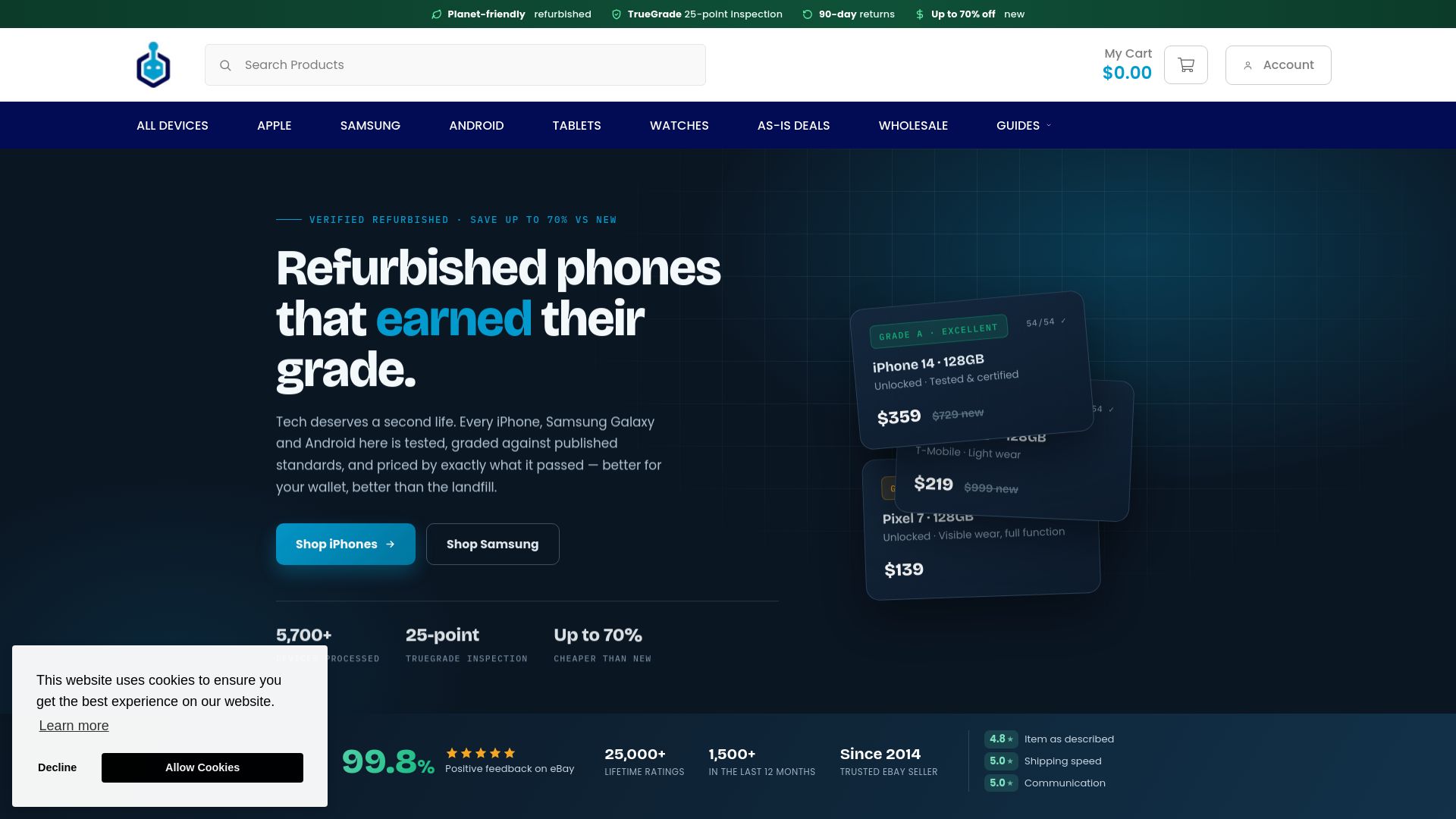
Start with the Device Giant home page to browse every category, or go straight to a collection:
- Refurbished Samsung Galaxy phones, including unlocked options
- Unlocked refurbished Android phones
- The Samsung Galaxy S24 in Marble Gray and the Apple iPhone 15 in Pink
Buying for a team or for resale? Our wholesale cell phone supply page covers bulk lots for resellers and repair shops.
A short checklist before you buy
- Set your tier. Decide whether you’re shopping under $200, between $200 and $350, or above $400. That one choice narrows the field fast.
- Choose unlocked or carrier-specific. If you plan to switch carriers, pay for unlocked. If not, a carrier-specific unit may be cheaper.
- Pick storage you will use. The step up to the next size is often small. It’s usually better value than replacing a full phone later.
- Read the cosmetic grade. Cosmetic wear is the cheapest compromise if you will use a case.
- Check the battery standard. Look for a stated figure, and compare it with the 85% and 90% marks above.
- Compare warranty and returns in days and months. The longer the window, the more time you have to confirm the phone fits your life.
- Confirm update support. Look up how many years of security patches your model still gets.
FAQ
How much should I pay for a refurbished phone in 2026?
Most buyers spend $180 to $350 for a standard-grade phone that is two to three years old. If you want a newer, certified model, expect $400 to $700. Budget phones of three to five years old can cost as little as $80 to $180.
Is a refurbished iPhone 14 still a good buy?
It is one of the most popular choices. NerdWallet reports that the iPhone 14 and 13 topped the best-selling used iPhone list in May 2026, with an average selling price of $281 in July. Check battery health and the warranty before you choose a listing.
Why do two refurbished phones of the same model cost different amounts?
Cosmetic grade, battery health, storage size and unlocked status all change the price. A phone with no cracks and strong battery health sells for far more than one with visible wear. Carrier-specific units are usually cheaper than unlocked ones.
Are refurbished phones better for the environment?
Yes. Environment America’s factsheet states that buying refurbished cuts the environmental impact of a phone purchase by 77% to 91%. The Carbon Trust adds that keeping the phone longer lowers its yearly footprint further.
Sources
- IndexBox: Refurbished Smartphone Market in the United States
- TechBloat: What’s my used iPhone worth?
- Android Authority: Samsung certified refurbished phone
- NerdWallet: Best places to buy a used iPhone or other cell phone
- Environment America: Refurbished Technology Factsheet
- Carbon Trust: Smart phones, smart choices
- aeCharge: iPhone USB-C changes


