
Refurbished Return Policy: What U.S. Buyers Need to Know

A refurbished return policy gives you a time-limited right to return a device for a refund, exchange, or store credit if it doesn’t meet the seller’s stated condition. The single most important thing you can do after receiving any refurbished device: start testing it immediately and document everything with photos and timestamps before the return window closes.
Consumer Reports documents return windows ranging from 14 days all the way to 90 days depending on the seller, and recommends at least a month to catch most defects. That clock starts the moment your device ships or arrives, depending on the seller’s terms. Miss it, and your only remaining option is the warranty, which covers repair or replacement but not a refund.
Every used electronics return policy worth reading should spell out:
- Return window length and whether it starts at shipment or delivery
- Condition requirements to qualify (like-new, original packaging, no cosmetic damage beyond the listed grade)
- Refund type available (full refund, exchange, or store credit only)
- Who pays return shipping and whether a prepaid label is provided
- Restocking fees and the exact amount or formula
- RMA process and how long you have to ship after approval
Key Takeaways
The most important rule when buying refurbished: read the return policy before purchase, test the device within 24–48 hours of receipt, and document everything with time-stamped photos and screenshots.
| Point | Details |
|---|---|
| Return windows vary widely | Consumer Reports documents windows from 14 to 90 days; aim for at least 30 days to catch most defects. |
| Test immediately on arrival | Run battery, screen, IMEI, and activation checks within the first 24–48 hours to stay inside the return window. |
| Document everything | Time-stamped photos, screenshots of diagnostics, and written seller communications are your evidence for disputes. |
| Credit card is your backstop | If a seller refuses a valid return, an “item not as described” dispute with your card issuer is often the fastest resolution. |
| Devicegiant’s 90-day policy | Devicegiant offers a 90-day return window with a 25-point inspection and disclosed grading on every listing. |
Table of Contents
- What every refurbished return policy actually covers
- How to initiate a return correctly
- Common exclusions, restocking fees, and charges to watch for
- How return policies and warranties differ, and what the law says
- Exact stress-test checklist to run during the return window
- If a seller refuses a valid return, here’s how to escalate
- How marketplace purchases differ from buying direct
- Policy tiers you’ll encounter across major U.S. sellers and programs
- Devicegiant’s approach to returns and why it matters
- Devicegiant: refurbished phones with a 90-day return policy
- Sources
What every refurbished return policy actually covers
The policy language is where buyers get surprised. Most sellers set a return window, but the fine print around condition requirements and refund types can quietly shrink what you’re actually entitled to.
| Policy element | Typical range | What to watch for |
|---|---|---|
| Return window | a range of days depending on seller policies | When the clock starts: shipment vs. delivery date |
| Refund type | Full refund, exchange, or store credit | Some sellers default to store credit unless you ask for cash |
| Restocking fee | up to a modest percentage of purchase price | Often triggered by missing accessories or opened packaging |
| Return shipping | Buyer pays or prepaid label | Prepaid labels are not universal; confirm before buying |
| Warranty length | ranges from about one month to one year | Who handles repairs: seller, manufacturer, or third-party depot |
| Condition required | Like-new or matching listed grade | “Original packaging” requirements can be a trap on refurbished items |
Platform rules and seller operational costs shape these minimums. Sellers on major marketplaces face account penalties if they ignore platform standards, which is part of why Amazon Renewed and similar programs enforce baseline return windows. Return costs for smartphones include shipping, inspection labor, and remarketing markdown, which can substantially exceed the refunded sale price. That’s the economic reason sellers write tight condition clauses.
One phrase that hides practical traps: “open-box.” Some sellers use it to mean the device was tested and resealed; others use it to mean cosmetic condition is unverified. If a policy says returns require “original packaging” and the device arrived in a generic box, document that immediately.
Understanding the difference between refurbished, renewed, and used listings matters here too. Renewed programs typically carry stricter condition standards and longer return windows than seller-refurbished listings, which affects what you can realistically claim.
How to initiate a return correctly
Getting the process right from the first contact matters. A misstep, like shipping the device before receiving an RMA number, can void your return entirely.
- Contact the seller in writing. Email or use the platform’s messaging system. State the defect, your order number, and the date you received the device. Keep the message thread.
- Request an RMA (Return Merchandise Authorization). Most direct sellers require this before accepting a return. Get the RMA number in writing and note any deadline to ship.
- Confirm the return label situation. Ask whether a prepaid label is provided. If not, use a tracked shipping method and save the receipt. Some sellers require a specific carrier.
- Factory reset the device before packing it. Remove your accounts, disable Find My iPhone or Google’s Find My Device, and sign out of all apps. Returning a device with your data on it creates a security risk and some sellers use it as grounds to reject the return.
- Pack with all original accessories. Include the charger, cable, SIM tool, and any documentation that came in the box. Missing accessories are one of the most common reasons returns get rejected or hit with a restocking fee.
- Photograph the package before sealing it. A time-stamped photo of the device and all accessories laid out, plus the sealed box, gives you evidence if the seller claims something was missing.
- Ship within the RMA deadline and save tracking. Once the seller receives the item, follow up in writing to confirm receipt and ask for a refund timeline.
For marketplace purchases, keep all communication on-platform. Opening a claim through the marketplace’s resolution center, rather than going directly to the seller’s personal email, preserves your access to the platform’s buyer protection program.
Pro Tip: If the seller offers a prepaid return label, download and save it immediately. Labels sometimes expire within 7–14 days, and if you miss that window, you may be responsible for shipping costs even when the return itself is valid.
Common exclusions, restocking fees, and charges to watch for
The clauses that reduce or void refunds are rarely highlighted. Here’s what to look for before you buy:
- Missing accessories. A charger or cable absent from the return box often triggers a restocking fee or outright rejection.
- Cosmetic damage beyond the listed grade. If you received a Grade B device and return it with a new crack, expect a deduction or denial.
- Data left on the device. Some sellers explicitly list this as grounds for rejection. Factory reset before shipping.
- Activation locks. Returning a device still locked to your Apple ID or Google account is a common reason sellers refuse to process refunds.
- Evidence of liquid damage or abuse. Sellers inspect returned devices and can deny a refund if damage indicators have tripped.
- “Unsanitary” or “altered” device language. These vague terms appear in some policies and can be used broadly. If a seller invokes one, ask for the specific inspection finding in writing.
On restocking fees: Sellers are generally allowed to charge them, but the fee must be disclosed before purchase under FTC guidance. A fee that appears only after you initiate a return, or that isn’t listed in the policy you agreed to at checkout, is worth disputing with your credit card company.
Shipping costs cut into net refunds more than buyers expect. Always calculate the net refund before deciding whether to return or keep a device with a minor defect.
How return policies and warranties differ, and what the law says
A return policy is your right to reverse the sale within a set window. A warranty is the seller’s obligation to repair or replace a defect over a stated period after that window closes. They’re not interchangeable, and confusing them is how buyers lose leverage.
The Magnuson-Moss Warranty Act requires any seller who provides a written warranty to make the full terms available before purchase. That means you’re entitled to read the warranty before you buy, not after. Sellers are generally obligated to repair or replace defects covered by the warranty, though the specific remedy depends on the warranty’s terms.
What the FTC says: FTC guidance on warranties states that a warranty must specify what the company will do if the product fails, whether that’s repair, replacement, or refund, and that state implied warranty laws may limit a seller’s ability to disclaim coverage entirely. In practice, this means a seller who writes “sold as-is” on a refurbished device may still owe you a remedy under your state’s version of the Uniform Commercial Code.
Implied warranties under the UCC vary by state but generally mean a product must be fit for its ordinary purpose. A phone that won’t make calls or a laptop that won’t boot fails that standard regardless of what the seller’s written policy says. Several states, including California and New York, have stronger consumer protection statutes that further limit “as-is” disclaimers on consumer goods.
The practical takeaway: if you’re past the return window and the device has a covered defect, the warranty is your path. If you’re inside the return window and want your money back, the return policy governs.
Exact stress-test checklist to run during the return window
Treat the first day of ownership as a diagnostic session. Most defects that qualify for return show up in the first 30–90 minutes of use if you know what to test.
Triage first:
- Confirm the IMEI or serial number matches the listing and the box
- Verify the model, storage capacity, and carrier unlock status
- Check that the cosmetic grade matches what you paid for (scratches, screen condition, housing)
Hardware checks:
- Battery health: on iPhones, check Settings > Battery > Battery Health; on Android, use an app like AccuBattery or check the dialer code ##4636##
- Charge the device from 0% and time it; a battery that won’t hold charge or charges slowly is a return-eligible defect
- Screen: look for dead pixels, yellow tinting, touch dead zones, and ghost touches
- All physical buttons: power, volume, and any dedicated keys
- Speakers and microphone: play audio at full volume, record a voice memo
- All cameras: front and rear, including video at 1080p
- All ports: USB-C or Lightning, headphone jack if present, SIM tray
- Biometrics: fingerprint sensor and Face ID or face unlock
Software and activation checks:
- Confirm the device is fully factory reset with no prior accounts
- Check for iCloud Activation Lock (Settings > [Your Name]) or Google’s Find My Device status
- Verify the OS version and that updates are available
- Test Wi-Fi and Bluetooth connectivity
- Confirm carrier unlock by inserting a SIM from a different carrier if possible
Pro Tip: Run all of this within the first 24–48 hours and take time-stamped screenshots of battery health, IMEI confirmation, and any anomalies. A short screen-recording walkthrough of the device’s condition is stronger evidence than photos alone if you need to dispute a return denial.
If a seller refuses a valid return, here’s how to escalate
A refusal isn’t the end. Work through this sequence in order, and document every step.
- Re-contact the seller in writing. Send a clear, dated message stating the defect, the policy terms you’re relying on, and a specific deadline (7–10 days is reasonable) for resolution. Keep it factual.
- Escalate to the marketplace. If you bought through a marketplace, open a formal dispute through its resolution center. Attach photos, the original listing, and your message thread. Keep all communication on-platform.
- File a credit card dispute. If the seller is unresponsive or the marketplace sides with them incorrectly, contact your card issuer. Most major cards cover “item not as described” disputes. You typically have 60–120 days from the statement date, depending on the card network.
- File a complaint with your state attorney general. Most state AG offices have online consumer complaint forms. This creates a formal record and sometimes prompts sellers to resolve quickly.
- Contact the FTC. The FTC advises keeping written records of all communications and using formal complaint letters or certified mail when a seller refuses a valid return. File at ReportFraud.ftc.gov.
- Small claims court. For amounts worth pursuing, small claims court is accessible without a lawyer in every U.S. state. Filing fees are typically under $100, and the process is designed for consumer disputes.
Sample complaint language: “I purchased [device] on [date], order number [X]. On [date] I discovered [specific defect], which falls within your stated [X]-day return window. I am requesting a full refund per your return policy. Please provide an RMA and prepaid return label by [date]. If I do not hear from you by that date, I will escalate this matter to my credit card issuer and the FTC.”
Pro Tip: Send escalation emails at the same time you file marketplace claims. Sellers who see a parallel credit card dispute in progress tend to resolve marketplace claims faster.
How marketplace purchases differ from buying direct
Buying through a marketplace adds a layer of protection, but it also adds complexity.
- Marketplace guarantees (Amazon’s A-to-Z Guarantee, eBay’s Money Back Guarantee) cover “item not as described” claims and can override a seller’s own return policy in your favor.
- On-platform messaging is required. If you take the conversation to email or phone, you lose your evidence trail and the marketplace’s ability to mediate.
- Return shipping rules vary. Some marketplace programs require sellers to provide prepaid labels; others leave it to the seller’s discretion. Check the specific program’s rules before initiating.
- Seller ratings matter. A seller with thousands of transactions and a 99%+ rating is statistically more likely to process a return without friction than a newer seller with limited feedback.
- Smaller direct refurbishers often offer better prices but fewer structural protections. The trade-off is real: a lower price from a direct seller means you’re relying entirely on their written policy and your credit card as a backstop, with no marketplace mediation layer.
Platform minimums for warranty and return windows are increasing across major marketplaces, which is raising the baseline buyers can expect. That’s good news, but it doesn’t replace reading the specific policy before you buy.
Policy tiers you’ll encounter across major U.S. sellers and programs
Rather than a single standard, the U.S. refurbished market has distinct policy tiers based on who refurbished the device and where it’s sold.
Manufacturer-certified refurbished (Apple Refurbished, Dell Refurbished): These programs typically offer 14–30 day return windows with full refunds, no restocking fees, and warranty coverage of 1 year handled directly by the manufacturer. Condition standards are the strictest, and the seller pays return shipping. Apple Refurbished offers a 14-day return window with a full refund and a 1-year warranty. Dell Refurbished similarly offers a 30-day return window with free return shipping on most orders.
Marketplace-certified programs (Amazon Renewed, Best Buy Certified Refurbished): Return windows typically run 30–90 days. Amazon Renewed offers a 30-day return window with a full refund and no restocking fee on most items, backed by the A-to-Z Guarantee. Best Buy’s open-box and certified refurbished items carry a 15-day return window for most customers (30 days for My Best Buy Plus/Total members), with exchanges or refunds and no restocking fee on most categories.
Condition standards depend entirely on the individual seller’s grading. This tier carries the most variability and the most risk.
Direct specialty refurbishers (such as Devicegiant): Programs like Devicegiant’s 90-day return policy sit at the longer end of the market. Devices go through a 25-point inspection with disclosed cosmetic grading before listing, which reduces the likelihood of condition surprises that trigger returns in the first place.
Devicegiant’s approach to returns and why it matters
Devicegiant’s recommendation is straightforward: buy from a seller whose written policy gives you at least 30 days, discloses the cosmetic grade before purchase, and backs the device with a warranty long enough to catch problems that don’t surface immediately.
Devicegiant’s own 90-day return policy is among the longest in the direct-seller segment. Every device goes through a 25-point TrueGrade inspection, and cosmetic grades (A through D) are disclosed on the listing so you know exactly what condition to expect before the box arrives. That grading transparency is what prevents the most common return trigger: receiving a device in worse condition than you expected.
When a buyer knows the grade upfront and the device passes a functional checklist before shipping, the gap between expectation and reality narrows considerably.
Devicegiant: refurbished phones with a 90-day return policy
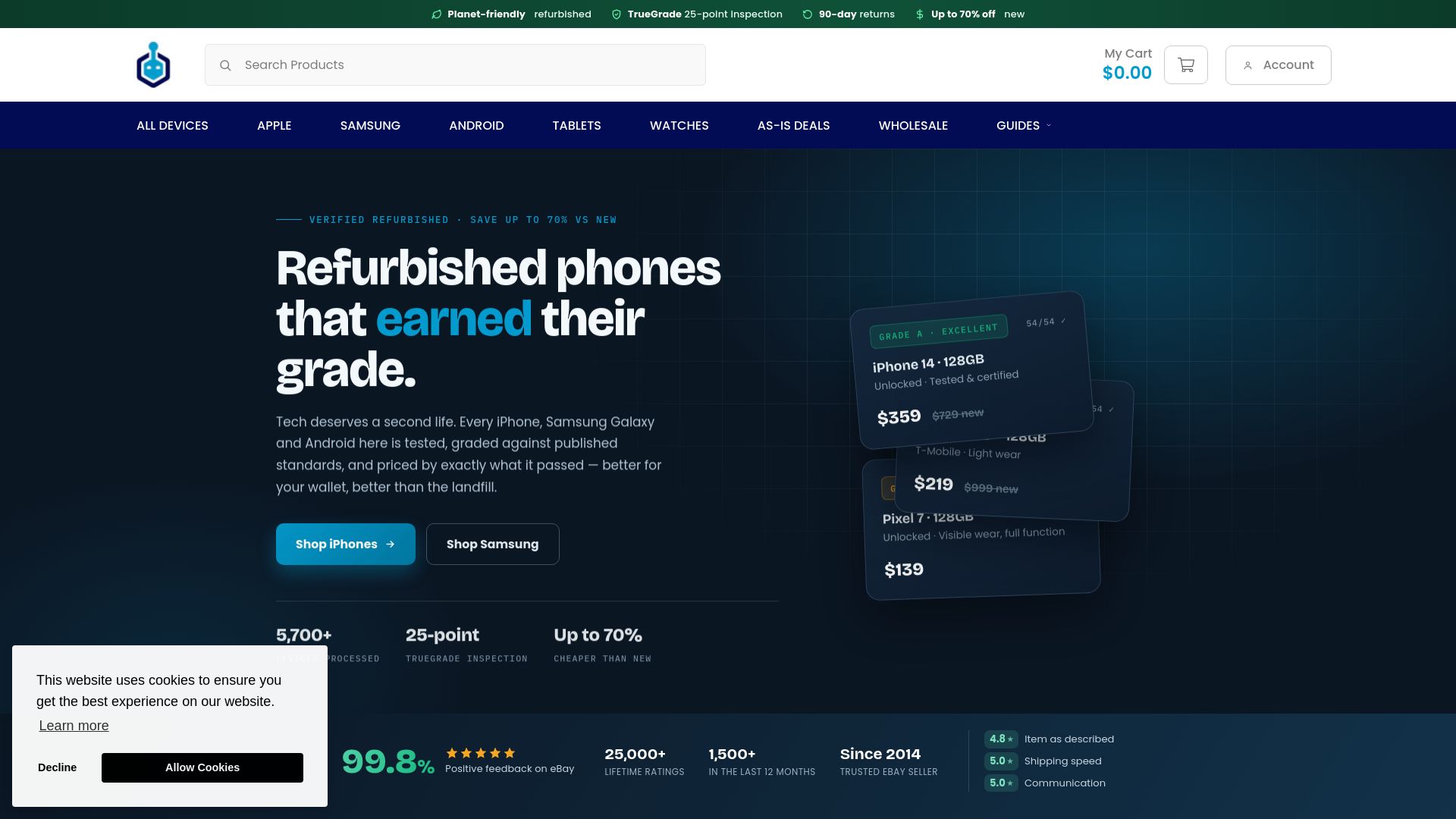
Many refurbished sellers give you a couple of weeks to a month and may charge a restocking fee if something goes wrong. Devicegiant offers a longer return period with detailed inspections and disclosed grading on every listing so you know the condition before you buy.
Every refurbished phone at Devicegiant is priced up to 70% below new, fully functional, and backed by a return policy that actually gives you time to run the stress-test checklist in this guide. Whether you’re looking for a Samsung Galaxy S22 Plus or a budget-friendly option under $100, the grading and inspection process means fewer surprises on arrival.
Browse the current inventory and check the listed grade and return terms on any product page before you buy.
Sources
These are the primary sources to consult for legal language, complaint forms, and platform policies:
- Refurbished electronics: grades, warranties and FTC rules | Legal Clarity
- Warranties | FTC
- Should you buy refurbished electronics? | Consumer Reports
This article is general information, not a substitute for advice from a qualified lawyer. Consult a qualified legal professional about your own circumstances before acting on anything here.


