
CTIA V5.1 Decodes Refurbished Phone Grades for Buyers

Refurbished phone grades tell you how a device looks, not whether it works. Grade A, B, or C describes scratches, dents, and screen wear, but functionality (cameras, battery, ports, locks) has to be verified separately by the seller. The one thing worth doing before you buy: confirm the seller discloses a battery-health percentage and states its diagnostic testing process, ideally against a benchmark like CTIA’s V5.1 grading scale.
TL;DR:
- Verified functional testing and BIOS or diagnostic screenshots are critical since cosmetic grade alone can’t confirm device reliability.
- Battery health percentage, as specified by industry standards like CTIA V5.1, should be disclosed separately from the cosmetic grade to accurately assess longevity.
- Buying from reputable sellers who clearly publish detailed grading definitions, warranty terms, and actual inspection results reduces the risk of hidden issues.
- The use of proprietary or inconsistent grading labels is common, so consumers should rely on explicit disclosures and industry benchmarks for comparison.
- Length of warranty and specific battery health thresholds are better indicators of a device’s long-term viability than cosmetic grade alone.
Table of Contents
- Grades at a Glance: What A, B, and C Actually Look Like
- Cosmetic Grade Versus Functional Test: The Split That Trips Up Buyers
- CTIA V5.1: The Benchmark Making Grading Terms Comparable
- The Buyer Checklist: What to Verify Before You Click Buy
- Warranty and Battery Thresholds: Weighing Protection Against Price
- Grading Doesn’t Look the Same Across Every Brand
- An Editor’s Take on Why Grading Transparency Still Falls Short
- Where to See Transparent Grading in Action
- Sources
Grades at a Glance: What A, B, and C Actually Look Like
Every retailer seems to invent its own naming scheme, but most map back to the same three tiers. Once you know what each one represents cosmetically, you can translate almost any listing, whether it says “Grade A” or “Excellent.”
- Grade A: Close to new. Expect faint micro-scratches invisible from normal viewing distance, no dents, and a screen with zero cracks. This tier carries the highest resale price among refurbished phone grades because it looks like it just left the store.
- Grade B: Visible light wear. You’ll likely spot minor scratches or a small dent on the frame, but the screen stays intact and uncracked. This is usually the sweet spot for value: noticeably cheaper than Grade A, cosmetically imperfect, functionally the same phone.
- Grade C: Heavier wear. Chips, scuffs, or a scratched back panel are common, and the phone still generally works fine. Buyers who don’t care about looks and just want a working device at the lowest price tend to land here.
Retailers also love inventing subgrades. A+ or A- might show up to split hairs between “flawless” and “one tiny mark.” Labels like Fair, Good, Excellent, and Pristine appear constantly across marketplaces, and they roughly map to C, B, A, and A+ respectively, though there’s no universal rule forcing a seller to use them consistently, as one phone grading breakdown points out.
Pro Tip: If you’re buying a phone to hide inside a case with a screen protector anyway, save your money and buy Grade B or C. Nobody will ever see the cosmetic difference once it’s covered.
Cosmetic Grade Versus Functional Test: The Split That Trips Up Buyers
A grade describes what you can see. It says nothing, by itself, about what you can’t see, and that gap is where most buyer regret comes from.
Cosmetic grading covers scratches, dents, discoloration, and cracked camera lenses. Functional testing is a completely separate process that should check the camera, speakers, microphone, cellular and Wi-Fi radios, sensors (Face ID, fingerprint), charging port, and whether the device carries an iCloud, FRP, or MDM lock that would brick it after purchase. A phone can be graded a pristine A and still fail half of those checks if the seller never ran them.
Battery health sits in its own category entirely. Wholesale trade practice commonly sets a floor above a high battery health percentage for a phone to qualify as Grade A on iPhones, according to wholesale grading standards for used phones. CTIA’s V5.1 standard goes further, attaching explicit battery-health floors to its consumer tiers rather than leaving the number to each seller’s discretion.
- Cosmetic grade: scratches, dents, screen cracks, discoloration
- Functional test: cameras, speakers, mic, radios, biometric sensors, charging port, activation locks
- Battery health: a separate percentage that should be disclosed, not assumed
- Parts provenance: whether a replaced screen or battery is OEM or aftermarket, which affects both durability and CTIA tier placement
A phone graded “like new” cosmetically can still carry an aftermarket battery sitting at 78% health. Grade and battery health are two different numbers, and only one seller in a hundred volunteers both without being asked.
CTIA V5.1: The Benchmark Making Grading Terms Comparable
CTIA rolled out Version 5.1 of its Wireless Device Grading Scales as a voluntary industry update, and it’s the closest thing the refurbished market has to a shared vocabulary. The standard maps wholesale grading criteria into consumer-facing tiers, bundling battery-health floors and parts-provenance rules into each tier so shoppers aren’t left guessing what “Grade A” means from one retailer to the next.
The tiers work on a sliding scale of both cosmetics and internals:
- Tier 1 (top tier): Near-new cosmetics, the highest battery-health floor CTIA defines, and a requirement for genuine OEM parts throughout the device.
- Tiers 2 through 4: Progressively more cosmetic wear allowed, lower battery-health floors, and explicit disclosure requirements when non-genuine parts are used.
That last point matters more than it sounds. A device with an aftermarket screen isn’t automatically disqualified from a good tier, but CTIA’s framework requires the seller to say so rather than bury it. That’s the actual innovation here, not the grading letters themselves, but the disclosure obligation attached to them, as CTIA’s own update summary makes clear.
Adoption is voluntary, so plenty of sellers still use their own homegrown labels instead of CTIA’s tier language. That’s not necessarily a red flag. It just means the burden falls back on you to read whatever definitions that specific seller provides, rather than trusting a label to mean the same thing everywhere.
The Buyer Checklist: What to Verify Before You Click Buy
Treat every refurbished listing like a used car listing. The photos and the grade name are the seller’s pitch. The checklist below is how you verify the pitch holds up.
- Find the seller’s condition definitions. Every legitimate refurbisher publishes what “Grade A” or “Excellent” means on their site. If you can’t find it in two clicks, that’s already a mark against them.
- Look for a battery percentage, not just a grade. A number like “battery health: 91%” tells you far more than any cosmetic label ever will.
- Check for actual unit photos, not stock images. A listing using generic manufacturer photos for a used device is a sign nobody actually inspected that specific phone.
- Confirm an explicit “no iCloud/FRP/MDM lock” guarantee. This single sentence, or its absence, predicts whether your phone works the day it arrives.
- Ask for the IMEI or serial number before shipping if you can. You can run it through a carrier or manufacturer lookup to confirm it isn’t reported lost or stolen.
- Read the return and warranty terms in full, not the headline number. A “90-day return” that only covers unopened boxes isn’t the same protection as one that covers functional defects.
Watch for the reverse signals too: a listing that skips battery info entirely, uses “good condition” with zero explanation of what that means, or offers no return window at all. Those gaps tend to cluster together, and dispute patterns in wholesale trading show battery health, aftermarket parts, and activation locks as the top four causes of buyer complaints industry-wide.
Pro Tip: Before you pay, ask the seller directly for a diagnostic screenshot from a tool like Apple’s built-in battery health screen or an Android equivalent. A seller with nothing to hide will send it in five minutes.
If something arrives that doesn’t match the listing, you have leverage worth using: ask for a replacement within the return window, a pro-rated partial refund if the issue is minor, or pre-shipment photos and diagnostics on your next order so you’re not relying on trust alone.
Warranty and Battery Thresholds: Weighing Protection Against Price
A cosmetic grade is the least important number on a refurbished listing once you factor in what actually causes buyer regret. Battery disclosure and warranty length do more to predict satisfaction than whether a phone has one extra scratch on the back, based on analysis of refurbished buying patterns.
Warranty length varies widely across sellers, from 30 days up to a year, and most cover functional failures (a dead speaker, a camera that stops focusing) rather than cosmetic complaints you noticed after the fact. Read the fine print for what triggers a covered repair versus a covered replacement.
- A device sitting right at an 85% battery-health floor for Grade A is legally “passing,” but it will degrade faster under daily use than one at 95%.
- If two listings are priced close together, the one with a longer warranty and a disclosed battery number is almost always the safer buy, even if its cosmetic grade is one notch lower.
- For anyone planning to keep the phone more than two years, checking whether the battery health meets a real threshold matters more than chasing a flawless screen.
If you’re weighing a battery replacement against buying a different unit outright, a repair guide comparing replacement versus buying new walks through when each option pays off.
Grading Doesn’t Look the Same Across Every Brand
The letters A, B, and C stay consistent across brands, but what counts as a defect shifts depending on the phone. iPhones get graded partly on battery-health percentage because Apple exposes that number natively in settings, which makes it an easy, verifiable line item. Android flagships from Samsung or Google don’t always expose battery health as cleanly, so some sellers substitute a “battery cycles” estimate or skip the disclosure entirely, which is worth asking about directly.
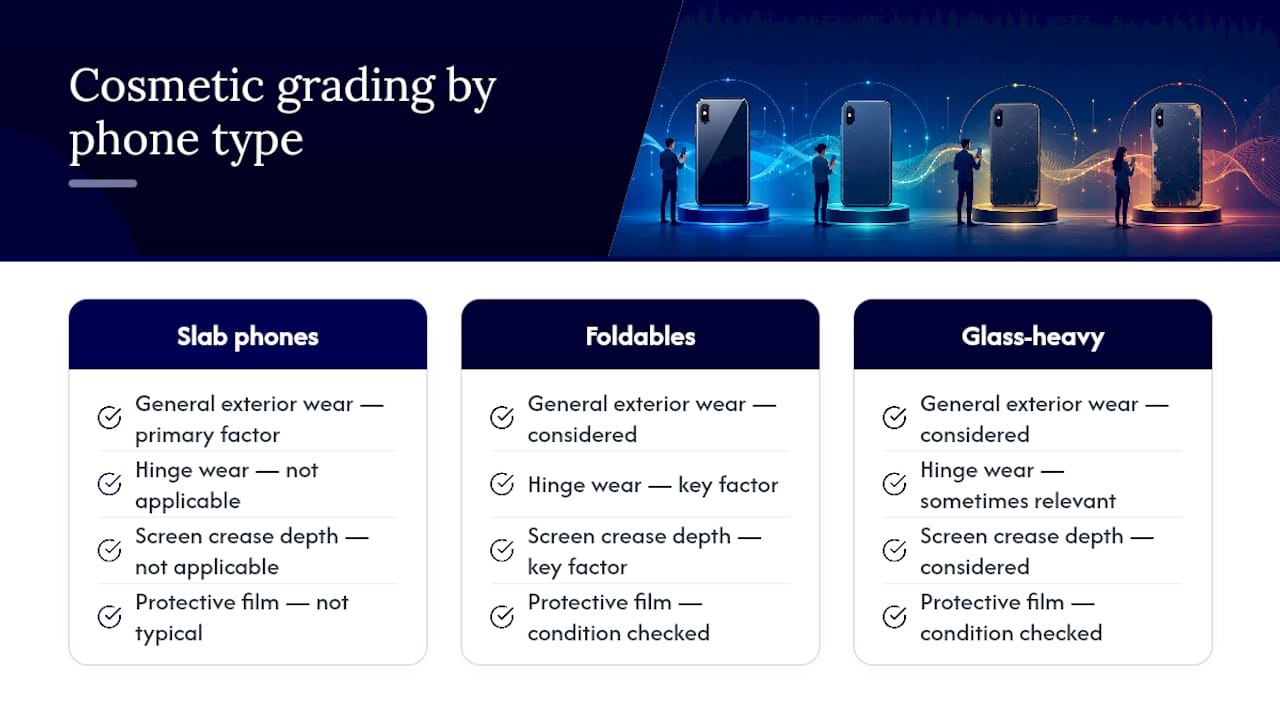
Foldables and glass-heavy designs (recent Samsung Galaxy Z models, for instance) introduce cosmetic categories that don’t exist on a standard slab phone: hinge wear, screen crease depth, and protective film condition. A Grade B foldable might look fine closed but show a visible crease when open, something a flat-phone grading scale never accounts for.
Budget and prepaid phones, meanwhile, often get graded more leniently across the board, since the price point already assumes some wear. A Grade B rating on a $100 prepaid device and a Grade B rating on a $700 flagship don’t carry the same cosmetic bar; the flagship’s B grade tends to look closer to what a budget phone’s A grade looks like, simply because expectations shift with price. That’s another reason to read a seller’s specific grading definitions for the exact model rather than assuming the letter grade transfers cleanly between brands.
An Editor’s Take on Why Grading Transparency Still Falls Short
The refurbished phone industry likes to talk about standardization, but the honest truth is that most of the friction buyers experience has nothing to do with grading letters and everything to do with disclosure habits. A seller can follow CTIA’s tier system to the letter and still bury the one number that matters, battery health, three clicks deep on a product page nobody checks.
What gets underestimated is how much the grade name distracts from the actual risk. Buyers fixate on whether a phone is “A” or “B” cosmetically, when the real predictor of a bad experience is whether the seller ran a genuine functional test and will stand behind the phone if something fails in week three. A pristine-looking Grade A phone with an unverified aftermarket battery is a worse buy than a scuffed Grade C phone with 92% battery health and a real warranty attached.
One certified refurbishers’ approach reflects that priority. Every phone goes through a 25-point inspection covering exactly the functional split this article describes: cameras, ports, sensors, locks, and battery, in addition to the cosmetic grade on the listing. The grade tells you what the phone looks like. The inspection and the warranty tell you whether it’s actually safe to buy.
— Saad
Where to See Transparent Grading in Action
You’ve got the checklist now: battery disclosure, functional testing, real return terms. The fastest way to put it to use is to compare listings that show all three upfront instead of hunting through vague seller descriptions one tab at a time.
Devicegiant publishes cosmetic grade, battery-health percentage, and inspection results directly on every product page, so you’re not stuck guessing whether “Excellent” means the same thing here as it did on the last site you checked. Every device passes the 25-point TrueGrade inspection before it’s listed, and every order carries a 90-day return window if something doesn’t match what was described. Browse the full refurbished phone selection and run any listing you’re considering against the checklist above. If you want a concrete example of what full disclosure looks like on a specific model, the Samsung Galaxy S22 Ultra 5G product page shows grading and battery details side by side. Pick a device, check the numbers, and buy with the information a grade alone never gives you.
Sources
- CTIA Wireless Device Grading Scales: Criteria and Definitions (V5.0/V5.1 reference)
- CTIA publishes wireless device grading standard in support of greater transparency for pre-owned devices
- Used phone grading for wholesale: A, B, C grades explained | Aikon


