
Best Time to Buy iPhone: When to Wait, When to Buy (2026)

The best time to buy an iPhone in 2026 is in the weeks following Apple’s September 2026 launch event, or during Black Friday week in November. Certified refurbished is the strongest value play year-round, particularly 2–3 months after a new launch when refurb inventory catches up.
Two windows deliver the most consistent savings for buyers of new devices. The first opens in late September and runs through October, when Apple officially drops the previous base model’s price and retailers follow within 24–48 hours. The second is Black Friday week, when carrier trade-in credits and retailer promotions peak simultaneously. If neither window fits your timeline, certified refurbished iPhones offer 40–70% off new pricing without requiring you to time a sale.
- If you need a phone now: Buy a certified refurbished iPhone from a vetted seller. You skip the waiting game entirely.
- If you want the newest model: Wait for the iPhone 18 announcement in September 2026, then buy in the first two weeks of October when launch-day hype fades and trade-in credits are still strong.
- If you want the lowest out-of-pocket cost: Target Black Friday week or buy certified refurbished. Both consistently beat launch-day pricing.
Pro Tip: Sell your current iPhone roughly 14 days before Apple’s September announcement. Trade-in values typically fall significantly the moment a new model is revealed, so getting out early preserves real money.
Table of Contents
- What’s the best month to buy an iPhone in 2026?
- How does Apple’s release schedule actually move prices?
- Where do real iPhone discounts actually appear in the U.S.?
- Should you wait for the iPhone 18 or buy now?
- New, last-gen, or certified refurbished: which is actually worth it?
- Why certified refurbished is often the smartest buy, regardless of timing
- The action checklist: exactly what to do when you’re ready to buy
- Key Takeaways
- The case for buying smarter, not just buying later
- Devicegiant: certified refurbished iPhones without the waiting game
- Useful sources to track prices and launch news
What’s the best month to buy an iPhone in 2026?
The table below gives you a fast verdict for every month. Use it to match your timeline to the right buying window.
| Month | Verdict | Why |
|---|---|---|
| January | Good | Post-holiday clearance; retailers move leftover stock |
| February | Good | Continued clearance; possible iPhone 17e-era refurb availability |
| March | Fair | iPhone 17e launched March 2, 2026; watch for prior-gen price drops |
| April | Fair | Spring deals thin out; wait unless you find a specific discount |
| May | Fair | Memorial Day sales offer modest discounts on select models |
| June | Neutral | No major Apple events; prices stable |
| July | Avoid | Pre-launch dead zone; full MSRP, new model weeks away |
| August | Avoid | Worst month to buy; prices stay high as September launch nears |
| September | Watch | iPhone 18 expected; prior-gen price drops begin at announcement |
| October | Buy | Best window for new buyers; discounts active, stock plentiful |
| November | Buy | Black Friday week; peak carrier credits and retailer deals |
| December | Good | Cyber Monday tail; gift-card promotions at Apple and Best Buy |
July and August are generally the worst months to buy an iPhone because a new model is about to be released, so prices remain high and trade-in values are not optimal.
Pro Tip: If you’re in the market in July or August, list your current phone now to capture peak trade-in value, then hold the cash until October.
How does Apple’s release schedule actually move prices?
Apple runs two annual launch moments that create predictable pricing pressure across its entire lineup.
The September flagship event is the older and more reliable of the two. Historical release data confirms a consistent early- to mid-September keynote, with retail availability opening roughly one week after preorders. The iPhone 17 launched September 9, 2025, following this pattern exactly. The iPhone 18 is widely expected to follow the same schedule in September 2026.
The spring “e” launch is newer but now a fixture. Since 2025, Apple has staged spring budget launches alongside its September flagships, creating a second annual pressure point. The iPhone 16e arrived in February 2025; the iPhone 17e followed on March 2, 2026. That spring event pushes the prior entry-level model down the price ladder and nudges refurbished supply upward.
What happens to prices the day a new iPhone launches?
Apple drops the previous base model’s MSRP by $100 immediately at the new-launch announcement, and retailers typically propagate that adjustment within 24–48 hours. Carriers often respond with trade-in credit bumps rather than straight price cuts, which is a meaningful distinction: a bill credit spread over 24–36 months is not the same as $100 off today.
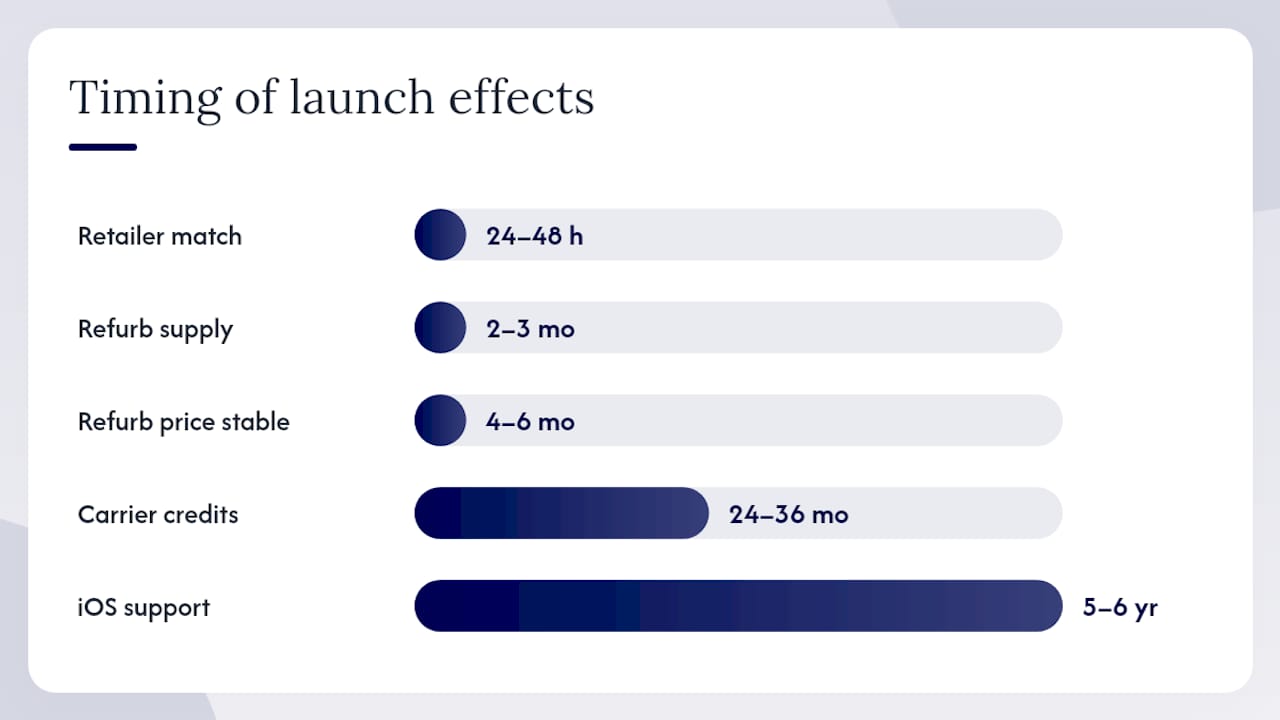
Here’s a simplified price path for a hypothetical base model after a new launch:
| Timing | Typical Price Movement |
|---|---|
| Launch day (new model) | Prior base model drops $100 officially |
| Week 1–2 post-launch | Retailers match or beat Apple’s new price |
| Month 1–3 | Carrier trade-in credits peak; refurb supply builds |
| Month 4–6 | Refurbished pricing stabilizes at 30–50% below original MSRP |
| 12+ months | Model approaches end of active retail; refurb becomes primary channel |
Two non-price factors also affect value over time. iOS support lifetime matters: Apple typically supports iPhone models for five to six years from release. A phone bought in 2026 should receive software updates through at least 2031. And resale value erodes faster in the first 12 months than at any other point in a model’s life, which is why the 40–80 rule (covered in the checklist section below) is worth understanding before you buy.
- Apple’s $100 official price drop applies to the base model only; Pro and Pro Max pricing rarely changes at launch.
- Carrier credits require qualifying plans and are typically spread over 24–36 months.
- Refurbished supply for a new model usually takes 2–3 months to build after launch.
- iOS support lifetime affects total cost of ownership more than launch-day price.
Where do real iPhone discounts actually appear in the U.S.?
The channel you buy from determines how the discount is structured, and that structure matters as much as the headline number.
Carriers (AT&T, Verizon, T-Mobile) offer the largest headline credits, often framed as “up to EX off” with a trade-in. The catch: those credits are typically delivered as bill credits over 24–36 months and require qualifying service plans. If you switch plans or pay off the device early, you may forfeit remaining credits. Do the math before committing.
Big-box retailers (Best Buy, Target, Walmart) tend to offer cleaner instant discounts, gift card promotions, or bundle deals. Best Buy’s “deal of the day” iPhone promotions during Black Friday week have historically delivered $100–$200 off without requiring a plan change. These are often the most straightforward savings for buyers who already have a carrier they like.
Online marketplaces and Apple’s own store provide Apple-certified refurbished inventory with a one-year warranty, though stock is limited and pricing sits closer to 15–20% off new rather than the deeper discounts available through third-party certified refurb sellers.
Certified refurbished sellers like Devicegiant offer the steepest discounts, typically 40–70% off new pricing, with no carrier contract required. The trade-off is that you’re buying a previous-generation model rather than the latest release. For most buyers, that’s a rational trade.
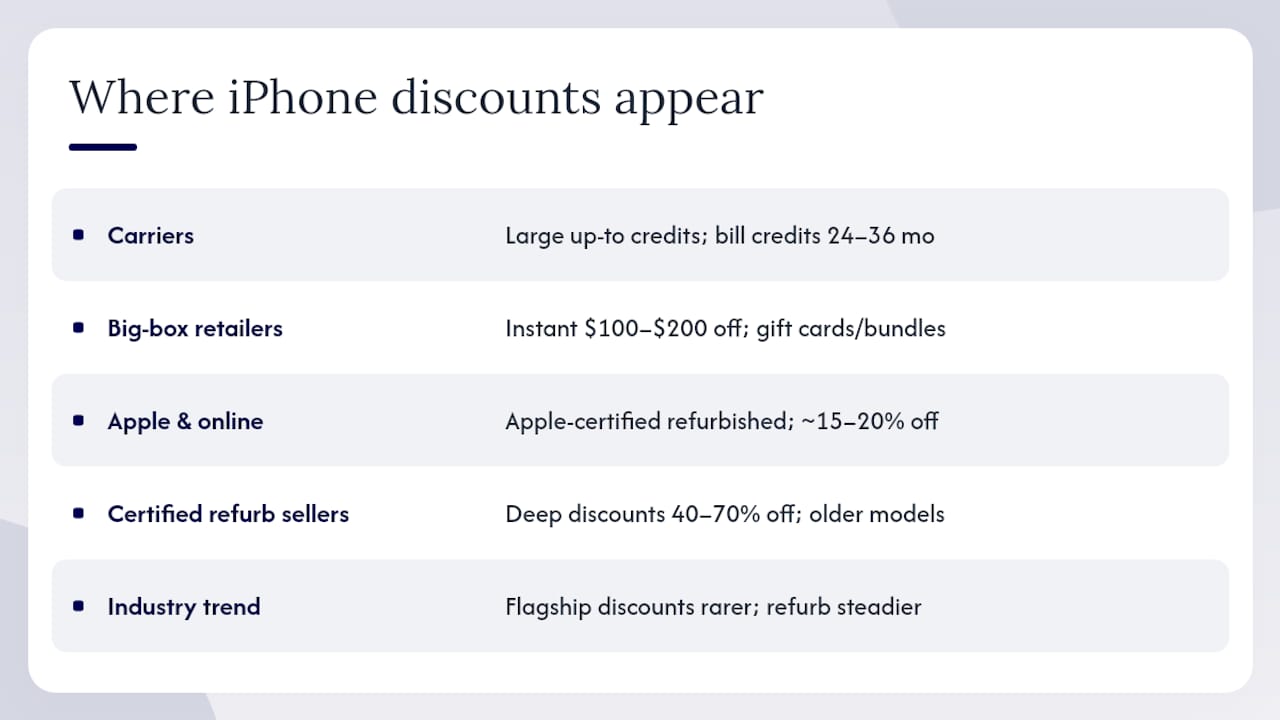
Industry analysis in 2026 notes that structural price increases and rising chip costs have reduced the frequency of deep flagship discounts, which makes certified refurbished a more predictable value play than it was three years ago.
When do the biggest promotions hit?
- Amazon Prime Day / October Prime Event: — Increasingly competitive iPhone deals, particularly on older models and accessories.
Pro Tip: Stack a retailer instant discount with a carrier trade-in credit when both are available simultaneously. Best Buy and carrier stores occasionally run joint promotions during Black Friday week that let you apply both. Read the terms carefully — some offers are mutually exclusive.
Should you wait for the iPhone 18 or buy now?
Tech press guidance is consistent on this: if a major refresh is weeks away, waiting is usually the rational move. But “usually” has real exceptions.
New, last-gen, or certified refurbished: which is actually worth it?
The right answer depends on what you’re optimizing for. Here’s the honest breakdown.
New (current generation)
Pros: Latest chip, full iOS support runway, full manufacturer warranty, Apple Trade In eligibility at peak value. Cons: Highest price, steepest first-year depreciation, limited discounts outside of Black Friday and launch windows.
Best for: buyers who want the newest features and plan to trade in within 12–18 months to reset the depreciation cycle.
Previous generation (last-gen new or open-box)
Pros: $100–$200 cheaper than current gen after the new launch, still recent hardware, available new from retailers. Cons: One generation behind on chip and camera, resale value already declining, iOS support clock started earlier.
Best for: buyers who want a new-in-box device without paying flagship prices and don’t need the latest camera system.
Certified refurbished
Pros: 40–70% off new pricing, inspected and graded, often unlocked, no carrier contract required. Cons: Previous-generation hardware, cosmetic wear (graded A–D), shorter included warranty than new (varies by seller).
Best for: budget-focused buyers, eco-conscious buyers, and anyone who needs a capable iPhone without the new-device premium.
| Condition | Typical Savings vs. New | iOS Support Remaining | Best Buying Window |
|---|---|---|---|
| New (current gen) | — | 5–6 years from release | October post-launch or Black Friday |
| Previous gen (new) | 10–20% | 4–5 years from release | October–November |
| Certified refurbished | 40–70% | Varies by model | Year-round; best 2–3 months post-launch |
A refurbished iPhone 15 from Devicegiant starts at $297. That’s a phone released in 2023 with a 48MP main camera, USB-C, and iOS 18 support well into the late 2020s. For most users, the gap between that and a $799 iPhone 17 is not $502 worth of real-world difference.
Why certified refurbished is often the smartest buy, regardless of timing
Certified refurbished doesn’t just save money. When done right, it removes most of the risk that makes buyers hesitant about used devices.
What to verify when your refurbished device arrives
- Power on and complete setup before the return window starts.
- Check battery health under Settings > Battery > Battery Health.
- Test Face ID, cameras (front and rear), speakers, microphone, and charging port.
- Verify the IMEI matches the paperwork and run it through a carrier unlock checker.
- Confirm the iOS version and check for available updates.
The action checklist: exactly what to do when you’re ready to buy
Follow this sequence to maximize savings and minimize regret.
- Check the MacRumors Buyer’s Guide first. It tracks days since each model’s last release and gives a “buy/wait” signal based on Apple’s historical cadence. If a model is flagged as “don’t buy,” a new version is likely weeks away.
- Sell your current iPhone 14 days before Apple’s September announcement. Trade-in values typically drop 10–20% the moment a new model is revealed. Listing on Swappa, eBay, or Facebook Marketplace two weeks early captures peak private-sale value.
- Set price alerts on your target model. Google Shopping, CamelCamelCamel (for Amazon listings), and Honey all track price history and send alerts when a specific model hits your target price.
- Decide: unlocked or carrier. Unlocked devices cost more upfront but give you flexibility to switch carriers and avoid 24–36 month bill-credit lock-ins. If you’re staying on your current carrier for two-plus years, a carrier deal can make sense. If not, unlocked is almost always the better long-term value.
- Do the carrier bill-credit math. Take the headline credit amount, divide by the number of months it’s spread across, and compare that monthly savings to the upfront cost difference of buying unlocked. Many buyers find the unlocked route wins after accounting for plan flexibility.
- Apply the 40–80 rule to your current phone. If your current iPhone’s battery health is above 80% and it handles your daily tasks without friction, you’re in the top 40% of the ownership cycle where the phone still has strong resale value. Sell before it drops below 80% battery health — that threshold triggers a visible depreciation step in resale markets.
- Check Devicegiant’s trade-in and resale guide for current market rates and timing advice specific to your model.
- Verify return and warranty terms before checkout. For new devices, Apple’s standard one-year warranty applies. For refurbished, confirm the seller’s stated warranty in writing before purchase.
Quick-reference tools
- MacRumors Buyer’s Guide: — Buy/wait signal based on release cadence.
Key Takeaways
The best time to buy an iPhone in 2026 is October (post-iPhone 18 launch) or Black Friday week, with certified refurbished as the strongest value option year-round.
| Point | Details |
|---|---|
| Avoid July and August | Full MSRP with a new model weeks away; worst value in the calendar year. |
| Best new-device windows | October post-launch and Black Friday week deliver the strongest combination of price drops and carrier credits. |
| Sell before the announcement | List your current iPhone 14 days before Apple’s September event to capture peak trade-in value. |
| Refurbished beats waiting | Certified refurbished iPhones at 40–70% off new pricing often outperform seasonal sale discounts on new devices. |
| Devicegiant for refurb | Devicegiant’s 25-point TrueGrade inspection, 90-day returns, and up to 70% off make it a reliable year-round alternative to timing a sale. |
The case for buying smarter, not just buying later
The conventional wisdom on iPhone timing is “wait for September.” That advice made more sense when flagship discounts were predictable and deep. In 2026, with chip costs and average selling prices both trending upward, the September launch discount on a prior-gen base model is often $100 off a phone that was already expensive. That’s not a deal. That’s a price correction.
The buyers who consistently get the most value aren’t the ones who time the September launch perfectly. They’re the ones who understand that a Grade A certified refurbished iPhone 15 or 16, bought from a seller with a real inspection process and a 90-day return window, delivers 80–90% of the flagship experience at 40–60% of the cost. The spec delta between a two-year-old iPhone and the current generation is real but narrow for most use cases. Most people don’t need the latest 2nm chip. They need a phone that works reliably, takes good photos, and runs current apps without lag.
Timing still matters for buyers who want new. But for the majority of value-focused buyers, the question isn’t “which month should I buy?” It’s “why am I paying new-device prices at all?”
Devicegiant: certified refurbished iPhones without the waiting game
Waiting for the right sale window makes sense in theory. In practice, you might wait three months for a $100 discount on a phone that a certified refurbished seller has in stock today at $300 less.
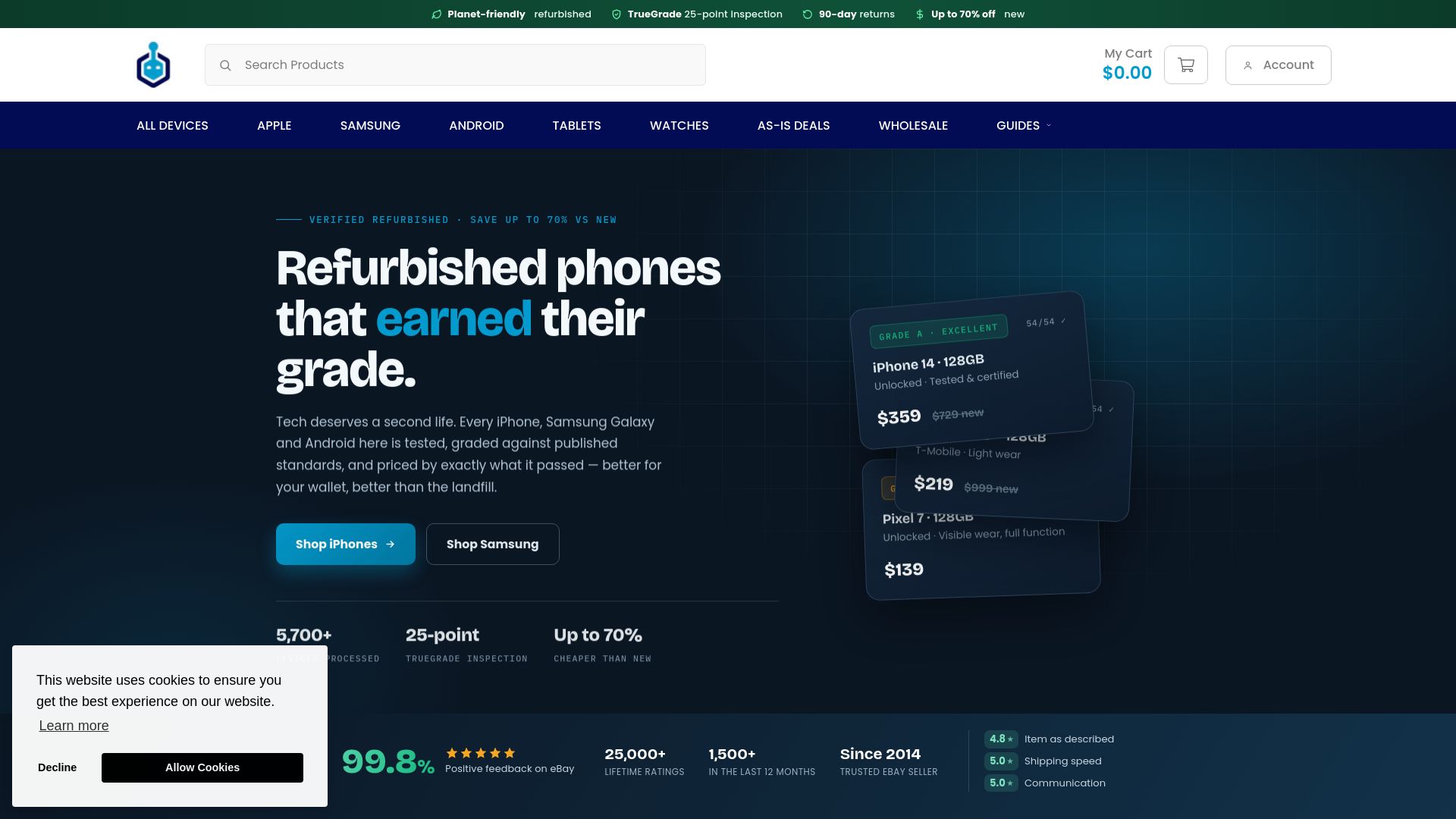
Devicegiant’s refurbished iPhones go through a 25-point TrueGrade functional inspection before listing, with cosmetic grades disclosed upfront so you know exactly what you’re getting. Every device ships with a 90-day return policy, and the company’s 99.8% positive eBay feedback reflects years of consistent delivery on that promise. Unlocked and carrier-specific options are available, and bulk wholesale lots are an option for resellers and repair shops.
If you’re a budget-focused buyer, an eco-conscious one, or simply someone who doesn’t want to pay $800 for a phone that will be worth $400 in 18 months, browse Devicegiant’s certified refurbished inventory and see what’s in stock today.
Useful sources to track prices and launch news
Stay current on iPhone pricing and release timing with these primary sources:
- Best time to buy an iPhone in 2026: When prices drop & which model to buy | Macworld
- Best Time to Buy an iPhone: Launch Cycles, Trade-In Timing, and Carrier Deals (2026) | DontPayFull
- Will Apple Reduce iPhone Prices? [2024 Market Strategy] — ThinkAtlas.blog
- When is the best time to buy Apple smartphones? — ShopSavvy
- List of iPhone models — Wikipedia
- This is usually the worst time to buy a new iPhone — not this year | Macworld (2026)
- About to Buy a New iPhone? Here’s Why You Should Definitely Wait | CNET
- All iPhone release dates in order — IGN


