
Circular Economy for Electronics: How Devices Stay in Use

A circular economy for electronics keeps phones, tablets and laptops working for as long as possible, then recovers their materials when they finally can’t. The alternative is the linear path: mine, manufacture, use briefly, discard. The most useful move you can make is the least glamorous one: keep a good device in service, whether that means repairing yours, passing it on, or buying one that already exists instead of one that has to be built.
This guide explains the model in plain terms, shows where each stage fits, covers the barriers that slow it down, and lists what U.S. consumers and small businesses can do this week.
TL;DR
- A circular economy treats electronics as resources to be kept in use, not trash. The priority order is reduce, reuse, refurbish, then recycle, with landfill last.
- The world generated a record 62 million tonnes of e-waste in 2022, and only 22% of it was documented as properly collected and recycled, according to UNITAR’s Global E-waste Monitor 2024.
- Reuse beats recycling. Roughly two-thirds of devices taken out of service still work, so extending their life captures most of the benefit.
- When a device can’t be reused, send it to a recycler certified to R2 or e-Stewards, and wipe your data first.
- Buying refurbished is the most direct way for an individual or a business to take part in the circular economy.
Table of Contents
- What a circular economy means for electronics
- The stages of the loop
- Why it matters: the scale of the problem
- What holds the circular economy back
- What you can do in the U.S.
- Where refurbished phones fit
- Our perspective: circularity is a promise you have to be able to verify
- Find a verified refurbished device
- How to judge a seller’s circular claims
- FAQ
- Sources
What a circular economy means for electronics
In a linear system, a phone is built from newly extracted materials, used for a few years, and thrown away. Value is lost at the end. In a circular system, the design, the business model and the habits around a product are arranged so that materials and devices stay in use. The European Commission’s circular economy platform describes it as decoupling economic activity from the consumption of finite resources, by keeping materials in use through design, repair and recycling.
The ITU’s standard on circular economy for information and communication technology adds two aims worth remembering: minimize the input of virgin materials, and avoid hazardous substances that would block recycling later.
Electronics are a hard case. A smartphone packs dozens of materials into a sealed, compact body. Gold, copper and other metals are valuable, but they are mixed with plastics, glass and adhesives. That is why the loop needs several stages, not just one.
The stages of the loop
Circularity does not happen at one point. The Circular Electronics Partnership’s design guide frames it across the whole value chain: product-service design, repair, refurbishment and recycling. Here is how each stage works for a device you might own.
| Stage | What happens | What you can do |
|---|---|---|
| Design | Products built to last, to be opened and to be updated | Favor models with long software support and replaceable batteries |
| Use | The device stays in daily service | Case, screen protector, battery care |
| Repair | A failed part is replaced | Fix a cracked screen or tired battery before replacing the phone |
| Reuse | The device moves to a new owner | Sell, trade in, donate or hand down |
| Refurbish | A used device is tested, repaired, cleaned and resold | Buy refurbished with clear grading and a return window |
| Recycle | Materials are recovered by sorting and dismantling | Use a certified recycler for devices that can’t work again |
| Disposal | Incineration or landfill | Avoid |
The order matters. The U.S. EPA’s hierarchy for end-of-life electronics ranks reuse (redeployment, refurbishment, repair) first, material recovery through recycling second, and incineration or landfilling last.
Why reuse comes before recycling
Recycling recovers materials, but the energy, labor and processing that went into making the device are lost. Reuse keeps all of that embedded effort alive. The EPA’s Sustainable Electronics Roadmap notes that about two-thirds of electronic devices removed from service are still functional. It also reports that e-waste is about 2% of landfill volume but accounts for 70% of the toxic waste in landfills.
The EPA’s overview of electronics life cycles makes the same point in simpler terms: reusing electronics extends product life and reduces raw-material use.
Refurbishing versus remanufacturing
The two words get mixed up. Remanufacturing, as described in the European circular electronics report, restores a used product to like-new condition by disassembling, cleaning, repairing and reassembling it to original specifications. Refurbishing in retail usually means a lighter process: test the device, replace worn or failed parts, wipe data, clean it and grade its appearance. What matters to a buyer is that the process is described honestly and the result is checked.

Why it matters: the scale of the problem
The numbers explain why the stages above are not optional. UNITAR’s monitor reports that the world produced 62 million tonnes of e-waste in 2022, up 82% from 2010, and projects 82 million tonnes by 2030. Most of it never enters a documented recycling stream, which means valuable metals are lost and hazardous materials can end up in soil and water.
There are economic reasons too. The European report cited above estimates that circular strategies can average 12% cost savings and 10% CO2e emissions reductions for companies that adopt them. Separately, a guide on the circular economy of digital devices points to social benefits: circularity can make devices available to people who couldn’t otherwise afford them, and it creates jobs in repair and refurbishment.
For a phone specifically, most of the carbon cost is locked in before you ever switch it on. Our breakdown of the smartphone carbon footprint explains why extending a phone’s life, or choosing one that was already made, does more than any recycling bin can.
What holds the circular economy back
If reuse is so clearly better, why isn’t everything already circular? A NIST workshop on the circular economy in the high-tech world identifies several barriers:
- Consumer confusion and data-security fears. People don’t know where to take old devices, and many keep them in drawers because they worry about their personal data.
- Limited collection and transport infrastructure. Devices have to travel to where they can be processed, and batteries add shipping complexity.
- Product changes that complicate recovery. Designs shift quickly, so processors must handle constantly changing formats.
- Poor data on material stocks and flows. It is hard to manage what isn’t measured.
The same report explains a design problem. Products are optimized for performance and cost, which often means glued or bonded assemblies that are hard to take apart for repair, refurbishment or recycling.
There is also a fair caution from the Circular Electronics Partnership. Its system map argues that a product can’t be called truly circular at the point of sale, because the value it keeps depends on how people use it and what they do with it at the end. In other words, a circular device only becomes circular if someone keeps it going and returns it properly. That puts a real share of the responsibility on buyers and sellers alike.
The ITU adds a reminder that strategies have to be tailored to each product category, balancing safety, reliability, substance rules and cost. A circular answer for a laptop is not automatically the right answer for a smartwatch.
What you can do in the U.S.
You don’t need to wait for manufacturers to redesign anything. The same loop applies to your own devices and your company’s.
1. Use what you have for longer
The cheapest circular act is not replacing a working device. A fresh battery or a screen repair often costs far less than a new phone. If your phone still receives security updates and does what you need, keep it. If you’re curious how long a used phone can really serve, see our look at how long refurbished phones last.
2. Pass working devices on
If a device still works, give it a second owner before you consider recycling: trade it in, sell it, donate it or hand it to family. Before you do, back up your data, sign out of your accounts, turn off activation locks and perform a factory reset.

3. Buy refurbished when you need a replacement
Buying a refurbished device means no new device has to be manufactured to meet your need. It is the point where an individual’s purchase directly feeds the circular economy. The trick is to buy from a seller that tests every device, discloses cosmetic condition and backs the sale with a real return window. Our guide to buying refurbished electronics online walks through what to check.
4. Recycle through certified channels
When a device can’t be repaired, sorting and dismantling by a certified recycler is the right next step. The EPA explains that two accredited standards exist, R2 and e-Stewards, and encourages recyclers to be audited by an independent third party. These standards cover environmental practices, worker health and safety, downstream handling and data destruction. Ask any recycler which certification it holds before you hand over a device.
5. For businesses: build a lifecycle plan
Small businesses can apply the same hierarchy that federal agencies follow. According to the EPA’s guidance on federal electronic equipment, agencies are directed under 41 CFR 102 to consider reuse, including redeployment, refurbishment and repair, before recycling or disposal. The same guidance notes that professional refurbishment requires media sanitization, software reinstallation and licensed software.
A practical version for a small company:
- Keep an inventory of devices with purchase dates.
- Redeploy working devices to lower-demand roles before retiring them.
- Wipe data with a documented process.
- Sell or donate what still works.
- Send the rest to a certified recycler and keep the paperwork.
- Buy replacements refurbished where the use case allows.
Where refurbished phones fit
Refurbished smartphones are the most accessible part of the loop. The phone already exists, its production emissions are already spent, and a second life spreads that cost over more years. The question for any buyer is trust: how do you know the phone really works and looks the way the listing says?
That’s why inspection and grading matter more than the word “refurbished” itself. If you want to see what a rigorous process looks like, read how we source refurbished phones and what our checks cover. And if you’re thinking about the e-waste side of your current phone, our guide to e-waste smartphones covers what to do with the old one.
Our perspective: circularity is a promise you have to be able to verify
We sell refurbished devices, so we have a stake here, and we’d rather be straight about it. The circular economy is easy to praise and hard to practice, and the gap is usually trust.
Buyers hesitate over used electronics for understandable reasons. They worry the battery is shot, the screen is hiding damage or the phone is locked to a carrier. A circular model only works if buyers are confident enough to choose a second-life device over a new one. So we build the model around removing doubt.
Every device goes through our TrueGrade inspection, a 25-point functional check. Each one is also graded for cosmetic condition, with grades running from A to D plus refurbished variants, so you know what you’re getting before you pay. We list whether a device is unlocked or tied to a carrier. And we back purchases with a 90-day return policy, which we believe is longer than most sellers offer. Our eBay history stands at 99.8% positive feedback.
We also agree with the caution above: a product isn’t circular just because a seller says so. It becomes circular when it is used for years and finally recycled properly. So we tell buyers to keep their devices going, and to use certified recyclers at the end. The savings, up to 70% less than new, are real, but the better reason to buy refurbished is that the phone in your hand didn’t need to be made.
— Saad
Find a verified refurbished device
If you’re ready to put the circular economy into practice, our full catalog of refurbished phones includes iPhones, Samsung Galaxy phones, Android phones, tablets and smartwatches, all inspected and graded, at up to 70% less than new. Each device passes the 25-point TrueGrade check and comes with a 90-day return policy.
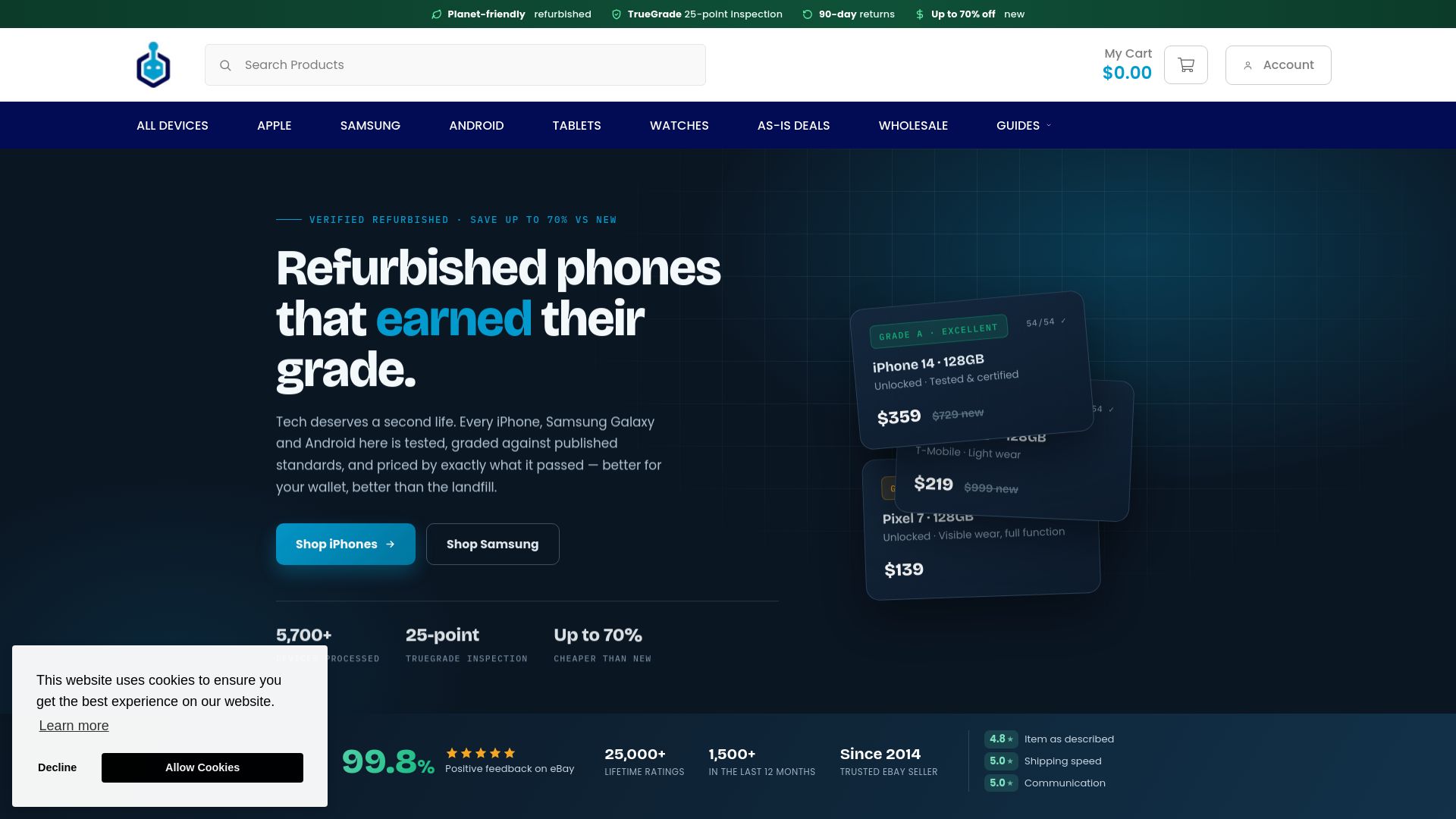
If you want something tested and working at a lower price, browse our tested and working devices. Shops and resellers can ask about our Wholesale & Bulk lots, which keep larger volumes of devices in circulation. If you resell, our walkthrough on reselling refurbished phones shows how the numbers work.
How to judge a seller’s circular claims
Green language is cheap. Before you trust a seller or recycler, run through a short list.
- Is the testing specific? A named checklist with a number of points beats vague phrases such as “fully tested.”
- Is cosmetic condition disclosed by grade? You should see what scratches or wear to expect.
- Is the return window long enough to find problems? Battery and connectivity issues can take days to show up.
- Is carrier status stated? Unlocked or carrier-specific should be clear before purchase.
- Is data handled properly? Sellers should wipe devices, and you should wipe yours.
- Does the end-of-life path exist? For recyclers, look for R2 or e-Stewards certification.
FAQ
Is buying refurbished really part of the circular economy?
Yes. Reuse and refurbishment sit above recycling in the EPA’s hierarchy because they keep a whole device in service rather than recovering only its materials. Buying refurbished also avoids the demand for a newly manufactured device. The benefit depends on the device then lasting, which is why testing and a return window matter.
Is recycling enough to solve the e-waste problem?
No. Only 22% of the 62 million tonnes of e-waste generated worldwide in 2022 was documented as properly collected and recycled, and recycling recovers materials but not the effort that went into building the device. Recycling is the right step for devices that can’t work again. For everything else, repair and reuse come first.
How do I recycle old electronics responsibly in the United States?
Back up and wipe your data, then use a recycler certified to the R2 or e-Stewards standard. The EPA recognizes both as accredited standards for environmental, worker-safety and data-security practices. Ask for the certification before you drop off a device.
What stops electronics from being fully circular?
NIST’s workshop report points to confusion among consumers, data-security concerns, limited collection infrastructure and designs that are glued together and hard to take apart. Better design and clearer return channels are the long-term fix. In the meantime, buyers can keep devices in use longer and choose refurbished.
Can a small business use a circular approach without a big budget?
Yes. Redeploy working devices, wipe data with a documented process, resell or donate what still functions, and recycle the rest through a certified recycler. Buying refurbished for roles that don’t need the newest model also lowers cost while keeping devices in circulation.
Sources
- UNITAR, Global E-waste Monitor 2024
- European Commission circular economy platform, Future Proofing the Electronics Industry
- ITU-T L.1022, Circular economy definitions and concepts for ICT
- Circular Electronics Partnership, Circular Electronics Design Guide
- Circular Electronics Partnership, system map
- U.S. EPA, Recycling of Federal Electronic Equipment
- U.S. EPA, Sustainable Electronics Roadmap
- U.S. EPA, Electronics Basic Information, Research, and Initiatives
- U.S. EPA, Certified Electronics Recyclers
- NIST, Circular Economy in the High-Tech World Workshop Report
- Circular Tech, A guide to the circular economy of digital devices

