
Smartphone Carbon Footprint: 88% from Production, Refurbished Cuts 34%

A typical smartphone generates roughly 40 to 80 kg of CO2e over its lifetime, and manufacturing accounts for the overwhelming majority, often 88% to 94%. The single biggest lever any consumer controls is not charging habits or app settings. It’s how long you keep a phone, and whether the next one you buy is new or refurbished.
TL;DR:
- Longer ownership of a smartphone significantly reduces its annual carbon footprint by spreading manufacturing emissions over more years.
- Replacing with verified refurbished devices cuts industry-wide emissions by approximately 14% and per-user footprints by around 34%, though rebound effects can offset these gains.
- Manufacturing components such as semiconductors, displays, and batteries account for over 88% of a phone’s total emissions, with mining and transport adding substantial environmental costs.
- Charging habits and usage have minimal impact on overall emissions; avoiding new production and extending device lifespan offer the greatest potential for reduction.
- Transparency in product carbon footprint disclosures varies widely; buying from brands that publish detailed reports and supporting refurbishment initiatives enhances environmental benefits.
Table of Contents
- What Is a Smartphone’s Carbon Footprint, in Real Numbers?
- Why Production Dominates: Materials, Mining, and Manufacturing Emissions
- Does Charging Your Phone Actually Matter for Its Footprint?
- Does Buying Refurbished Actually Cut Your Carbon Footprint?
- What Actions Cut a Phone’s Carbon Footprint the Most?
- How Should You Read a Smartphone LCA or Product Carbon Report?
- Why Verified Refurbished Devices Make Sense From Where We Sit
- How Do Popular Smartphone Brands Compare on Carbon Footprint?
- What Is the Industry Doing About Smartphone Emissions?
- Our Take: Skip the Vague “Buy Green” Advice
- How to Choose a Verified Refurbished Phone
- Sources
- FAQ
What Is a Smartphone’s Carbon Footprint, in Real Numbers?
Life cycle assessments and manufacturer product carbon footprint (PCF) reports converge on a fairly tight range for modern smartphones: roughly 40 to 80 kg of CO2e across a device’s full life, from raw material extraction to disposal. Spread over a typical two to three year ownership period, that works out to approximately 15 to 30 kg CO2e per year of use, though the math changes fast depending on how long you actually keep the device.
Manufacturer disclosures give concrete anchors for this range. Samsung’s Galaxy S26 environmental report attributes about 88.1% of the phone’s footprint to production.
Why do published numbers vary so much between brands and studies? Screen size, battery capacity, memory configuration, and the source of aluminum or rare earth elements all swing the total. A phone with a larger battery and more RAM simply requires more mined material and more energy-intensive fabrication, so bigger, more powerful devices tend to carry heavier footprints even before they leave the factory.
Why Production Dominates: Materials, Mining, and Manufacturing Emissions
Manufacturing typically accounts for 88% to 94% of a device-only smartphone carbon footprint, according to a summary of recent product environmental reports. That share concentrates in a handful of components: the semiconductor chips, the display, the printed circuit board, and the battery.
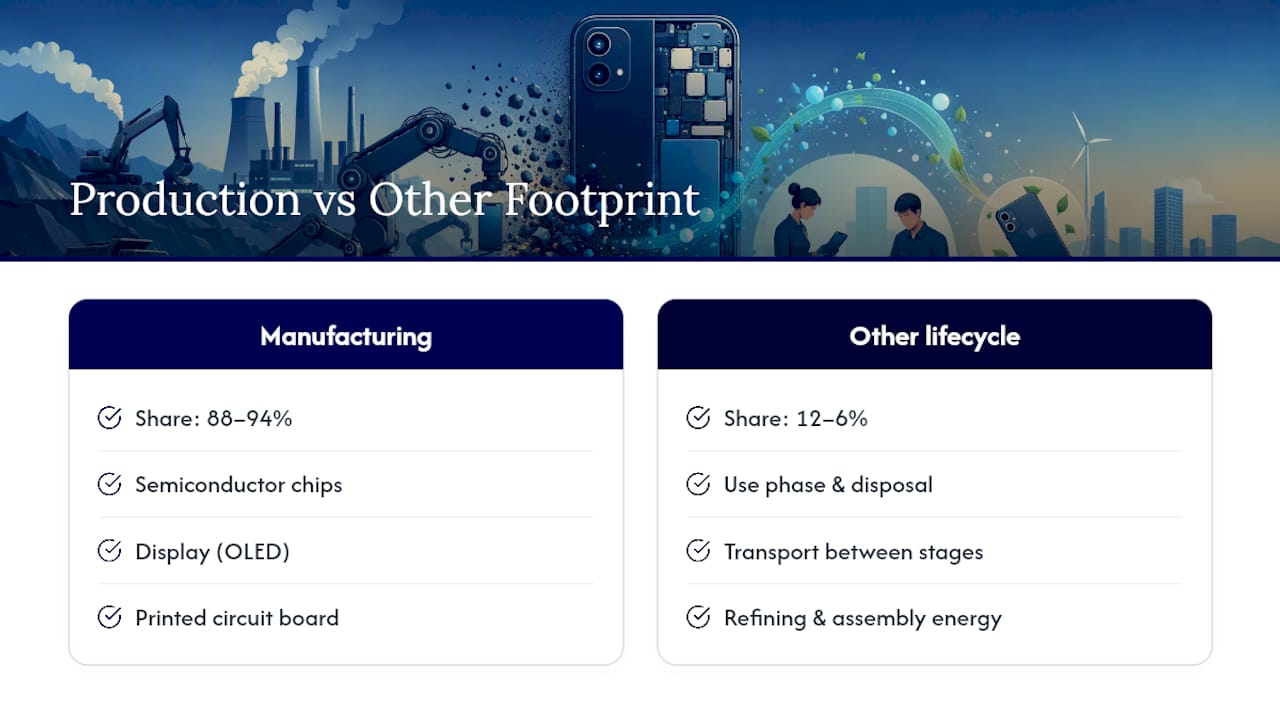
Chip fabrication is especially energy-hungry. Cleanroom manufacturing demands ultra-pure materials and enormous amounts of electricity, much of it still drawn from grids running on fossil fuels in the regions where fabs are concentrated. Displays carry a similar burden, particularly OLED panels that require rare metals and multiple deposition steps.
Then there’s the mining. Extracting cobalt, lithium, tin, tungsten, and gold for a single phone touches dozens of mine sites across multiple continents, and that extraction carries its own carbon cost plus documented environmental degradation, from deforestation to water contamination near mining regions. Transport compounds the problem: components often cross borders several times between mining, refining, sub-assembly, and final assembly before a phone ever reaches a store shelf. Every one of those legs adds emissions, and the electricity mix at each manufacturing stop, whether it’s coal-heavy or renewable-heavy, shifts the total substantially.
Does Charging Your Phone Actually Matter for Its Footprint?
Not much, on its own. Device-only use-phase emissions typically make up under 5% of a smartphone’s total footprint, according to the same product carbon footprint data. That’s a small slice next to manufacturing’s 88% to 94% share.
The picture changes once you count network infrastructure and data centers. Ericsson’s life cycle research on smartphones finds that including network impacts can multiply device-associated usage emissions by roughly three to four times for heavy data users. Streaming video for hours a day, or relying constantly on cloud backups, pushes real-world impact well above what device-only figures suggest. If you’re trying to trim use-phase emissions, cutting unnecessary streaming and offloading heavy uploads to Wi-Fi matters more than obsessing over charger wattage.
Does Buying Refurbished Actually Cut Your Carbon Footprint?
Yes, and the evidence is now specific enough to put a number on it. Recent market modeling on the U.S. second-hand smartphone market found that current reuse levels reduce per-user annual carbon footprints by about 34%, while cutting production-related emissions industry-wide by roughly 14%, according to research published in Communications Earth & Environment. That’s a meaningful dent, driven purely by fewer new devices needing to be manufactured.
But the same study found a catch: rebound effects erase a real chunk of that benefit. When people buy used phones cheaply, they sometimes replace them sooner than they would have replaced a new device, or spend the savings on other electronics. Shorter ownership spans on resold phones can cancel out close to half of the theoretical gains from reuse.
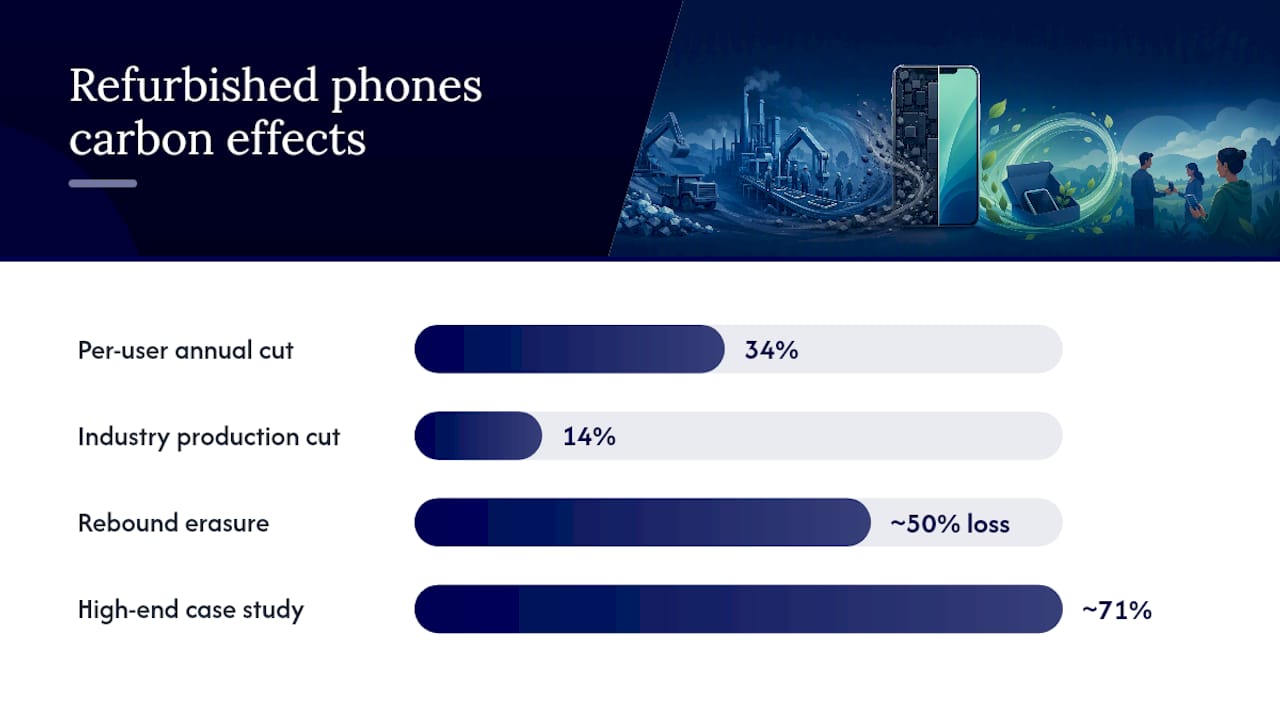
Peer-reviewed life cycle modeling backs up the underlying logic even where rebound isn’t a factor. A study on circular end-of-use scenarios for smartphones found repair and refurbishing scenarios can cut global warming potential substantially compared to buying new, with reductions reported in a broad range depending on conditions, depending on allocation method and how long the second life lasts. One case study on a refurbished high-end smartphone in Chile, documented in an LCA conference paper, found a significant reduction in global warming potential compared to buying new, with one supply chain study reporting around 71% and shouldn’t be read as a universal number.
What determines whether reuse actually delivers those gains or gets eaten by rebound:
- Keeping a refurbished phone for a full ownership cycle rather than flipping it again within months
- Buying from sellers who extend a phone’s usable life through real repair, not just a cosmetic wipe
- Choosing refurbished over new specifically to skip a purchase, not as an extra device
- Favoring sellers who use sea freight over air freight for cross-border logistics, which the same LCA research found can cut transport emissions per tonne-kilometer by a large margin, up to about 90%
The direction of the evidence is consistent across every study: extending a phone’s life, however you do it, beats replacing it. The size of the benefit just depends on how long that extended life actually lasts.
What Actions Cut a Phone’s Carbon Footprint the Most?
Given that manufacturing drives the overwhelming majority of a phone’s footprint, the highest-impact actions all point toward avoiding or delaying new production. Ranked by likely impact:
- Keep your current phone longer. Every extra year of use spreads that 40 to 80 kg CO2e manufacturing cost over more time, lowering the effective annual footprint.
- Buy verified refurbished instead of new. This is the single action with the clearest quantified backing, given the 34% per-user reduction found in recent market modeling.
- Repair rather than replace when a screen cracks or a battery degrades. LCA modeling shows repair scenarios often produce the largest percent reduction in warming potential among circular options.
- Choose repairable models with accessible batteries and available parts for your next purchase, so future repair stays realistic.
- Recycle through formal channels at true end of life, since UNEP reports less than 16% of global e-waste currently reaches formal recycling.
On daily habits: avoid letting your battery sit at 0% or 100% for extended periods, since heat and deep discharge cycles accelerate degradation, and skip fast chargers you don’t need. Neither habit moves your footprint dramatically, but battery health directly determines how many years you can realistically keep the phone.
Pro Tip: Before recycling a phone, check whether a refurbisher will buy it instead. A device with a cracked screen still has resale value in the refurbished market, and diverting it there avoids the “recycling” pitfall of shredding parts that still had years of life left. Our guide on e-waste smartphones and what eco-conscious buyers should do breaks down the disposal options in more depth.
How Should You Read a Smartphone LCA or Product Carbon Report?
Life cycle assessments draw their boundaries differently, which is the main reason figures for “the same” phone can vary by 20 or 30 kg CO2e across sources. Two allocation approaches dominate: first-user allocation assigns the full manufacturing burden to the original owner, while system expansion spreads that burden across every owner the device has over its full life. System expansion almost always makes refurbishment look more favorable, since it reflects the reality that a resold phone’s manufacturing emissions get divided among more users.
Transport assumptions, the local electricity mix at assembly plants, and which processes get included all shift the total further. When you read a PCF disclosure, check three things: whether network and data infrastructure are included or excluded, what end-of-life assumption was used (recycled, landfilled, or exported), and which allocation method applies. A number without those details is difficult to compare against anything else.
Why Verified Refurbished Devices Make Sense From Where We Sit
We built Devicegiant’s TrueGrade inspection around a 25-point checklist precisely because embodied emissions, the 88% to 94% locked into manufacturing, can’t be undone once a phone exists. A verified refurbished purchase, backed by a 90-day return window, lets you skip that manufacturing cost entirely while still getting a device confirmed to work. Our refurbished eco-friendly smartphones guide covers what “verified” should actually mean before you buy.
How Do Popular Smartphone Brands Compare on Carbon Footprint?
Direct brand-to-brand comparisons are harder than they should be, because manufacturers don’t all disclose PCFs using the same boundaries, and few publish every model. What the available disclosures show is a pattern more than a ranking: flagship phones with larger batteries, bigger displays, and more RAM consistently report higher total footprints than budget or mid-range models, regardless of brand.
Those numbers sit close enough together that the brand matters less than the device tier. A compact, lower-spec phone from nearly any major manufacturer will tend to report a smaller footprint than that brand’s own flagship, simply because it contains less material and less energy-intensive silicon.
The more useful comparison for a shopper isn’t “Brand A versus Brand B.” It’s new versus refurbished within the same brand and tier. A refurbished flagship almost always beats a new mid-range phone on lifecycle carbon, because the embodied manufacturing emissions of the flagship were already spent by someone else. If you’re comparing options, look for whichever manufacturers publish full PCF disclosures at all. Transparency itself is a decent proxy for a company taking the issue seriously, since plenty of brands still don’t publish anything comparable.
What Is the Industry Doing About Smartphone Emissions?
Regulatory pressure on smartphone carbon disclosure has picked up meaningfully. The European Union’s Ecodesign for Sustainable Products Regulation is pushing toward mandatory digital product passports and repairability scoring for electronics, a direct response to the manufacturing-dominant footprint pattern documented across the industry. France already requires a repairability index on phones sold at retail, giving shoppers a visible score before purchase.
On the corporate side, more manufacturers now publish detailed PCFs voluntarily, following Apple’s and Samsung’s lead in itemizing exactly where emissions occur across materials, manufacturing, transport, use, and end of life. These disclosures matter because they let researchers and buyers verify claims instead of trusting a vague “sustainability” label. Logistics improvements show up in these reports too. Several manufacturers now disclose shifting a larger share of shipping from air freight to sea freight, a change that LCA research shows can cut transport-related impacts by up to 90% per tonne-kilometer.
Trade-in and buyback programs have also expanded across the industry, functionally acknowledging what the second-hand market modeling shows: keeping devices circulating longer reduces aggregate demand for new manufacturing. None of this replaces the need for mandatory, standardized carbon disclosure across the whole industry, but the direction of movement is toward more transparency, not less.
Our Take: Skip the Vague “Buy Green” Advice
Most consumer advice on this topic stays frustratingly generic: recycle responsibly, buy energy-efficient devices, be mindful of your usage. None of that engages with what the research actually shows, which is that manufacturing so thoroughly dominates a phone’s footprint that almost nothing you do after purchase matters as much as the purchase decision itself.
The recent market modeling on rebound effects is the piece most advice ignores entirely. It would be easy to tell readers “buy used and you’ve solved it,” but the data says otherwise: refurbished buyers who flip their phones again within a year give back roughly half the potential benefit. The advice that actually holds up under scrutiny is less exciting than it sounds: buy refurbished, and then don’t treat it as disposable. Keep it the way you’d keep a new phone.
Where conventional wisdom gets it most wrong is treating recycling as the finish line. Recycling matters, but reuse and repair prevent the emissions recycling can never recover. Prioritize extending a device’s working life first. Everything else is a distant second.
— Saad
How to Choose a Verified Refurbished Phone
There are other ways to lower your next phone’s footprint, buying secondhand through marketplaces, repairing what you already own, or waiting out a longer upgrade cycle. But if you want the certainty of a working device without gambling on a stranger’s listing, verified refurbishment gets you there with a documented inspection standing behind it, not just a seller’s word.

Every device that goes out under a TrueGrade process gets checked against a 25-point functional inspection before it ships, and it comes with a 90-day return window if anything doesn’t hold up. That combination, disclosed cosmetic grading plus a real return policy, is what to look for from any refurbished seller. A guide to buying refurbished electronics without getting burned walks through the red flags to watch for elsewhere.
If you’re ready to make the swap, browse refurbished phones up to 70% off and filter by grade and carrier to find a device that fits your budget and your standards for build quality.
Sources
For deeper reading: the Communications Earth & Environment study on second-hand smartphones, the International Journal of LCA’s circular end-of-use modeling, UNEP’s e-waste reporting, Samsung’s Galaxy S26 environmental report, and the EPA carbon footprint calculator for comparing device impacts against household baselines.
- Why repair is the first step to tackling smartphone e‑waste (Trellis summary of product PCFs)
- Your phone is really smart — UNEP
FAQ
What Is the Biggest Source of Carbon Emissions on Earth?
Fossil fuel combustion for energy, industry, and transportation remains the largest global source of carbon emissions overall; individual consumer electronics like smartphones are a small fraction of that total, even though their manufacturing phase is emissions-intensive on a per-device basis.
Is ChatGPT or Google Search Worse for the Environment?
Reliable, directly comparable data on this specific question isn’t well established yet, and figures vary widely depending on query type and infrastructure assumptions, so no confident comparison can be made here.
Is Apple or Samsung More Ethical on Sustainability?
Both companies publish detailed product environmental reports and have expanded trade-in programs, but neither this article’s research nor available disclosures support ranking one company as more ethical overall.
Does Buying a Refurbished Phone Really Lower Emissions?
Yes. Market modeling found current U.S.


