
E-Waste Laws in the USA: What They Cover and What to Do

The United States has no federal law that requires you to recycle your old phone, laptop or TV. The binding rules come from the states, and they differ widely in which devices they cover, who can use the programs and what is banned from the trash. The simplest way to stay on the right side of all of them is to keep devices in use longer: pass them on, resell them, or buy refurbished instead of new.
TL;DR
- There is no federal e-waste recycling mandate for households. Federal hazardous waste law has a household exemption, so state law is what binds you.
- About half of U.S. states have electronics recycling laws, and many of them ban some electronics or batteries from landfills. Coverage, fees and who qualifies vary by state.
- Battery rules are the fastest-moving part: California added battery-embedded products on January 1, 2026, and Illinois, Washington and other states have staggered deadlines through 2028.
- Businesses face stricter rules than households. Devices sent to a reseller for reuse or repair are treated differently from devices thrown away.
- Reuse comes before recycling. A refurbished phone delays a device’s trip into the waste stream, which is the outcome these laws are built to protect.
Table of Contents
- Is there a federal e-waste law?
- What counts as e-waste?
- How state laws differ
- What changed in 2025 and 2026
- Rules for households
- Rules for small businesses
- Rules for resellers and repair shops
- Why reuse fits the direction of the law
- Find a verified refurbished phone
- FAQ
- Sources
Is there a federal e-waste law?
Not one that requires recycling. A Wharton analysis of U.S. e-recycling law found that the federal Resource Conservation and Recovery Act (RCRA) covers some toxic electronic waste, but there is no national program for collecting and recycling consumer electronics. A national bill aimed at responsible recycling stalled in a House subcommittee. The piece dates from 2016, and the national picture has not changed in that respect: states have filled the gap.
Two federal pieces are still worth knowing:
- The household exemption. RCRA’s hazardous waste rules exclude material that comes from homes. That is why a household is not breaking federal hazardous waste law by throwing out a device. State laws are the ones that can stop you.
- Universal waste rules. Under EPA’s universal waste framework (40 CFR Part 273), batteries are a universal waste category: devices made of one or more electrochemical cells that store and deliver electric energy. Universal waste rules streamline collection and handling instead of banning it, and some battery types, such as non-hazardous batteries, are excluded from the category.
There is one federal rule aimed at a specific product. EPA’s electronics stewardship page explains that a 2006 rule excluded used cathode ray tubes (the glass tubes in old TVs and monitors) from the definition of solid waste when conditions are met, and that 2014 revisions added export tracking for CRTs sent abroad for reuse or recycling. It matters mainly to people handling old tube TVs and monitors, not to anyone with a smartphone.
What counts as e-waste?
There is no single legal definition. Each state decides which products are covered, and the lists differ.
For a common baseline, EPA’s standardized terms for municipal recycling list electronics as computers and peripherals, drones, mobile devices, televisions and wearable electronics. Batteries are listed as rechargeable (lithium-ion, lead-acid, nickel-cadmium, nickel-metal hydride) or primary (alkaline, lithium, silver oxide), coming from small consumer electronics, large vehicles, personal electric mobility devices and other battery-operated household devices. Collection usually happens through transfer stations, retail bins and community events.
State definitions get more specific. California’s Department of Toxic Substances Control defines a covered electronic device as a video display device with a screen larger than 4 inches diagonally, or a covered battery-embedded product. The list includes monitors, TVs, laptops, tablets, smart displays, gaming devices and digital picture frames. California treats unwanted covered devices as universal waste, and they cannot go in household trash.
Wisconsin shows a different approach. Its Department of Natural Resources bans landfill or incinerator disposal of listed electronics: TVs, desktop and laptop computers, tablets, e-readers, monitors, printers, game components, DVD players, fax machines and cell phones, among others.
The practical lesson: a smartphone is covered by some state laws and not others, a screen over 4 inches is the line in California, and a cell phone is on Wisconsin’s list. Check your own state’s environmental agency page before you toss anything.
How state laws differ
Roughly half of U.S. states have their own electronics recycling laws, and they are built differently. Three features explain most of the variation.
Who pays
Some states put the cost on manufacturers, through extended producer responsibility (EPR): makers fund collection and recycling in proportion to what they sell. Others charge a fee at the register. California does the latter for covered devices.
Who can use the program
Most state programs are designed for households and, in many cases, schools and small organizations. California’s program is broader. In states where larger companies are not eligible, businesses have to arrange recycling commercially.
What is banned from the trash
Many states with programs also ban at least some electronics from landfills. A ban without a convenient drop-off would be unworkable, which is why bans usually come paired with a collection system.
If you live in a state with no program, nothing federal stops you from putting a phone in the trash. That does not make it a good idea: phones contain lithium-ion batteries, and damaged batteries are a fire risk in garbage trucks and sorting facilities.

What changed in 2025 and 2026
The energy has moved from classic electronics to batteries. California’s CalRecycle program page confirms that SB 1215 added covered battery-embedded products to the state’s Covered Electronic Waste Recycling Program effective January 1, 2026.
The Auto Sound & Security Association’s California summary explains that from that date a 1.5% recycling fee, capped at $15, is charged at the point of sale on covered battery-embedded products. Manufacturers must send retailers annual notices identifying covered and exempt products by brand and model.
Other states have staggered battery deadlines. According to Packaging Daily’s May 2026 report on state battery stewardship:
- Illinois requires distributor and retailer recycling programs from January 1, 2026, with a disposal ban from January 1, 2028 and civil fines of $7,000 per violation, which double if unpaid.
- Washington’s SB 5144 requires battery stewardship organizations to submit plans by July 1, 2026, with a portable-battery disposal ban on January 1, 2027.
- California’s AB 2440 battery producer responsibility begins no later than April 1, 2027.
- Connecticut and Nebraska have battery laws taking effect from 2027 into 2028.
- New Jersey’s 2024 EV and Hybrid Battery Management Act is the first state law to bring electric vehicle propulsion batteries into a stewardship scope.
The same report notes that most state battery programs rely on the threat of being barred from selling in the state, not only fines, to get producers to take part. For consumers, the effect is more collection points and, over time, more places where a dead battery cannot legally go in the bin.
Because deadlines move and bills get amended, treat any date here as a starting point and confirm it on your state agency’s page.
Rules for households
If you are an individual, the rules boil down to a short routine:
- Find out whether your state bans the device from the trash. Search your state environmental agency’s electronics page.
- Look for a program drop-off. Retail take-back bins, municipal events and transfer stations are the usual routes, as EPA’s list of collection methods shows.
- Wipe your data first. Sign out of your accounts and factory reset the device before it leaves your hands.
- Never put a swollen or damaged battery in a bin. Take it to a battery collection point, and keep it away from heat in the meantime.
The better move for a phone that still works is to sell it, trade it in or pass it on. A working phone is a product, not waste. Our guide to what eco-conscious buyers should do with e-waste smartphones walks through the options, and our explainer on refurbished versus recycled phones shows how the two routes differ.
Rules for small businesses
Business obligations are stricter than household ones, and they depend on the state. Three points matter most.
Hazardous waste determination. The household exemption does not apply to a company. In Wisconsin, for example, businesses must determine whether their electronic waste is hazardous under NR 662.011, and the listed electronics are banned from landfills and incinerators. Anyone who collects, stores, transports or processes used electronics must follow the applicable requirements.
Eligibility for state programs. Many programs are limited to households and small organizations. When your company has more employees than the program allows, you will need a commercial recycler, so check the employee threshold in your state before you drop off a pallet of old devices.
Retail registration in California. Retailers selling covered devices there collect point-of-sale fees and must register and file returns with the state tax agency. The ASA summary above describes the fee structure for covered battery-embedded products.
New York is one of the states with detailed business rules. A guide to New York’s electronics recycling law for businesses explains what companies in that state must do with their old equipment.
Businesses in the middle of an upgrade cycle often forget the other half of the equation: what they buy. A team that replaces phones every two years generates a steady stream of waste. Buying verified refurbished phones for new hires or field staff means fewer new devices manufactured and a lower cost per seat. Our guide to buying refurbished electronics online covers how to evaluate sellers.
Rules for resellers and repair shops
This is the section that matters most if you buy and sell devices for a living. EPA’s lithium-ion battery recycling FAQ states that electronics a business sends to a reseller for reuse, repurposing or repair are not solid wastes and are not subject to RCRA requirements, because repairing electronics before resale is not considered reclamation.
In plain terms, a device that is headed back into use is treated as a product. A device that is being discarded is waste. The line between them is intent and what actually happens to the device. That is why reuse channels can move working equipment without the paperwork that comes with disposal.
What a refurbisher or repair shop does need to manage:
- Batteries that fail inspection. Once a battery is pulled and discarded, it enters universal waste or state battery rules.
- Devices that cannot be repaired. These go to a recycler, and your state’s disposal bans apply.
- Retail obligations. If you sell in California, the fee and notification rules for covered products may apply to you.
If you resell, our wholesale and bulk lots are one way to source inventory that is already inspected and graded.
Why reuse fits the direction of the law
Every law above tries to do the same thing: stop devices and batteries from ending up in landfills and incinerators. Recycling is the safety net. The step before it is keeping the device working.

That is also where the money is. A phone you buy refurbished is one that did not need to be built from newly mined materials, and one that stays out of the waste stream for another cycle of use. The laws punish improper disposal, and nothing in them penalizes buying a used device.
For readers worried about quality, the useful questions are the ones that apply to any refurbished purchase: how the seller tests devices, how condition is described and how long you can return one. Our pieces on the refurbished return policy and how refurbished phone batteries are handled answer those. For the bigger picture, see how devices stay in use in a circular economy.
Our perspective
Laws set the floor. They tell you what you cannot throw away, but they say little about the more useful question: why is this device being replaced at all? Most phones that reach a recycling bin still have years of use in them.
That is why we built our business around reuse. Every device we sell goes through our TrueGrade 25-point functional inspection, and we grade the cosmetic condition individually, from A to D, so you know what you are getting before you order. We offer a 90-day return policy, and our devices cost up to 70% less than new.
Our view is simple. If you are going to buy a phone anyway, the choice that is best for your budget and the one that is best for the landfill are the same choice. Keep a good device in circulation, and the e-waste problem gets smaller by one phone.
Saad
Find a verified refurbished phone
If you are replacing a phone, tablet or watch, start with devices that are already built, tested and graded. At Device Giant, each one goes through the TrueGrade 25-point functional check, comes with disclosed cosmetic grading and is covered by a 90-day return policy. We carry iPhones and iPads, Samsung Galaxy phones, Android phones, tablets, smartwatches and chargers, in unlocked and carrier-specific versions.
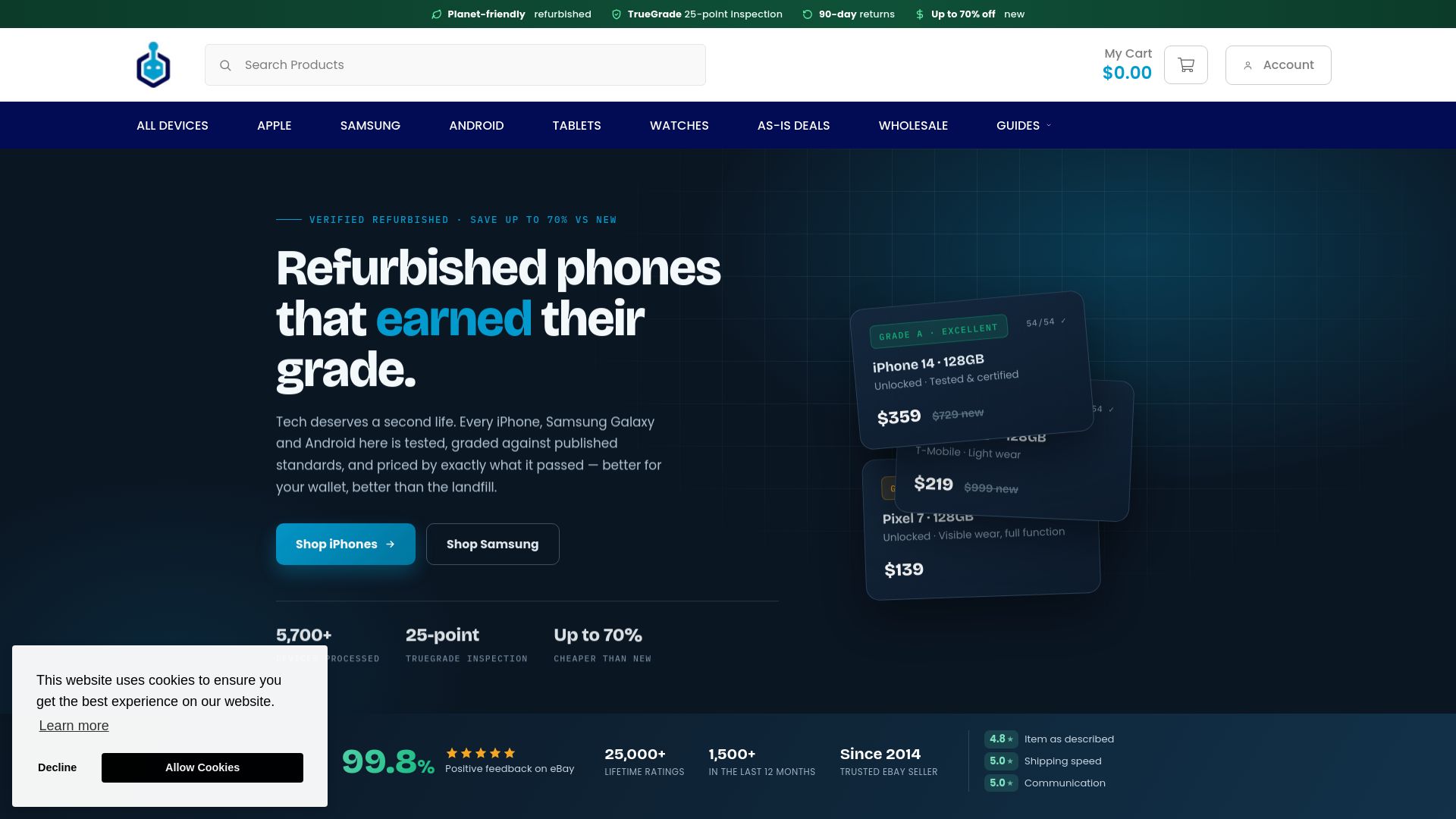
Browse the full range on the Device Giant store, or go straight to refurbished iPhones and iPads or Samsung Galaxy phones.
FAQ
Is e-waste recycling mandatory in the United States?
Not at the federal level. Federal hazardous waste rules exempt household waste, so no national law requires you to recycle a phone. State laws are where the requirements are, and many states ban at least some electronics or batteries from landfills.
How many states have e-waste laws?
About half of U.S. states have electronics recycling laws, and a smaller group of them ban some or all e-waste from disposal. The exact count changes as laws are amended, so check your state environmental agency’s page for the current list of covered devices.
Are smartphones covered by e-waste laws?
It depends on the state. Wisconsin lists cell phones among the electronics banned from landfills. California’s covered devices are defined by a screen larger than 4 inches diagonally, plus covered battery-embedded products, and mobile devices appear on EPA’s list of electronics for municipal recycling programs.
Do e-waste laws apply to businesses differently?
Yes. The household exemption does not cover companies, so a business may need to determine whether its electronics are hazardous waste and use an eligible program or a commercial recycler. Devices sent to a reseller for reuse or repair are not treated as solid waste under EPA’s guidance.
What is the best way to avoid creating e-waste?
Keep devices in use as long as they work, and buy refurbished when you upgrade. Recycling is the right end for a device that cannot be repaired, but extending a working phone’s life delays that point.
Sources
- How U.S. Laws Do (and Don’t) Support E-Recycling and Reuse, Knowledge at Wharton
- Universal Waste, U.S. EPA
- Regulations for Electronics Stewardship, U.S. EPA
- Standardized Terms for Materials Accepted by Municipal Recycling Programs, U.S. EPA
- Covered Electronic Devices, California DTSC
- Information for businesses that handle used electronics, Wisconsin DNR
- Electronic Waste Management, CalRecycle
- California E-Waste Compliance, ASA
- US State Battery Stewardship Fees Set for 2027-28, Packaging Daily
- Lithium-Ion Battery Recycling Frequently Asked Questions, U.S. EPA


