
Refurbished Phone Scams: How to Spot Them and Buy Safely

You avoid refurbished phone scams by checking three things before you pay: who the seller is, what “refurbished” means in their listing, and what happens if the phone is wrong. A seller who answers all three in writing, with a real return window and a payment method that protects you, is very unlikely to be a scam. A seller who dodges any of them is one you can skip. At Device Giant, every phone goes through a 25-point functional inspection called TrueGrade, is graded for cosmetic condition, and ships with a 90-day return policy, so the questions below have clear answers before you check out.
TL;DR
- Very low prices, no contact information and requests to pay outside the marketplace are the FTC’s classic warning signs.
- Ask what the seller means by “refurbished,” what the warranty covers and how returns work, and get the answers in writing.
- Run the phone’s IMEI through a stolen-phone checker and confirm the carrier lock status before you rely on the device.
- Pay by credit card. Never use gift cards, wire transfers, cash-reload cards or cryptocurrency.
- If something goes wrong, keep every record, dispute the charge and report the seller at ReportFraud.ftc.gov.
Table of Contents
- What a refurbished phone scam actually looks like
- Warning signs before you buy
- A five-step check you can do in ten minutes
- How to check the IMEI and lock status
- Understand what “refurbished” means, and what it should include
- Payment: the protection that matters most
- What to do if you were scammed
- Different buyers, different checks
- Perspective: why we publish the grade and the test
- Where to buy with these checks already answered
- FAQ
- Sources
What a refurbished phone scam actually looks like
Most people who say they were scammed on a refurbished phone describe one of a few outcomes:
- Nothing arrives. The listing was bait and the seller vanished.
- A counterfeit or stolen phone arrives. California’s Attorney General warns that a price that is too good to be true may mean the seller sends nothing, a counterfeit or a stolen item.
- The wrong phone arrives. The model, storage size or color differs from the listing, and the return is then made difficult.
- The phone works at first but has hidden problems. Typical examples are non-original parts, a weak battery or a lock that blocks your carrier.
- The “refurbished” label meant very little. The seller wiped the phone and put it back on sale with no real testing.
The first outcomes are outright fraud. The last ones are quieter: the seller never lied in a way you can prove, because “refurbished” has no single legal definition that every seller follows. That is why the BBB’s advice starts with finding out what the seller means by the word, plus checking the return policy and warranty terms.
The fix for both kinds is the same habit: treat every claim a listing makes as something you want to see written down.
Warning signs before you buy
You can rule out most bad listings in five minutes, before you enter any payment details.
The price is far below the market
Refurbished phones are legitimately cheaper than new ones. Device Giant, for instance, sells refurbished devices at up to 70% less than new. But a discount has a ceiling. If a recent flagship model is priced at a fraction of what every other seller asks, the savings are probably coming from the buyer’s pocket. The FTC lists very low prices among the signs of a marketplace scam. Compare the same model, storage size and condition grade across several sellers. The outlier is the one to question.
You cannot find who the seller is
The FTC also flags listings with no contact information. A legitimate store shows a business name, a working email or phone number and clear policies. The BBB adds that a suspicious site may show poor-quality photos, typos, missing or nonworking contact details, no reviews, scam complaints or a misleading web address. Look closely at the URL: one swapped letter or an odd ending on a familiar name is a common trick.
The seller wants you to pay somewhere else
If a seller on a marketplace asks you to move to text, email or a payment app, stop. The FTC warns that paying outside the marketplace can cost you the marketplace’s buyer protections. The same goes for any request to pay with gift cards, cash-reload cards, cryptocurrency or a wire transfer. Those methods are hard or impossible to reverse.
The condition is vague
“Like new,” “great shape” and “fully tested” mean nothing without a definition. A trustworthy listing tells you the cosmetic grade, what was tested, the battery situation, whether the phone is unlocked or tied to a carrier, and what accessories are included. Consumer Reports suggests asking about parts and accessories before buying, since certified resellers replace defective parts with new ones while non-certified sellers might use used parts.
There is no real return policy
The BBB singles out unauthorized third-party resellers that offer no returns as especially risky. A return window is the cheapest insurance you have, because it gives you time to find problems that a quick unboxing will not show.
A five-step check you can do in ten minutes
- Research the seller. Search the business name along with “reviews” and “complaints.” Read the BBB profile if there is one. Check that the website lists a physical business identity and working contact options.
- Read the condition definition. Find out how the seller grades phones and what testing each one gets. Device Giant publishes cosmetic grading from A to D, along with refurbished variants, and every phone gets the 25-point functional check, so the condition is stated before you buy.
- Get the warranty and return terms in writing. The BBB recommends obtaining warranty terms in advance. Warranty lengths differ from seller to seller, so compare the number of days, who pays return shipping and whether a refund or only a replacement is offered.
- Check the phone’s identity. Once the phone is in your hands, compare the serial number on the box with the one on the device, as New York City’s consumer protection department advises, and inspect the packaging, accessories, wear and damage before you accept the purchase. Then run the IMEI check described below.
- Pay with a credit card. This is the single most protective choice you control.
How to check the IMEI and lock status
Every phone has an IMEI, a unique 15-digit identifier that carriers use to recognize a device. A phone reported lost or stolen can be blocked from wireless service even if it looks perfect on your desk. Our guide explains what an IMEI number is and how to find the IMEI on your phone. On most phones you can dial *#06# to display it.
Then run it through a checker. The US wireless industry’s trade association, CTIA, launched a free Stolen Phone Checker that accepts an IMEI, MEID or ESN and shows whether a used or refurbished phone has been reported lost or stolen. A red result indicates wireless service may be blocked. Our walkthrough of what an IMEI check reveals covers how to read the results, and the red flags before you buy section is worth a minute if you are buying from an individual rather than a store.
Do this within your return window. If the IMEI shows a problem, you want to learn it while a refund is still possible.
Also confirm the lock status. An unlocked phone works with any compatible carrier. A carrier-specific phone works with the carrier named in the listing. Neither is better in itself, but the listing should say which one you are getting, and it should match your plan. Device Giant offers both unlocked and carrier-specific devices and states which is which on each product page.

Understand what “refurbished” means, and what it should include
There are broadly three kinds of sellers: the phone’s maker, a retailer selling certified refurbished stock, and independent resellers. Quality and policies vary within each, so the useful question is not who sells it but what was done to the phone.
A solid refurbishment should include:
- Functional testing. Screen, touch, cameras, speakers, microphones, buttons, charging port, wireless connections and battery are all checked. TrueGrade runs 25 functional checks on every Device Giant phone.
- A separate cosmetic grade. Scratches and wear do not affect function, but they affect price and your expectations. A to D grading lets you choose how much cosmetic wear you accept in exchange for savings.
- Disclosed compatibility. Carrier lock, storage and model details are stated.
- A return window long enough to test. At 90 days, our return policy gives you time to use the phone through a full billing cycle, a few battery cycles and varied conditions.
Warranty periods are not standardized. Consumer Reports notes that refurbished warranty lengths vary by seller, so compare the number of days and what the coverage includes rather than assuming.
Payment: the protection that matters most
The FTC advises paying with a credit card or a secure online payment system that protects buyers. Credit and debit card payments can be disputed if the product never arrives or is not as described. California’s Attorney General likewise recommends using a credit card and checking your statements for unexpected charges.
Practical rules:
- Use a credit card rather than a debit card when you can. A dispute is then about the card company’s money, not yours.
- Keep the entire transaction on the platform where you found the listing.
- Never pay with gift cards, cash-reload cards, cryptocurrency or wire transfers.
- Save the listing (a screenshot with the price and description), your receipt, tracking information and every message.
What to do if you were scammed
If the phone is fake, wrong, defective or never came, act in this order. Time matters because return and dispute windows close.
- Contact the seller and, if you bought on a marketplace, the marketplace. Do it in writing and keep copies. Note the return, refund and help deadlines the platform sets.
- Dispute the payment. If you paid by credit or debit card, call the card issuer and dispute the charge. The FTC notes that you can withhold payment on the disputed amount while the issuer investigates.
- Build your file. California’s Attorney General stresses keeping the advertisement, price, receipt, communications and statements so your dispute or complaint has support.
- Report it. Report the seller to the marketplace, a dishonest business to ReportFraud.ftc.gov, and notify your state attorney general. Reports help investigators spot patterns even when your own case takes time.
If the phone arrives and simply is not what the listing said, do not wait. Start the return inside the seller’s window, and photograph the phone, box and serial number first.
Different buyers, different checks
Price-sensitive shoppers. Savings are real, but only if the phone lasts. Prioritize the return window and a stated battery and function check over the last few dollars of discount.
Eco-conscious shoppers. Buying refurbished keeps a working device out of the e-waste stream. That benefit only holds if the phone stays in use, which is another reason to buy one that has been fully tested and graded rather than gambling on an unverified listing.
Small business owners. Buying for a team means every phone needs a known carrier status and a consistent condition. Ask for the same grade across the order and confirm lock status per device. Device Giant sells wholesale and bulk lots.
Resellers and repair shops. Run an IMEI check on every unit in a lot before you resell it, since you inherit any problem the phone carries. Confirm the grading scale and what the inspection covered before you commit to quantity.

Tech-savvy upgraders. You will want the exact model, storage size, lock status and cosmetic grade. A listing that does not state all four is not detailed enough to buy from.
Perspective: why we publish the grade and the test
Scams in refurbished phones thrive on one thing: a buyer cannot see inside the phone, so they have to take the seller’s word. Our answer is to make the word checkable.
Every device we sell goes through TrueGrade, a 25-point functional inspection, and gets its own cosmetic grade. We state the condition on the listing, along with whether the phone is unlocked or tied to a carrier. You should not have to guess what you are buying.
We also think the return window should be long enough to find real problems. Ours is 90 days, which is longer than most sellers give. Our 99.8% positive feedback on eBay comes from people who got the phone they expected, and that is the standard we hold ourselves to.
A refurbished phone is a good purchase when it is tested, honestly graded and backed by a return policy. That is also the greener choice, because a phone that works keeps another one out of the landfill.
Saad
Where to buy with these checks already answered
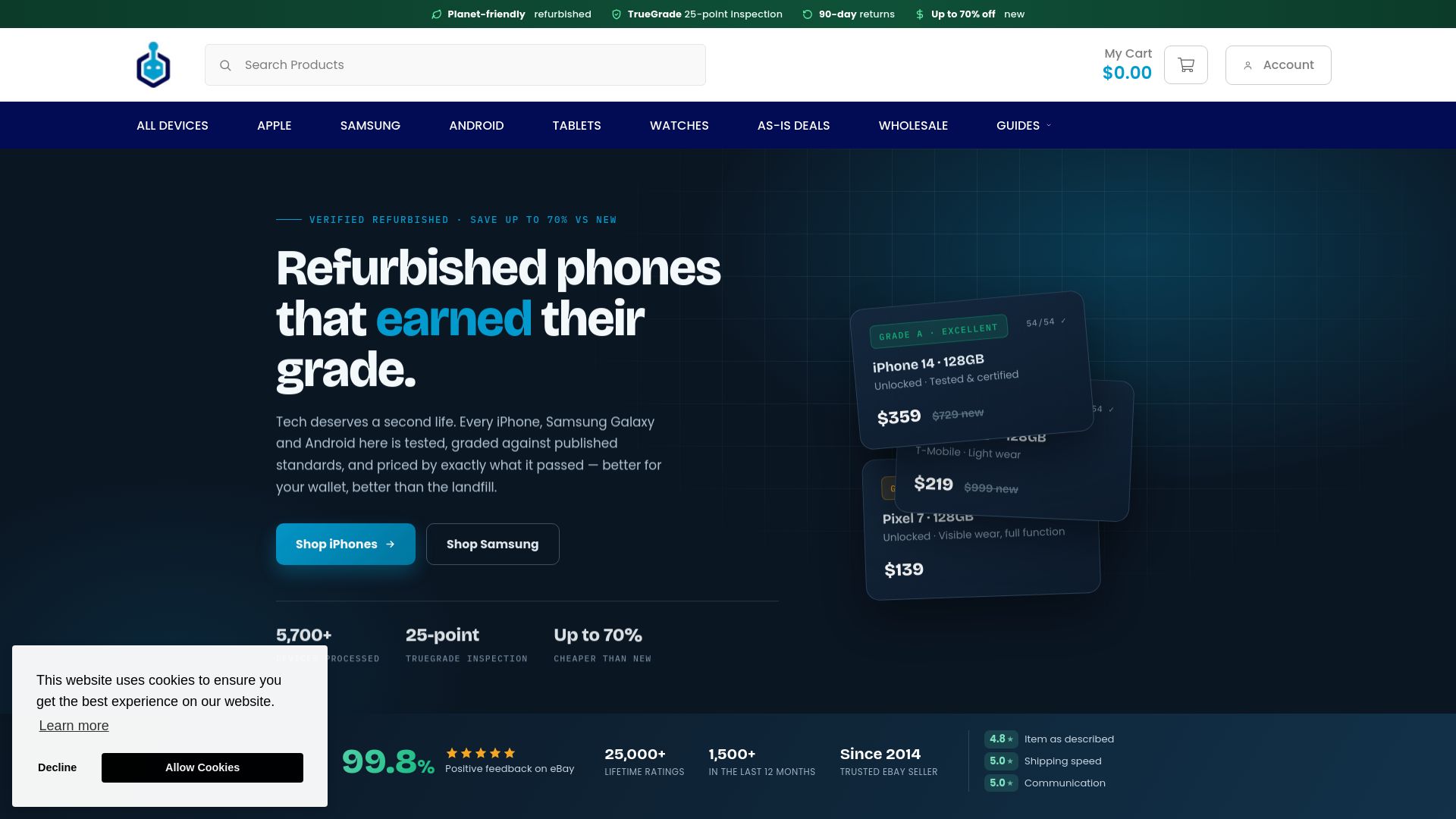
If you would rather not run every check against an unknown seller, our store is built around them. Each phone, tablet and smartwatch has the 25-point functional check, a disclosed cosmetic grade and a 90-day return policy behind it. You can browse refurbished phones up to 70% off, or go straight to a category such as refurbished Samsung Galaxy phones, unlocked Android phones or refurbished iPads.
Buying for a business or for resale? Our wholesale and bulk section is on the same site.
FAQ
Are refurbished phones a scam?
No. Refurbished phones are a legitimate way to save money, and the BBB’s guidance for buyers is to learn the seller’s definition of “refurbished,” check the return policy and warranty, and pay by credit card. The scams come from fake sellers and vague listings, not from the category.
How can I tell if a refurbished phone is stolen?
Find the IMEI by dialing *#06# or in the phone’s settings, then enter it in a stolen-phone checker such as the free one from the wireless industry’s CTIA. A red result indicates that service may be blocked. Do this inside your return window.
What is the safest way to pay for a refurbished phone?
A credit card, or a secure payment system that protects buyers, and always inside the marketplace where you found the listing. Gift cards, wire transfers, cash-reload cards and cryptocurrency are the methods the FTC warns against, because they are very hard to reverse.
What should I do if the phone never arrived or is not as described?
Contact the seller and the marketplace in writing, then dispute the charge with your card issuer and keep your records. Report a dishonest seller at ReportFraud.ftc.gov and to your state attorney general.
Sources
- Buying From an Online Marketplace, Federal Trade Commission
- Online Purchases, California Attorney General
- BBB Scam Alert: How to spot a scam when shopping for refurbished products
- Shopping for Electronics, NYC Department of Consumer and Worker Protection
- CTIA announcement of the free Stolen Phone Checker
- Should You Buy Refurbished Electronics?, Consumer Reports


