
Phone Unlocking Laws in the USA: What Your Rights Are

Unlocking a phone you own is legal in the United States. No federal law makes a carrier unlock every phone on a fixed schedule, though. Your real rights come from a 2014 federal law and from each carrier’s own policy, and those policies differ. If you are buying a phone to use on any network, the simplest route is to buy one that is already unlocked, with its condition and compatibility stated before you pay. That is how we sell at Device Giant.
TL;DR
- Unlocking is legal. A 2014 federal law lets the handset owner unlock a used phone when the carrier authorizes connection.
- The FCC’s 60-day uniform unlocking rule was proposed in 2024 and is not a final nationwide mandate.
- Each carrier sets its own conditions: paid-off financing, an account in good standing, a minimum number of active days, and no lost or stolen report.
- Unlocking removes the software lock only. The phone still has to support the new carrier’s network bands.
- Check the lock status and the bands before you buy a used or refurbished phone.
Table of Contents
- Is it legal to unlock a phone in the US?
- The carriers’ voluntary standards
- Where the FCC’s 60-day rule stands
- What each major carrier requires today
- How to unlock a phone you already own
- Unlocked does not mean it works everywhere
- Buying an already unlocked phone
- We think the lock should never be your problem
- Unlocking laws are not the same as other phone laws
- FAQ
- Sources
Is it legal to unlock a phone in the US?
Yes. The Unlocking Consumer Choice and Wireless Competition Act, Public Law 113-144, was enacted on August 1, 2014. It allows specified persons, including the handset owner, to circumvent the lock on a used wireless handset when the network operator authorizes connection. The Copyright Office’s rule at 37 C.F.R. § 201.40 reflects the same exemption.
This matters because unlocking software could once raise copyright-circumvention questions. The 2014 law settled that for ordinary owners. You are not breaking the law by unlocking your own phone, and you are not breaking it by buying a phone that has already been unlocked.
The law does not oblige a carrier to unlock on request at any moment. It protects your right to unlock. The conditions for when a carrier does it are set elsewhere.
The carriers’ voluntary standards
The other piece dates to the same year. On February 11, 2014, the wireless industry association CTIA adopted six voluntary unlocking standards, which the FCC’s cell phone unlocking page records. They cover disclosure, postpaid unlocking, prepaid unlocking, notice, response time, and unlocking for deployed military personnel.
In plain terms, the standards say:
- Postpaid: a carrier unlocks once the service contract or device-financing plan is fulfilled, or an early termination fee is paid.
- Prepaid: a carrier unlocks no later than one year after activation, subject to reasonable time, payment or usage requirements.
- Notice: a carrier that locks devices must either tell you when you are eligible or unlock the device remotely without an extra fee.
- Fees: a carrier may charge a reasonable fee to people who are not, and never were, its customers.
These are industry commitments, not statutes. That is why the details differ from one carrier to the next.
Where the FCC’s 60-day rule stands
Search results on this topic can look contradictory, so here is the sequence.
In 2024 the FCC proposed a uniform framework requiring providers to unlock handsets within 60 days of activation. A proposal is not a rule. According to the FCC’s January 2026 announcement, on January 12, 2026 it granted Verizon a waiver from the 60-day handset-unlocking requirement. That requirement had come from a condition attached to Verizon’s TracFone acquisition. The waiver lets Verizon align with the CTIA Consumer Code while the FCC considers an industry-wide approach.

The FCC’s waiver order states that the industry-wide proceeding remained pending. So as of today, there is no final nationwide 60-day mandate. Later 2026 reporting described continued pressure from Congress for action, including a 180-day proposal, but nothing final has replaced the carriers’ own policies.
The proposal also contemplated a fraud exception. Under it, a provider could refuse to unlock a handset if it determined within the 60 days that the device had been obtained through fraud, according to a legal analysis of the 2024 proposal.
What to do with this: plan around your carrier’s published policy, not around a rule that may or may not arrive.
What each major carrier requires today
Policies change, so treat the figures below as a snapshot and confirm on the carrier’s page before you act.
| Carrier | Postpaid conditions | Prepaid conditions |
|---|---|---|
| Verizon | Unlocks automatically when the phone was bought at full retail price or the financing balance is paid in full. Lost or stolen devices stay locked until the report is cleared. | Locked until 365 days of paid and active service. |
| AT&T | Bought more than 60 days ago, paid in full, not active on another AT&T account, not reported lost, stolen or involved in fraud. | 12 months of paid service, no association with another AT&T account, no lost, stolen or fraud report. |
| T-Mobile | Sold by T-Mobile, not reported lost, stolen or blocked, account in good standing, active on the line for at least 40 days, paid in full if financed or leased. | Generally 365 days since activation, with stated exceptions. |
The sources, in the same order: Verizon’s device unlocking policy (updated February 18, 2026), AT&T’s unlock page (updated June 29, 2026), and T-Mobile’s SIM unlock policy.
Details that trip people up
Gift cards. Verizon says a purchase or payoff made with a gift card delays unlocking by 35 days while it verifies the payment source. If you are paying off a phone to unlock it, a card payment avoids that wait.
Canceled accounts. T-Mobile requires a zero balance on a canceled account before it will unlock a device.
T-Mobile prepaid exceptions. If the line was activated less than 365 days ago, T-Mobile asks for more than $100 in refills during that period for each active line. More than 14 days must have passed since purchase, and no more than two unlocks may have been completed per line in the prior 12 months.
Lost or stolen reports. Every carrier above keeps a device locked while a lost or stolen report is open. This is the one condition you cannot fix by paying.
Verizon and re-locking. Verizon says it will not re-lock a device once it has been unlocked.
The 2026 waiver changes how Verizon may handle new devices going forward, so read its current page for the rule that applies to the phone in your hand.

How to unlock a phone you already own
The routine is the same at every carrier. Skipping a step is what causes delays.
- Confirm who the phone is locked to. On an iPhone, go to Settings > General > About. AT&T says the Carrier Lock line shows the status, and “SIM locked” means locked. A line reading “No Restrictions” suggests the phone is unlocked, according to US Mobile’s compatibility guide. On Android, inserting a SIM from another carrier is a practical test. Only the carrier can confirm the status for certain.
- Check the account. Is the financing paid off? Is the account in good standing? Has the minimum number of days passed? Use the table above.
- Make sure the phone is not reported lost or stolen. If it is, the lock stays until the report is cleared.
- Request the unlock from the carrier that locked it. Many carriers notify you or unlock automatically once you qualify. Where they do not, use the request form on their support page. A carrier that locks devices must give notice of eligibility or unlock remotely without an extra fee under the CTIA standards.
- Restart and test with the new SIM or eSIM. Make a call, send a text and load a page over mobile data.
If you are not eligible yet, the usual causes are an unpaid balance, too few active days, or a payment method that triggers a verification wait. Fix the cause, then ask again.
Unlocked does not mean it works everywhere
This is the part many buyers miss. According to the FCC, unlocking disables the software that stops a phone from working on another compatible network. It does not make the phone technologically compatible with every carrier, and some functions may not work.
A phone’s radio supports a specific set of bands. If it lacks the bands your new carrier uses for coverage in your area, an unlocked phone can still give you weak signal or no 5G. Before you switch, compare the phone’s supported bands with the carrier’s network. Our guide on verifying unlocked phone bands walks through it, and the T-Mobile compatibility guide shows how to run an IMEI check.
For activation, the same T-Mobile guide covers SIM, eSIM and porting once the phone is unlocked.
Buying an already unlocked phone
Everything above applies when a carrier sold you a locked phone. If you are buying a used or refurbished phone, the cleanest answer is to avoid the unlock process by choosing a phone that arrives unlocked. Then you do not depend on a prior owner’s account, balance or carrier policy.
What to look for in a listing:
- The lock status stated plainly: unlocked or tied to a named carrier.
- The cosmetic condition disclosed, not implied.
- A functional inspection record, not just a quick power-on test.
- A return window long enough to test the phone on your own network.
At Device Giant, every phone goes through our TrueGrade 25-point functional inspection and gets an individual cosmetic grade from A to D, with refurbished variants. We sell both unlocked and carrier-specific devices, so the listing tells you which you are getting. Orders carry a 90-day return policy, which gives you time to confirm signal and features on your own carrier.
Browse unlocked refurbished iPhones and iPads, refurbished Samsung Galaxy phones, or refurbished Android phones. Our products are offered at up to 70% less than new.
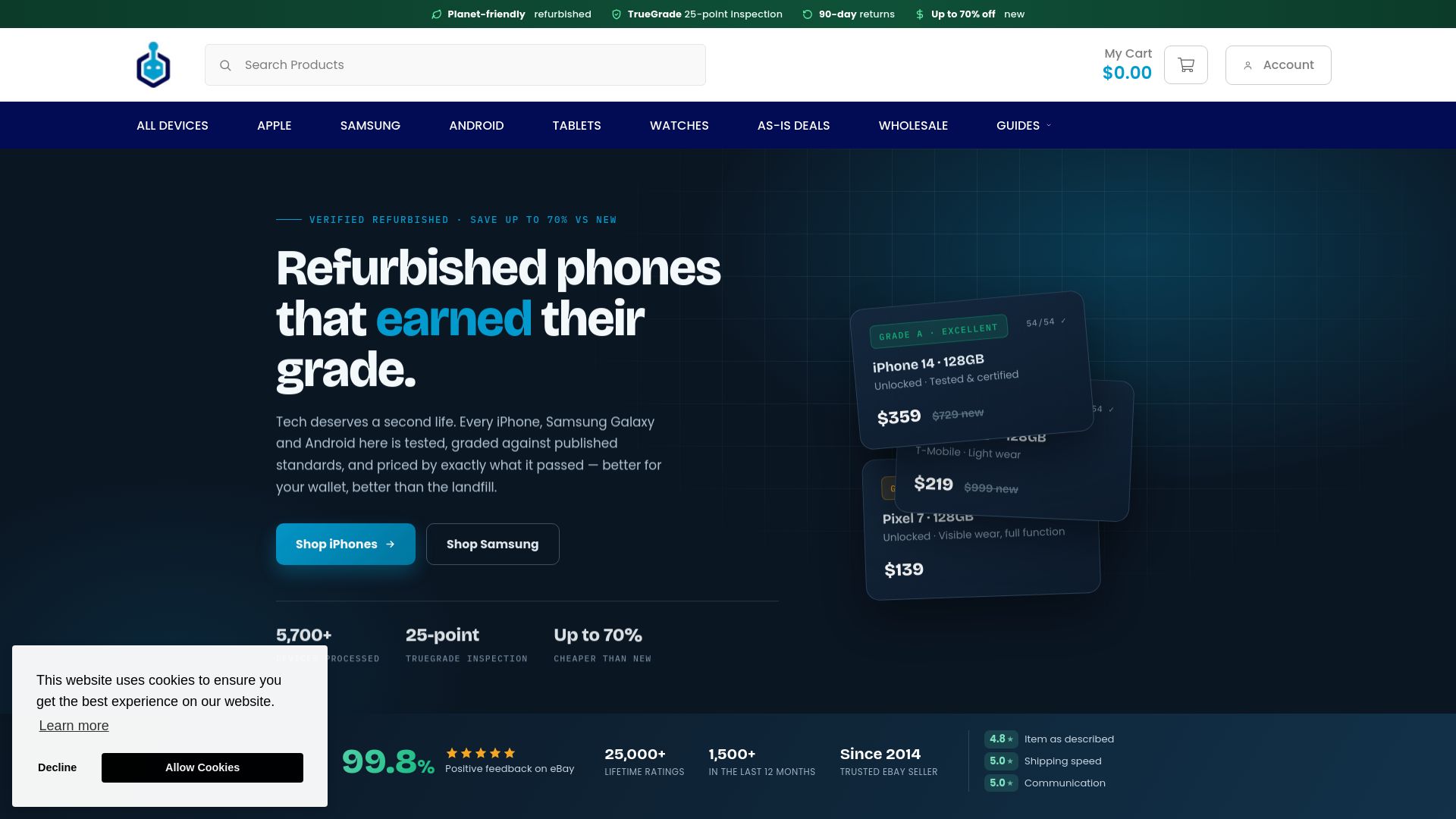
If you run a repair shop or resell phones, we also sell wholesale and bulk lots from the Device Giant store.
We think the lock should never be your problem
Most of the confusion we see in this topic comes from one fact: the law protects your right to unlock, but it does not hand you a phone that is ready to use on any network. That gap is where buyers lose time and money.
We built our process so the gap closes before the phone ships. Each device gets the TrueGrade 25-point functional check, each gets a disclosed cosmetic grade, and the listing says whether it is unlocked or tied to a carrier. You should know what you are buying before you pay, not after a week of calls to a carrier.
The 90-day return policy is part of the same idea. A phone can look compatible on paper and still disappoint on your street. Ninety days is enough time to find out. Buying refurbished also keeps a working phone out of the landfill, which matters to us as much as the savings.
Saad
Unlocking laws are not the same as other phone laws
Some people searching this topic are really after something else. State phone laws, such as restrictions on handheld use while driving, are traffic-safety rules that vary by state, as in this AAA overview of state traffic safety laws. They have nothing to do with carrier locks. If you need to know whether a rule applies where you drive, check your state’s current law.
FAQ
Is it illegal to unlock my phone in the US?
No. Since the 2014 federal law, owners can unlock a used phone when the carrier authorizes connection. You can also use a phone that someone else has already unlocked. The carrier’s conditions decide when it will do the unlocking.
Do carriers have to unlock my phone after 60 days?
Not under a final nationwide rule. The FCC proposed a 60-day framework in 2024, and its January 2026 order says the industry-wide approach is still pending. Verizon received a waiver on January 12, 2026. Your carrier’s published policy is what applies.
How do I know if my phone is locked?
On an iPhone, open Settings > General > About and look at the carrier lock line. On Android, try a SIM from another carrier. Only your carrier can confirm the status with certainty.
Will an unlocked phone work on any carrier?
Not always. Unlocking removes the software restriction, but the phone must support the new carrier’s bands and technology, and some features may not work. Check the supported bands before you switch.
What if my carrier says the phone is not eligible?
Find the unmet condition. Common ones are an unpaid balance, too few active days, a gift-card payment still being verified, or an open lost or stolen report. Resolve it, then ask again.
Sources
- Exemption to Prohibition on Circumvention of Copyrighted Works, wireless phones (U.S. Copyright Office)
- Cell Phone Unlocking (Federal Communications Commission)
- FCC Acts to Bring More Uniform Approach to Handset Unlocking Rules
- FCC Waiver Order DA 26-43
- Nelson Mullins analysis of the 2024 handset unlocking proposal
- Verizon Device Unlocking Policies
- AT&T unlock policy page
- T-Mobile SIM Unlock Policy
- US Mobile device compatibility help page
- AAA State Traffic Safety Laws


