
Check IMEI First: Trusted Refurbished Sellers, Demand 25 Point Tests

The sellers worth trusting are the ones that publish a real inspection checklist, state clear warranty and return terms, and let you verify the device’s IMEI or serial number before you pay. Before checkout, confirm the return window in writing and run an IMEI check against the carrier status. Everything else, including price, matters less than these two checks.
TL;DR:
- Verify the seller provides a published inspection checklist that details tested components like batteries, screens, and ports before purchasing.
- Confirm cosmetic grading matches actual photos of the device and avoid listings that rely solely on stock images, which may hide condition issues.
- Check that the IMEI or serial number is listed or provided to run a carrier status check, ensuring full compatibility with your network.
- Use the return window immediately after arrival to test all functions, verify device condition, and document discrepancies before it expires.
- Prioritize seller transparency over brand reputation, favoring those who openly disclose inspection results, test data, and detailed warranty coverage.
Table of Contents
- What makes a refurbished seller trustworthy
- What to confirm on the listing before you pay
- Checks to run the moment your device arrives
- Reading warranty and return terms so they actually help you
- Picking the safest way to pay
- Red flags that signal a risky refurbished seller
- Why verification matters more than brand reputation alone
- Shopping for an inspected refurbished device
- FAQ
- Sources
What makes a refurbished seller trustworthy
A trustworthy seller gives you information you can verify, not just promises. The strongest signal is a published inspection process that names what gets tested: battery health, screen condition, ports, sensors, buttons, and any prior repairs. A vague “fully tested” label without specifics is a weak signal on its own.
Cosmetic grading should match what you actually see. Sellers who grade condition honestly (and show real photos of the specific unit, not stock images) give you a far better idea of what arrives at your door. The Federal Trade Commission warns that listings using only stock photos prevent buyers from checking the actual item they’re purchasing, which is one of the simplest ways a seller can hide condition problems.
Warranty and return terms should be easy to find, not buried in a footer link. Look for the specific coverage window, what voids it, and who pays for return shipping if a problem shows up. A seller that makes these terms hard to locate is telling you something about how disputes will go later.
Beyond the listing itself, a few other traits separate reliable sellers from risky ones:
- A real business identity: a physical address, a working support line or chat, and a way to reach a person if something goes wrong.
- Trackable shipping with delivery confirmation, not just a promise that the item shipped.
- Third-party reputation you can check independently, such as marketplace ratings, rather than testimonials the seller controls.
- Clear dispute mechanisms through the marketplace itself, separate from the seller’s own promises.
The FTC also recommends checking seller ratings and reading recent buyer comments from multiple sources, since some reviews can be fake or incentivized. A single five-star average means less than a pattern of detailed, specific feedback from recent buyers. Sellers with a long history of consistent ratings across hundreds or thousands of transactions are generally a safer bet than newer accounts with a handful of glowing reviews and no track record to examine.
What to confirm on the listing before you pay
Treat the listing itself as your main source of evidence. Work through these checks in order before you commit to a purchase:
- Confirm the IMEI or serial number is listed, or ask the seller to provide it, so you can run a status check before paying.
- Match the exact model number to your carrier’s required bands and confirm eSIM support if you need it; an “unlocked” label doesn’t always mean full compatibility.
- Request dated photos of the actual unit if the listing only shows stock images, including close-ups of the screen and back panel.
- Ask for a detailed description of battery health and exactly what accessories are included in the box.
- Read the warranty exclusions and return deadline carefully, and note in writing who covers return shipping costs.
- Pay with a method that offers buyer protection rather than a direct bank transfer or gift card.
- Save a screenshot of the full listing and keep a copy of every message exchanged with the seller.
The FCC notes that compatibility issues are a frequent subtle failure: a phone labeled “unlocked” can still lack the bands a specific carrier needs, so checking the exact model number against your carrier’s requirements matters more than trusting the label alone. A practical explainer on eSIM compatibility is worth a quick read if you’re buying a device that relies on it, since eSIM support varies by model and region.
Checks to run the moment your device arrives
Your return window is the most valuable protection you have, so use it immediately rather than letting the device sit in a drawer for a month. Start with a factory reset and walk through the activation flow to confirm the device isn’t locked to someone else’s account.
From there, Consumer Reports recommends testing every major function right away: connect to Wi-Fi and cellular service, insert your SIM or activate your eSIM, and test the cameras, speakers, microphones, buttons, biometric sensors, Bluetooth, charging, and storage capacity. A device that passes a quick power-on test can still fail several of these in the first hour of real use.
Check that the IMEI or serial number printed in the device settings matches what was listed, and run a carrier status check if one is available. Compare the battery health reading and the cosmetic condition against the photos from the original listing, and photograph anything that doesn’t match.
If something is wrong, contact the seller immediately with timestamped photos and a clear description of the issue. If the seller doesn’t respond or refuses a reasonable fix, open a dispute through the marketplace or your payment provider before the window closes. Waiting past the return deadline, even by a few days, can cost you the entire protection you paid for.
Reading warranty and return terms so they actually help you
A longer warranty period sounds reassuring, but Consumer Reports points out that warranty length alone is a weak way to judge a seller. What matters more is what the warranty actually covers and how easy the claims process is when something breaks.
Before you rely on any warranty, check these details:
- Compare coverage scope, not just duration: battery degradation, liquid damage, and cosmetic wear are commonly excluded even on longer warranties.
- Identify who is actually responsible for repairs, the seller or a third-party service center, and whether they can offer a repair instead of a refund.
- Know the specific dispute windows for both the seller’s policy and your marketplace’s buyer protection, and keep every record until that window closes.
- Treat your credit card’s purchase protection and your marketplace’s own guarantee as backup options if the seller refuses a fair resolution.
The FTC’s guidance on warranties notes that companies may have the right to attempt a repair before issuing a refund, so knowing who to contact and keeping detailed records from day one puts you in a much stronger position if a claim gets contested.
Picking the safest way to pay
Credit cards and platform-managed payment systems give you leverage that a bank transfer or payment app simply doesn’t. If a seller never delivers or misrepresents the item, a credit card chargeback gives you a path to recover your money that direct payment methods don’t offer.
Before you buy, read the marketplace’s buyer guarantee closely: what it covers, what it excludes, and the exact deadline for filing a claim. If the seller doesn’t resolve a legitimate problem, escalate to your bank or card issuer for a chargeback, and contact your state consumer protection office if the pattern looks like fraud rather than a one-off mistake. A guide to protecting your identity during online purchases covers practical habits worth adopting, including saving listing snapshots, receipts, and every message with the seller before a dispute ever becomes necessary.
Red flags that signal a risky refurbished seller
Some warning signs show up before you ever click “buy,” and they’re worth taking seriously rather than explaining away.
- Listings that use only stock photos instead of images of the actual unit, which the FTC flags as a common way sellers hide real condition.
- Prices far below every comparable listing, which can indicate a counterfeit, a stolen device, or a bait-and-switch scheme.
- Sellers who push you to pay off the marketplace, since that strips away the buyer protections the platform would otherwise provide.
- Sellers who change the agreed price or condition after you’ve already shipped a trade-in or made a deposit.
That last pattern isn’t hypothetical. The FTC and the State of Georgia charged operators of an electronics buyback scheme with lowering quoted payouts after consumers had already sent in their devices, then making it difficult to get the devices back. If you notice any of these behaviors, stop communicating, preserve every message and screenshot, and report the seller to both the marketplace and the FTC.
Why verification matters more than brand reputation alone
The refurbished market rewards sellers who are willing to show their work. A brand name or a polished storefront tells you very little compared to a published inspection checklist you can actually read before you buy. The sellers worth trusting are the ones willing to tell you exactly what they tested and exactly what they didn’t.

This is where a standard like a detailed multi-point inspection checklist becomes genuinely useful. It gives you a concrete list to compare against any seller’s claims, battery health, screen integrity, port function, sensor accuracy, prior repair history, and more, rather than taking “like new” at face value. Pair that with a return window longer than typical short periods, and you have a seller that’s giving you real room to catch problems a quick unboxing might miss.
My advice after years of watching how refurbished disputes actually play out: favor unit-level transparency over marketing language every time. A seller willing to show you the specific device, with specific test results, is telling you something a generic product photo never will.
— Saad
Shopping for an inspected refurbished device
We built our process around the checklist above because we think it’s the right standard for this category, not just a marketing angle. Every device we sell goes through our TrueGrade detailed functional check covering battery health, screen condition, ports, buttons, sensors, and more, and each unit gets an individual cosmetic grade so you know exactly what you’re receiving before it ships. We back every purchase with a return policy, and we disclose device condition and carrier compatibility clearly on every listing.
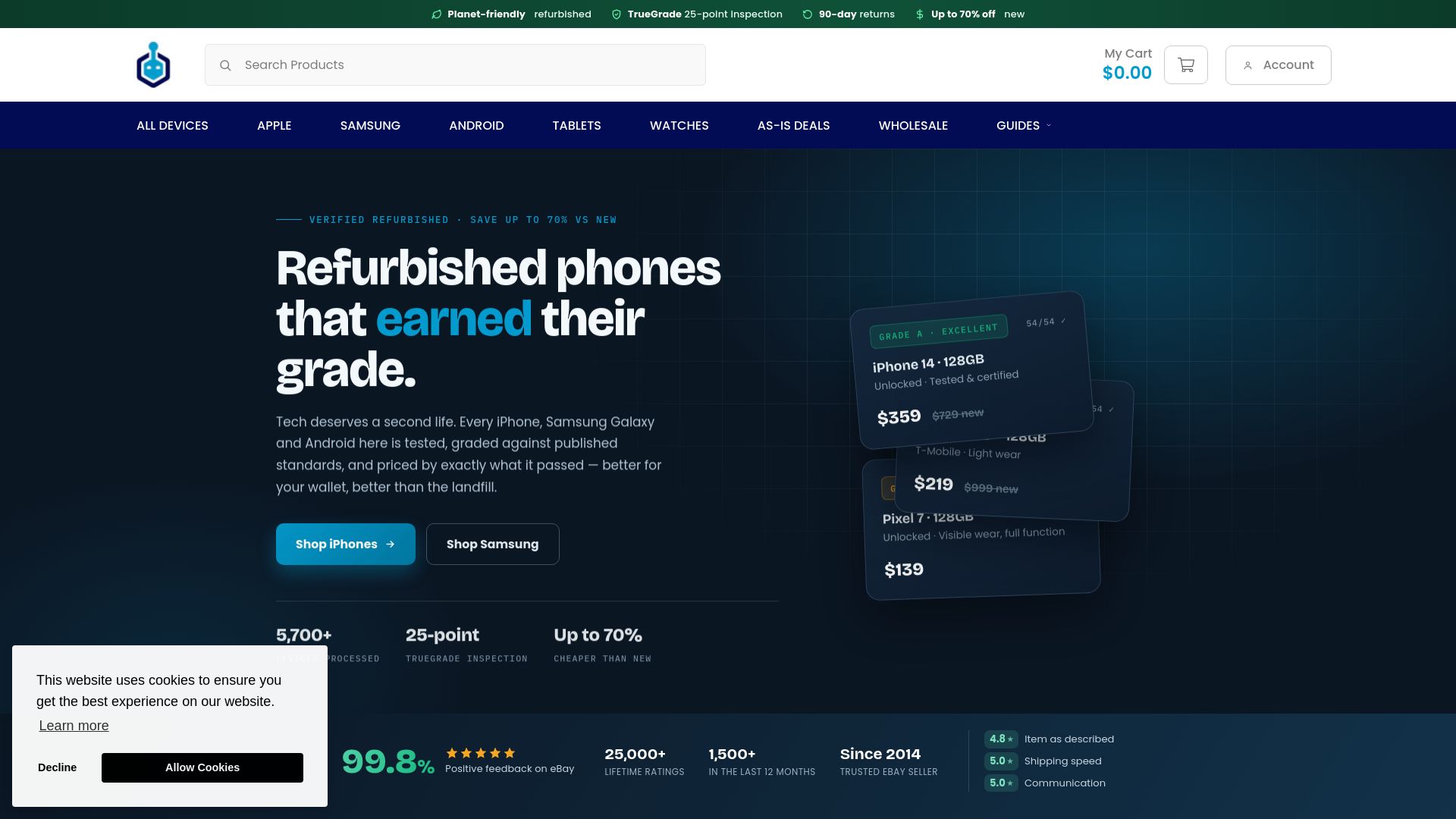
When you’re browsing our inspected refurbished inventory, look for the same details this guide recommends everywhere: specific inspection notes, real photos of the unit, and warranty terms stated plainly rather than buried in fine print.
- TrueGrade detailed inspection covering battery, screen, ports, buttons, and sensors.
- Individual cosmetic grading so condition is never a surprise.
- Return policy stated clearly for refurbished electronics.
| What to check | Where to find it on our listings |
|---|---|
| Inspection detail | TrueGrade detailed checklist results noted per device |
| Cosmetic condition | Individual A to D grade with matching photos |
| Return window | Return policy stated clearly on every product page |
| Compatibility | Carrier and unlock status listed per model |
If you’re ready to see it in practice, the refurbished iPhone 15 in pink and the refurbished iPhone 14 in purple both show the kind of listing-level detail worth demanding from any seller you buy from.
FAQ
What is the most trusted refurbished website?
There’s no single “most trusted” site, but the safest choice is a seller that publishes a detailed inspection checklist, discloses cosmetic grading, and offers a clear return window of several weeks or more. Cross-check that seller’s ratings and recent buyer comments independently, since the FTC warns that some reviews can be fake or incentivized.
What is the best website to buy refurbished products?
The best option is whichever seller gives you verifiable details before you pay: a published testing process, real photos of the specific unit, and warranty terms you can read in full. Compare a few sellers against that standard rather than assuming one platform is universally best.
Where is the best place to buy refurbished?
Prioritize sellers over categories: a manufacturer-certified program, a large retailer, or an independent refurbisher can all work well if they publish inspection details and honor clear return terms. Consumer Reports notes that manufacturer-certified programs often include one-year warranties, while many large retailers offer shorter guarantees, so compare the actual coverage before deciding.
Where can I find trusted refurbished phone sellers?
Look for sellers who list IMEI or serial numbers, disclose battery health, and grade cosmetic condition honestly rather than using vague terms like “like new” with no detail. A guide to checking a phone’s IMEI before buying walks through how to verify a device isn’t reported lost, stolen, or blacklisted before you commit to a purchase.
How long should a refurbished phone warranty last?
Warranty length varies by seller, and a longer window is only useful if the coverage itself is broad. Focus on what’s excluded, such as battery wear or accidental damage, and how claims get handled, since Consumer Reports found that coverage scope matters more than duration alone.
Sources
- Buying From an Online Marketplace | Consumer Advice
- Expert tips for buying secondhand products to save you money — Consumer Reports
- FTC, State of Georgia charge operators of electronics buyback scheme with bilking consumers out of millions — FTC


