
Warranty First Refurbished Phone Checklist for U.S. Buyers

Yes, buying a refurbished phone is a safe way to save money when you buy from a seller that discloses an inspection standard, backs the device with a written warranty, and gives you a real return window. Skip any of those three protections and you are gambling on a stranger’s definition of “like new.” Get all three and a refurbished phone can perform like new for a fraction of the price.
TL;DR:
- Buy from sellers that disclose inspection standards, offer a written warranty, and provide at least a 30-day return window to ensure device quality.
- Manufacturer-certified programs tend to offer longer warranties and original parts, while third-party retailers generally provide around 90 days of coverage.
- Refurbished phones may have reduced software update support and lower battery capacity, especially with lower-grade devices, compared to new units.
- Certification and condition grading are inconsistent industry-wide, so verify battery health, replaced parts, actual photos, and warranty details before purchasing.
- Always verify carrier compatibility using the model number and confirm the device is unlocked, not just carrier-locked, to avoid network issues.
Table of Contents
- What “refurbished” means and how refurbishing actually works
- Are refurbished phones worth it? Benefits and trade-offs
- Refurbished grading explained
- Where to buy refurbished phones
- Your pre-purchase and post-delivery verification checklist
- Risks, scams, and red flags to avoid
- What a trustworthy seller disclosure should look like
- Who should buy refurbished, and who should buy new
- Shop confidently with Device Giant
- FAQ
- Sources
What “refurbished” means and how refurbishing actually works
“Refurbished,” “renewed,” and “recertified” get used almost interchangeably, but the process behind the label matters more than the word itself. A seller-refurbished phone has typically been inspected and repaired by a third-party reseller, while a manufacturer-certified device goes through the brand’s own testing line using original parts. Both can be reliable, but the paperwork and warranty terms usually differ.
A proper refurbishing process generally includes a full diagnostic and testing of battery health, display response, charging ports, and cameras.
- A full diagnostic of battery health, display response, charging ports, and cameras.
- Testing of cellular, Wi-Fi, Bluetooth, and GPS radios to confirm they connect and hold signal.
- Replacement of worn components like batteries or screens that fail inspection thresholds.
- A complete data wipe and factory reset to remove the previous owner’s information.
- A final cosmetic grading pass before the device is listed for sale.
Manufacturer-certified programs tend to use stricter parts standards, often requiring original manufacturer components, and they commonly pair that with longer warranty coverage than you will find from an independent retailer. Many certified refurbished programs offer around a year of coverage, while plenty of third-party retailers settle on 90 days. Neither path is automatically wrong, but you want to know which one you are buying into before you check out.
Are refurbished phones worth it? Benefits and trade-offs
For most budget-conscious buyers, a refurbished phone is worth it. You get a device that performs the same as a new one for a meaningfully lower price, which is the entire point of the secondary market. The buyers who benefit most are people replacing a lost or broken phone on a budget, parents buying a first phone for a kid, and anyone who wants flagship features without flagship pricing.
Refurbishing and reusing phones conserves meaningful raw materials: for every million smartphones reused or recycled, recoverable resources include thousands of pounds of copper and silver along with smaller but significant amounts of gold and palladium. Choosing refurbished is one of the more direct ways an individual buyer reduces electronic waste.
The trade-offs are real, though. A refurbished phone may have fewer years of software update support left than a brand-new unit purchased on day one, since the clock on manufacturer support started when the phone first launched. Battery capacity will sit below 100% in most cases, and grading affects how much cosmetic wear you should expect. A Grade A device should look nearly new, while a lower grade might show scratches that do not affect function but do affect resale value later.

Refurbished grading explained
Grading tiers are the shorthand sellers use to describe cosmetic condition, and they are not standardized across the industry, so the same letter can mean different things from one retailer to the next. Generally, you can expect:
- Grade A (Excellent): minimal to no visible scratches, screen free of marks, battery typically above a strong health threshold.
- Grade B (Good): light scratches or small marks visible on close inspection, fully functional.
- Grade C (Fair): noticeable scratches or wear, still fully functional, priced lower accordingly.
- AS-IS or “renewed” listings: sold with limited or no warranty, often reflecting unknown or untested condition.
Before buying, ask the seller what battery health threshold qualifies a device for each grade, whether photos shown represent the actual unit or a stock image, and what parts, if any, were replaced. A lower grade should come with a lower price and, ideally, the same warranty as a higher grade. If it does not, treat that as a red flag rather than a bargain.
Where to buy refurbished phones
Not all sellers carry the same risk, and the type of seller you choose should match how much you value certainty over price.
- Manufacturer-certified programs typically offer the strongest warranties, often a full year, and use original parts, making them the lowest-risk option when available for your model.
- Large retailers and marketplaces often provide a 90-day warranty with inspection standards that vary by listing, so read the specific product page rather than assuming a store-wide policy applies.
- Specialist refurbishers can offer strong value when they publish a clear inspection checklist, disclosed grading criteria, and a real return window, so check those three details before trusting the listing.
- Individual sellers, through classifieds or peer-to-peer marketplaces, carry the highest risk since there is no inspection standard, no warranty, and often no recourse if the phone fails. Consumer Reports recommends avoiding individual sellers for this reason and prioritizing retailers with at least a 30-day return period, since the biggest risk with any used device is a latent defect that only shows up after days of regular use.
Your pre-purchase and post-delivery verification checklist
Treat the first week with a refurbished phone as a testing window, not just an unboxing. Work through these steps in order:
- Confirm the written warranty and return window before you pay, and save a screenshot of the policy along with your order confirmation and receipt.
- Check the IMEI or serial number against the carrier’s blacklist database and confirm Activation Lock or Google Factory Reset Protection has been removed by the seller.
- Verify unlocked status and carrier compatibility. Being unlocked removes a software restriction, but it does not guarantee the phone supports your carrier’s frequency bands, so look up the exact model number on your carrier’s compatibility checker rather than trusting the marketed name alone.
- Test battery health and charging using the phone’s built-in battery health tool, and run the charger through a full cycle to confirm it holds a charge normally.
- Run core functionality tests: front and rear cameras, microphone, speakers, Face ID or fingerprint sensor, Wi-Fi, Bluetooth, and GPS.
- Inspect physical condition, including moisture indicator strips inside the SIM tray and charging port, and compare the unit against the listing photos for any undisclosed damage.
- Keep every document: order confirmation, warranty terms, and any seller correspondence, in case you need to file a dispute.
Pro Tip: Do all of this within the first few days, not the last day of your return window, so you actually have time to request a replacement or refund if something fails.
If a phone fails any of these checks, the FTC recommends gathering your receipts, warranty terms, and customer service contacts before escalating a complaint, since having that paperwork ready speeds up resolution considerably.
Risks, scams, and red flags to avoid
Most refurbished phone purchases go smoothly, but a few recurring scams are worth knowing by name. Buyback and resale schemes have been the subject of FTC enforcement actions for quoting one price, then paying far less once a device is in hand, a pattern that shows why documented, transparent return and refund procedures matter on the buying side too. Misrepresented grading, missing or blacklisted IMEI numbers, and vague or fabricated warranty claims round out the common complaints.
Watch for these red flags on a listing:
- Evasive or vague answers when you ask about inspection steps or parts used.
- No stated return policy, or a return window shorter than 14 days.
- A brand-new seller account with no transaction history or reviews.
- A price dramatically below every comparable listing for the same model and grade.
If something goes wrong, paying by credit card gives you a dispute option your bank can pursue, and you can file a complaint with the FTC or your state attorney general if a seller refuses to honor a stated policy.
What a trustworthy seller disclosure should look like
We built our TrueGrade inspection around the idea that a disclosure should answer every question a cautious buyer would ask. Each device we sell goes through a 25-point functional check covering battery health, display, cameras, buttons, ports, and all wireless radios, and we grade cosmetic condition separately from functional performance so you know exactly what you are getting. Every phone comes with a 90-day return policy, which is longer than many sellers offer, giving you real time to run the tests above before you are locked in.
When you evaluate any seller’s disclosure, including ours, look for:
- A stated battery health threshold, not just the word “tested.”
- A list of which parts, if any, were replaced during refurbishing.
- Actual photos of the graded condition, not generic stock images.
- A clearly stated return window and warranty length on the product page itself.
Who should buy refurbished, and who should buy new
Refurbished makes the most sense if you want a secondary device, you are budget-conscious, or reducing electronic waste matters to you. It also suits anyone upgrading a phone for a kid or a parent where flagship specs are not the priority. New phones still make more sense for mission-critical use, like a primary work device where you cannot risk downtime, or for buyers who want the longest possible runway of security and software updates. There is no wrong answer here, just a mismatch between the device and the use case.
— Saad
Shop confidently with Device Giant
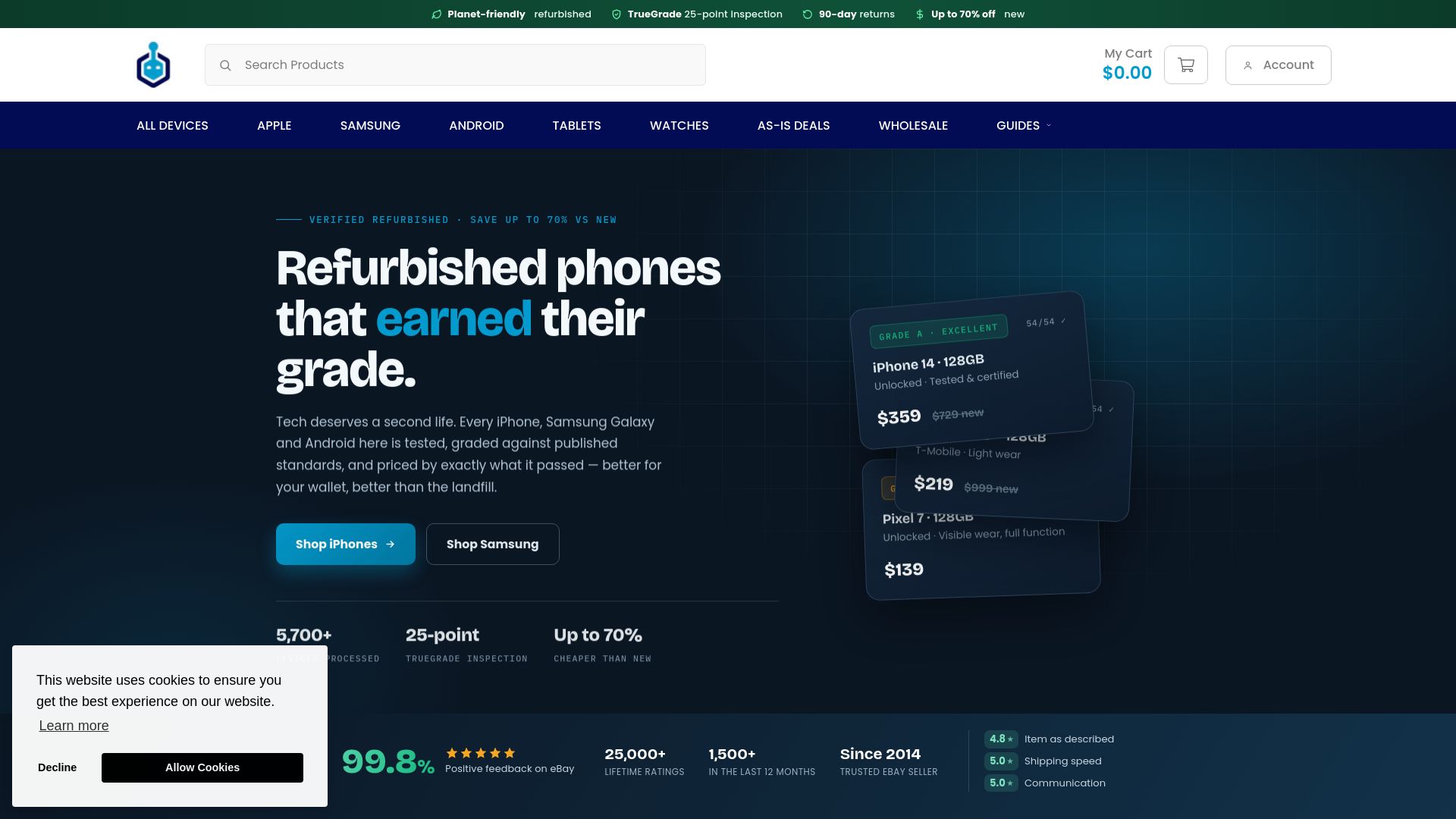
We make the three buyer protections easy to verify because we put them on the page: every phone in our inventory lists its TrueGrade inspection results, its cosmetic grade, and a 90-day return policy before you ever reach checkout.
Browsing is straightforward:
- Filter by model, storage, and grade to match your budget and condition preference.
- Read the inspection notes and grade photos on each product page before adding to cart.
- Choose unlocked or carrier-specific models depending on which network you plan to use.
Ready to compare options? Browse our refurbished iPhone and Android inventory and check the warranty terms listed on any device page before you buy.
FAQ
What to look for in a refurbished phone?
Look for a disclosed inspection standard covering battery health, display, cameras, and radios, plus a written warranty and a return window of at least 30 days. Confirm the IMEI is clean and the device is unlocked or compatible with your specific carrier, since unlocked status does not guarantee band compatibility.
How long should a refurbished phone warranty last?
Warranty length varies by seller: manufacturer-certified programs often provide around a year, while many retailers offer about 90 days. Our return policy gives you time to run a full set of functionality tests; check our website for current details.
Are refurbished phones as reliable as used phones bought privately?
Refurbished phones from a seller with disclosed inspection standards are generally more reliable than privately sold used phones, since private sellers rarely test components or offer a warranty. Consumer Reports specifically recommends avoiding individual sellers in favor of retailers that provide warranties and return periods.
How do I check if a refurbished phone is unlocked and compatible with my carrier?
Check the exact model number against your carrier’s online compatibility tool rather than relying on the marketed name, since compatibility depends on supported frequency bands, not just unlocked status. You can also verify the IMEI is clean and not reported lost or stolen before completing the purchase.
What should I do before trading in or selling my old phone?
Back up your data, remove the SIM and any SD card, unlink accounts like Find My iPhone or your Google account, and perform a factory reset to erase personal information. The FTC outlines these four steps as the minimum before handing off a device to a buyer or trade-in program.
Sources
- Businesspersons’ guide to federal warranty law — FTC
- Should you buy a refurbished phone? — Consumer Reports
- Cell phone unlocking — FCC
- The secret life of a smartphone — EPA


