
Resellers Vet Graded Phones Wholesale With 25 Point CTIA Checks

Buy from a wholesaler that publishes its grading criteria, documents its testing, and backs lots with a written commercial warranty. Before committing to any order, request the supplier’s grading rubric and a sample lot so you can verify condition against the promised grade. One option that publishes grading detail and testing standards buyers can check against is available.
TL;DR:
- Suppliers that publish detailed grading criteria and testing standards reduce the risk of receiving mismatched or misrepresented devices.
- Verifying individual device test results, especially battery health and functional performance, is essential before completing an order to protect margins.
- Data wiping and battery safety protocols, including certificates and strict handling of damaged batteries, are crucial to compliance and liability mitigation.
- Starting with a sample lot and detailed documentation allows for better assessment of grading accuracy and supplier reliability before larger purchases.
- Building a standardized vendor evaluation checklist centered on transparency and inspection reports ensures consistent quality in wholesale sourcing.
Table of Contents
- What “graded” actually means for wholesale buyers
- Testing and inspection: the checks that protect your margins
- Data wiping and battery safety: compliance and packing requirements to avoid liability
- MOQ, pricing drivers, and how to structure your first wholesale order
- Shipping, returns, and commercial warranty: what to require in writing
- Buyer’s vetting checklist: documents, questions, and red flags to reduce risk
- Device Giant: how our TrueGrade inspection and policies meet buyer requirements
- What resellers should do first
- Device Giant wholesale: how to get pricing and request sample lots
- Sources
- FAQ
What “graded” actually means for wholesale buyers
Grade labels only help you if they map to something consistent. Most suppliers use A, B, and C tiers, but the words behind those letters vary unless the vendor aligns with an outside standard. CTIA’s grading update brought its scale into line with SERI’s R2 Equipment Categorization specifically to make grading consistent and transparent across the secondary market, which cuts down on disputes when a buyer and seller disagree about what “Grade B” should look like.
- Grade A typically means light or no visible wear and full function.
- Grade B allows minor cosmetic marks with no impact on use.
- Grade C covers visible wear, scratches, or scuffs, still fully functional.
Battery health is graded separately from cosmetics, and a device can look flawless while carrying a battery near the end of its useful life. CTIA’s V5.1 criteria lay out both cosmetic and functional matrices, giving buyers a fixed reference to check a vendor’s grade report against instead of taking the label on faith. Aligning to that standard is what separates a defensible wholesale claim from a guess.
Testing and inspection: the checks that protect your margins
A grade means little without a record of what was actually tested. Before you sign anything, ask the supplier to put its functional test results in writing, unit by unit or by sampled batch.
- Power on and charging behavior
- Display integrity, including dead pixels and touch response
- Cellular, Wi-Fi, and Bluetooth radios
- Camera function, front and rear
- Charging port and button function
Device Giant’s TrueGrade inspection is a working example of the kind of documentation to expect: a 25-point inspection that checks function alongside cosmetic condition before a device is graded. Whatever supplier you choose, ask for the equivalent checklist and sample results, not just a summary grade.
Battery reporting deserves its own line item. Devices with notably low battery health are usually candidates for rework or parts rather than resale as-is, since they will underperform for the next owner and generate returns.
Pro Tip: Ask for battery health figures per unit, not a lot average. Averages hide the weak units that will come back to you as claims.
Data wiping and battery safety: compliance and packing requirements to avoid liability
Every phone in a wholesale lot should arrive with prior user data fully removed, and you should not have to take that on faith. EPA guidance on electronics calls for data deletion before resale and flags lithium-ion batteries for special handling, and a credible supplier will have a documented process for both.
- Request a written data-sterilization process or wipe certificate, and ask to sample a percentage of IMEIs against it.
- Confirm damaged or swollen batteries are pulled from resale stock rather than shipped, consistent with the EPA’s battery handling guidance.
- Ask about lithium-ion shipping restrictions and whether high-value lots travel on insured freight, since battery-related shipping rules affect how pallets are packed and labeled.
None of this needs to slow down an order once a supplier has the paperwork ready. It just needs to exist before the pallet ships, not after a customer complains.
MOQ, pricing drivers, and how to structure your first wholesale order
Minimum order quantities vary by supplier and by how many SKUs you want mixed into a lot. A single-model order of one grade is usually easier to source at a lower MOQ than a mixed pallet spanning several models and grades.
- Expect price to move with model age, cosmetic grade, and battery health, in that order of impact.
- Locked carrier units typically price lower than unlocked ones, and AS-IS stock prices lower than tested refurbished stock.
- Request a sample lot before committing to a full order, so you can check grading accuracy firsthand.
- Ask for a pre-shipment inspection report and a serial or IMEI list for every unit, so you can reconcile the shipment on arrival.
Treat the sample lot as a negotiating tool as much as a quality check. A supplier that hesitates to send one is telling you something about how confident it is in its own grading.
Shipping, returns, and commercial warranty: what to require in writing
Consumer warranty rules do not carry over automatically to wholesale purchases. The FTC’s guide to federal warranty law makes clear that federal consumer-warranty protections do not apply automatically to products bought for resale, which means the commercial terms in your contract are what actually protects you.
- Get the commercial warranty terms in writing, including what counts as a valid claim.
- Confirm the inspection window, often 48 to 72 hours after delivery, during which you can flag DOA units or grading mismatches.
- Clarify restocking fees and the claims process before you place the order, not after a dispute starts.
- Check who carries shipping insurance and who absorbs the cost of a lost or damaged shipment.
A supplier unwilling to put any of this in a document is asking you to trust a verbal promise with your working capital.
Buyer’s vetting checklist: documents, questions, and red flags to reduce risk
Score candidate suppliers the way you would score any vendor RFP, on paper, before you send money.
- Request the grading rubric, IMEI sampling data, functional test logs, battery reports, a data-wipe certificate, and the commercial warranty text.
- Check operational signs of a serious operation: consistent inventory cadence, proper packing standards, a defined claims SLA, and a warehouse you can verify.
- Treat vague grading language, refusal to provide a sample lot, or an opaque instant-quote pricing engine as reasons to walk away. Regulatory filings, including a 2023 petition to the FTC from PIRG and iFixit, point to real cases of deceptive buyback and wholesale practices in this market, which is exactly why documentation matters more than a low quoted price.
- Weight your scoring toward grading transparency and inspectable samples over the cheapest bid. A buyer’s checklist for wholesale iPhone suppliers can help structure this into a repeatable RFP process.
Pro Tip: Build your supplier scorecard once and reuse it for every RFP. Consistency in how you score vendors matters more than any single vendor’s pitch.
Device Giant: how our TrueGrade inspection and policies meet buyer requirements
Device Giant grades every device through its TrueGrade 25-point inspection, covering function and cosmetic condition before a grade is assigned. Consistent grading also supports the sustainability case for buying refurbished, since fewer functional units end up discarded when grading matches expectation on arrival.

What resellers should do first
Start with a sample lot, a written grading rubric, and per-unit battery reports before placing a full order. Consistent grading is what protects resale yield over time, since mismatched grades quietly erode margin one return at a time.
— Saad
Device Giant wholesale: how to get pricing and request sample lots
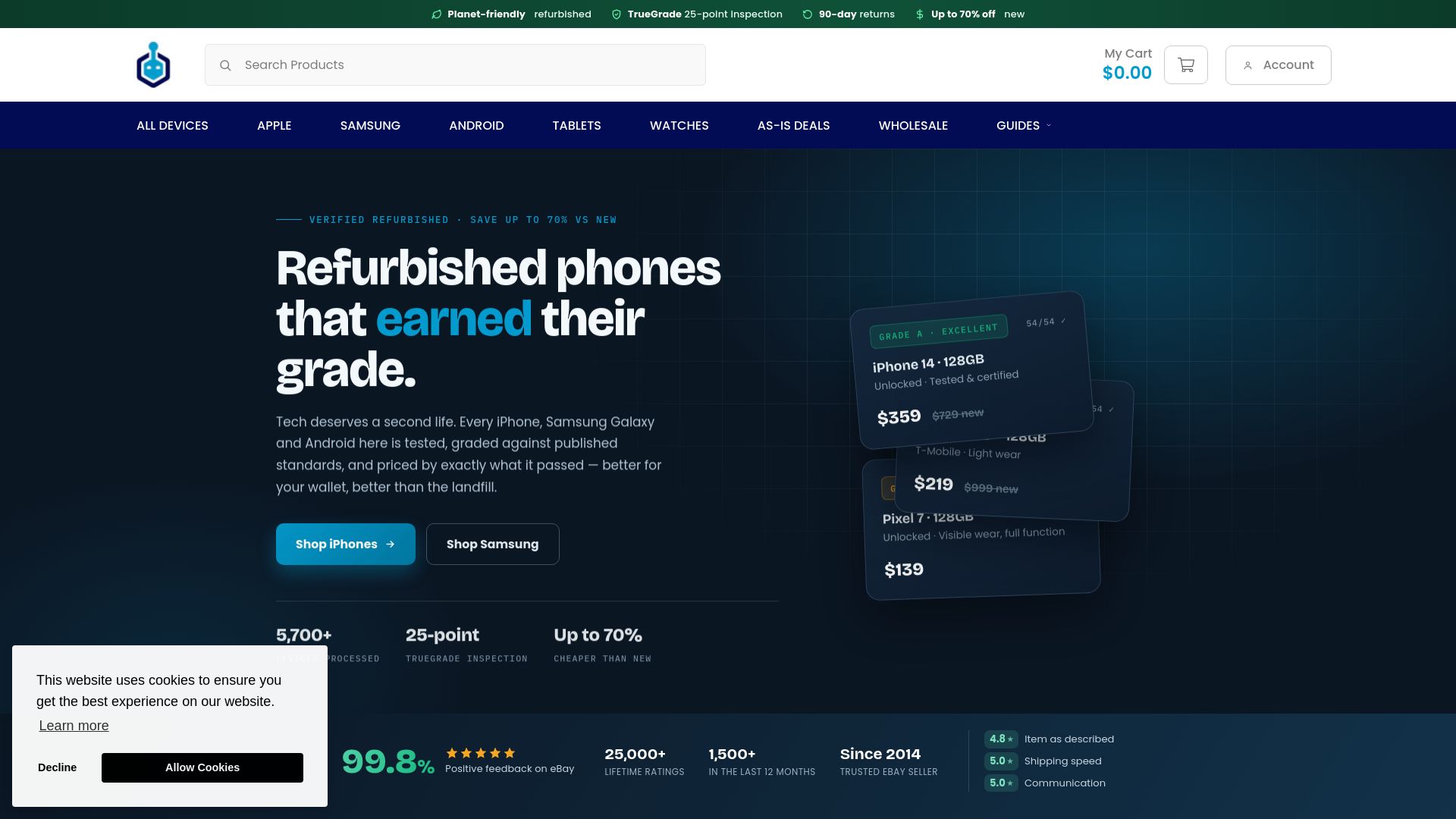
Buying wholesale should not mean guessing at condition until the pallet arrives. Device Giant’s wholesale and bulk inventory is graded through the same TrueGrade process used on individual sales, backed by a 90-day return policy you can verify before you order.
- Send your desired models, grade requirements, and target quantity to start a quote.
- Ask for a sample lot alongside your pricing request to check grading accuracy firsthand.
- Confirm the TrueGrade inspection results and return terms in writing before finalizing.
Visit the Device Giant storefront to request wholesale pricing or set up an account.
Sources
- Businessperson’s Guide to Federal Warranty Law | Federal Trade Commission
- CTIA updates wireless device grading standard to help extend the lifecycle of pre-owned wireless devices
- Electronics donation and recycling | US EPA
FAQ
Where can I buy phones wholesale?
Buy from wholesalers that publish their grading criteria and testing process, such as Device Giant’s wholesale and bulk channel, rather than a supplier that only offers an instant price quote with no documentation.
How do I buy cell phones at wholesale?
Request the supplier’s grading rubric, a sample lot, and written commercial warranty terms before ordering, then confirm battery health reporting and data-wipe certification. Placing a smaller sample order first lets you verify grading accuracy before committing to a full pallet.
Where can I find a bulk supplier of iPhones?
Look for a supplier that grades iPhones against a documented standard like CTIA’s V5.1 criteria and offers a written return policy. Refurbished iPhones are often sold individually and through wholesale channels with inspection documentation attached.
Where can I find cheap wholesale iPhones?
Pricing on wholesale iPhones depends on model age, cosmetic grade, battery health, and whether units are locked or unlocked, so “cheap” usually means an older model or a lower cosmetic grade. Comparing AS-IS versus tested refurbished stock from the same supplier is a reliable way to find lower price points without losing grading transparency.
What documents should I request before placing a wholesale order?
Ask for the grading rubric, functional test logs, battery health reports, a data-wipe certificate, and written commercial warranty terms. These documents let you verify a supplier’s claims instead of relying on a summary grade alone.

