
Check IMEI: Confirm T‑Mobile Compatibility for U.S. Unlocked Phones

Most unlocked phones can work on T-Mobile, but whether yours does depends on two separate things: the SIM lock status and whether the hardware supports T-Mobile’s radio bands. The fastest way to know for sure is to run T-Mobile’s IMEI Status Check with your device’s 15-digit IMEI. Unlocking removes a software restriction, it doesn’t add missing radio bands or guarantee every feature will work.
TL;DR:
- Many unlocked phones are compatible with T-Mobile if they support key bands like n71, n41, LTE bands 4, 66, 12, and 71, but check the exact model’s band list first.
- The IMEI status check is the fastest way to confirm if a device supports T-Mobile’s network and is truly unlocked, requiring the device’s IMEI number.
- Unlocking removes software restrictions but does not guarantee hardware support for T-Mobile features or all carrier services, especially on imported or international models.
- T-Mobile’s eligibility criteria for unlocking devices depend on account type and payment status, with automatic unlocking common for fully paid postpaid and prepaid devices.
- For optimal service, ensure the phone has the necessary radio bands, especially n71 for 5G and low-band LTE, and perform individual feature tests after activation.
Table of Contents
- How to check compatibility now with the IMEI status check
- What ‘unlocked’ actually means and what it doesn’t do
- T-Mobile BYOD and unlock eligibility you need to know
- Which bands and features determine real compatibility
- Getting a locked phone unlocked: steps and timing
- Activating an unlocked phone on T-Mobile: SIM, eSIM, and porting
- Fixing partial compatibility and knowing when to replace the phone
- How Device Giant reduces the risk of buying an incompatible phone
- A quick pre-switch checklist worth following
- Where to buy a phone that’s already confirmed to work
- Sources
- FAQ
How to check compatibility now with the IMEI status check
Before you do anything else, find your IMEI. Dial *#06# on the phone, or check Settings under “About Phone,” or look at the original box or the SIM tray. Every phone has one, and it’s the single piece of information T-Mobile needs to tell you what to expect.
Once you have it, enter it into T-Mobile’s IMEI Status Check tool, described in T-Mobile’s official BYOD guidance as the fastest and most accurate way to determine compatibility and lock status. The tool returns one of four outcomes:
- Compatible: the phone supports the bands and technology T-Mobile needs, and you can activate it without extra steps.
- Partially compatible: the phone will connect but may miss features like Wi-Fi Calling or full 5G speeds, often fixable with a software update or a settings change.
- Not compatible: the hardware lacks the bands T-Mobile relies on in your area, and no unlock or setting will fix that.
- Unknown: T-Mobile has no record for that IMEI, which usually means you should confirm the exact model number and check the manufacturer’s band list directly.
If your result comes back unknown or ambiguous, don’t guess. Cross-reference the model number against T-Mobile’s published band list or contact the phone’s manufacturer for its specification sheet. A five-minute check now saves a returned SIM card and a wasted afternoon later. For a deeper walkthrough before buying anything, Device Giant’s 25-point checklist for unlocked phones covers the same verification steps in more depth.
What ‘unlocked’ actually means and what it doesn’t do
“Unlocked” only means the phone isn’t tied to a specific carrier’s SIM. It says nothing about the radio hardware inside. According to the Federal Communications Commission, unlocking a phone removes software restrictions but does not change the device’s hardware or its supported radio bands, and being unlocked never guarantees every carrier service will function.
That distinction trips up a lot of buyers, especially with phones bought overseas or through resale marketplaces.
- An unlocked phone can accept any SIM card but still lack the specific radio bands a carrier needs in your region.
- International model variants are frequently built for different frequency allocations than the ones used in the United States.
- Carrier-specific features like VoLTE, Wi-Fi Calling, and certain carrier apps may stay unavailable even after the SIM slides in and the phone connects.
The FCC has confirmed that unlocking a device removes only software carrier locks; it does not add or change the physical radio hardware, meaning a fully unlocked phone can still be incompatible with a given network.
T-Mobile BYOD and unlock eligibility you need to know
Before you can even test compatibility, the phone has to be unlocked in the first place. T-Mobile’s SIM unlock policy lays out separate rules depending on account type.
- Postpaid devices generally need a minimum number of active days on the account, plus any device financing paid off in full and no outstanding balance.
- Prepaid devices typically require a substantial period of active service or enough paid refills, and T-Mobile limits how many devices can be unlocked per account each year.
- When conditions are met, T-Mobile often unlocks the device automatically and remotely, without a manual request.
- Exceptions apply for devices reported lost, stolen, or tied to fraud, which stay locked regardless of how much time has passed.
Before contacting T-Mobile or your previous carrier, gather your IMEI, account number, and proof the device is fully paid off. Having that ready turns a multi-day back-and-forth into a same-day resolution.
Which bands and features determine real compatibility
A phone can pass the IMEI check and still perform poorly if it’s missing the bands that carry most of T-Mobile’s coverage. T-Mobile’s own network technology page lists the frequencies it depends on most heavily.
- Band n71 (600 MHz) carries T-Mobile’s widest 5G coverage, including much of its rural and in-building reach.
- Band n41 (2.5 GHz) delivers the mid-band speed boost T-Mobile markets as Ultra Capacity 5G.
- Bands n2 and n25, along with LTE bands 4, 66, 12, and 71, fill in coverage where 5G isn’t yet available.
A phone missing n71 or the low-band LTE equivalents will often show strong signal outdoors and near-nothing indoors, since low-band frequencies penetrate walls better than mid-band or high-band signals. Missing n41 usually means slower 5G speeds rather than a total loss of service. On the feature side, VoLTE, Wi-Fi Calling, and T-Mobile’s 5G UC branding can all require provisioning that some imported or off-brand phones never receive, even when the raw radio hardware checks out.
Pro Tip: Search the exact model number, not just the phone’s marketing name, on the manufacturer’s spec sheet: a “Galaxy S23” sold in Europe can carry a different band list than the U.S. retail version.
For a closer look at reading spec sheets correctly, Device Giant’s guide on verifying unlocked phone bands breaks down where to find this information on most manufacturer sites.
Getting a locked phone unlocked: steps and timing
If your IMEI check shows the phone is still locked, unlocking it is usually straightforward as long as the account meets the criteria above.
- Confirm eligibility first: check active-day requirements, financing status, and account balance before requesting anything.
- Contact the original carrier (or follow the phone manufacturer’s unlock process if it was purchased directly from them) and provide the IMEI and account details.
- Expect same-day results in many cases, though financed devices with a remaining balance won’t unlock until that balance is paid off.
- If the request is denied and you believe it shouldn’t be, ask for the denial reason in writing and escalate through the carrier’s customer service.
The FCC’s guidance on cell phone unlocking notes that unlocking commitments are governed by carrier policy alongside CTIA industry standards, and carriers retain the right to withhold unlocking on financed or reported-stolen devices. If a dispute goes nowhere with customer service, that FCC page outlines where consumers can file a formal complaint.
Activating an unlocked phone on T-Mobile: SIM, eSIM, and porting
Once the phone is confirmed unlocked and compatible, activation is the easy part.
- For a physical SIM, insert a T-Mobile SIM card into the tray and follow the on-screen activation prompts or T-Mobile’s app.
- For eSIM, T-Mobile can send an activation QR code or profile directly to the device, no physical card needed.
- If you’re porting a number from another carrier, keep the old line active until T-Mobile confirms the port completed successfully, which typically avoids a service gap. Porting generally follows a similar verification pattern across most carriers, even outside the U.S.
- After activation, test voice calls, data, MMS, VoLTE, and Wi-Fi Calling one by one rather than assuming everything works because the phone shows signal bars.
If any single feature doesn’t activate, that’s usually a provisioning issue T-Mobile support can fix remotely, not a sign the whole phone is incompatible.
Fixing partial compatibility and knowing when to replace the phone
Most “partially compatible” results are fixable with a few settings changes rather than a new phone.
- Update the phone’s carrier settings and firmware first, since manufacturers push compatibility patches after a device changes networks.
- Manually check or reset APN settings if data doesn’t connect after activation.
- Call T-Mobile support to confirm VoLTE and Wi-Fi Calling are provisioned on the account, since some phones need that enabled on the network side, not just the device.
- Run the IMEI through the GSMA Device Check tool if the phone was bought used, since a blocked or blacklisted IMEI looks identical to a compatibility failure at first glance.
Pro Tip: If the IMEI check specifically flags missing n71 or LTE band 12 support, no software update will fix that. Replacement is the only real path forward.
How Device Giant reduces the risk of buying an incompatible phone
Every phone Device Giant sells goes through a TrueGrade 25-point functional inspection, with cosmetic condition disclosed on a clear A-to-D grading scale before it ships. That inspection, paired with a 90-day return window and a long track record of positive feedback on eBay, gives buyers a way to correct course if a device turns out to be the wrong fit for their carrier.
Device Giant’s own IMEI and compatibility guides walk buyers through the same verification steps covered here before they commit to a purchase, which matters most for buyers choosing between several similar unlocked listings.

A quick pre-switch checklist worth following

If I had to boil this down to one habit: check the IMEI before you do anything else, not after. Confirm unlocked status, verify band support against the exact model number, request an unlock if needed, then activate and test every feature individually.
Be especially cautious with international models and secondhand phones sold without any IMEI history. A phone with no verifiable history is a phone you can’t fully trust, no matter how good the price looks.
— Saad
Where to buy a phone that’s already confirmed to work
Checking bands and IMEI history yourself takes time, and a phone that fails the check after you’ve already bought it means dealing with returns and restocking fees. Sellers of graded, unlocked phones who perform inspection and compatibility checks, and offer a return policy, help reduce the risk if a device doesn’t fit your network.
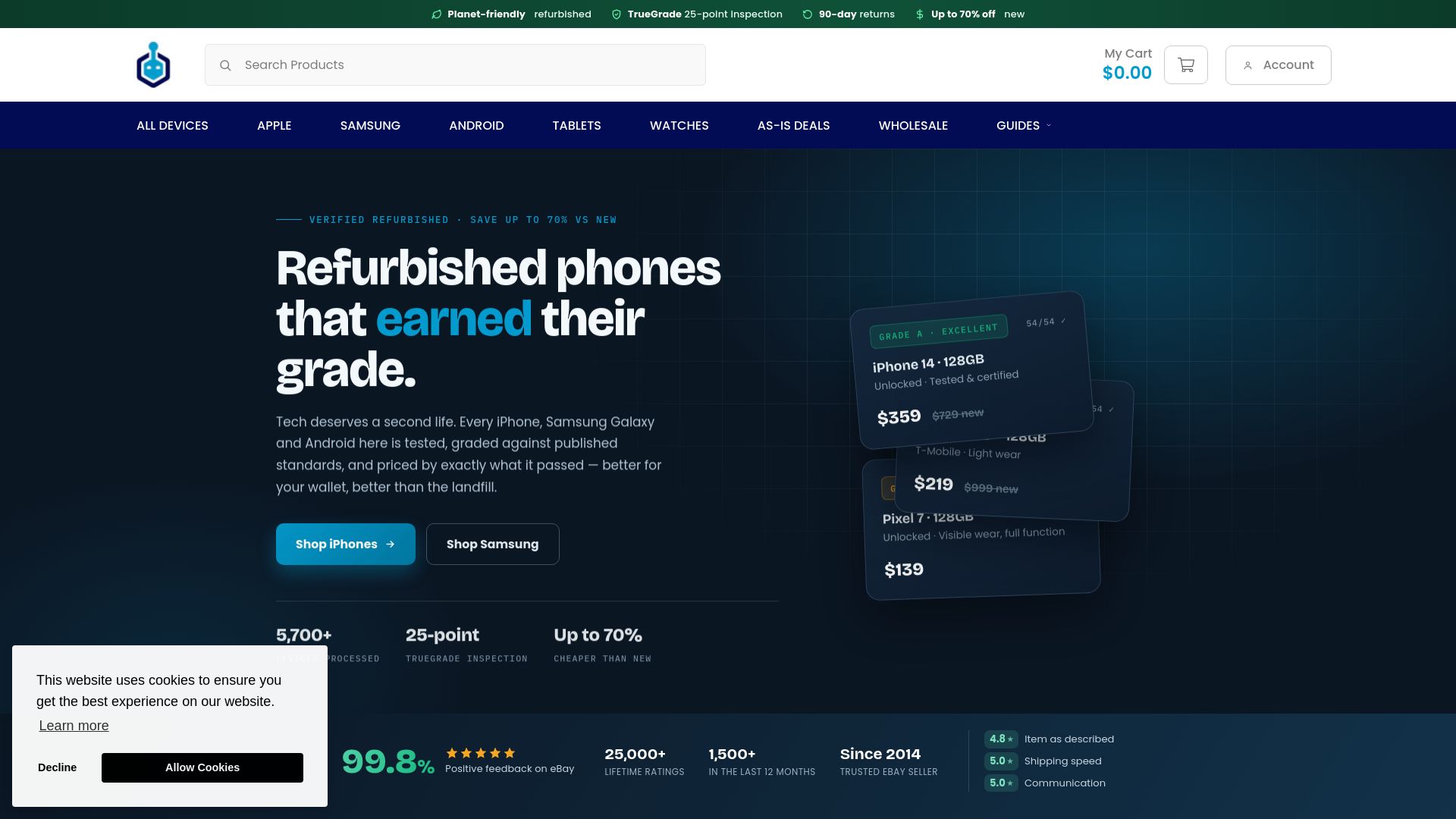
- Browse Apple iPhones, Samsung Galaxy, and Android phones across multiple carriers and price points.
- Check the refurbished iPhone 15 in Pink from $278 or the refurbished iPhone 15 in Blue from $297 for recent unlocked options.
- Consider the refurbished iPhone 14 in Purple from $204 for a lower price point with the same inspection standard.
Every listing shows its grade and condition up front, so you know what you’re buying before it ships. Visit Device Giant to check current unlocked inventory.
Sources
FAQ
Which unlocked phones are compatible with T-Mobile?
Most modern unlocked phones sold for the U.S. market work on T-Mobile as long as they support the carrier’s key bands, including n71 and n41 for 5G and LTE bands 4, 66, 12, and 71. The only way to confirm a specific model is to run its IMEI through T-Mobile’s IMEI Status Check.
Do international unlocked phones work in the USA?
Some do, but many international model variants are built for different regional frequencies and lack the specific bands T-Mobile and other U.S. carriers rely on. Always check the exact model number’s band list rather than assuming an unlocked phone works everywhere.
How do I check if a phone is compatible with T-Mobile?
Find the phone’s 15-digit IMEI by dialing *#06# or checking Settings, then enter it into T-Mobile’s IMEI Status Check. The tool returns whether the device is compatible, partially compatible, not compatible, or unrecognized.
Will T-Mobile accept an unlocked phone?
T-Mobile accepts unlocked phones that meet its band and technology requirements, following the BYOD process that starts with an IMEI check. Being unlocked is necessary but not sufficient. The hardware still has to support T-Mobile’s network, per FCC guidance on what unlocking does and doesn’t change.

