
25 Point Checklist: Pallets or Graded Stock for Buyers & Resellers

Graded phones are inspected, tested, and sold with a disclosed cosmetic grade and buyer protections. Phone pallets are bulk lots aimed at buyers who plan to test, repair, or harvest parts themselves. Choose graded units if you want retail-ready stock or a personal phone with a return policy. Choose pallets if you have repair skills, testing capacity, and the patience to sort winners from losers, guided by standards like CTIA’s grading scales or a 25-point inspection process such as TrueGrade.
TL;DR:
- Buying graded phones ensures you receive devices that have undergone specific functional and cosmetic inspections, reducing the risk of undisclosed issues.
- Proper grading involves thorough testing of power, display, cameras, radios, and battery health, usually verified through documented checklists.
- Pallets are bulk lots originating from returns or overstock, with manifest details allowing precise valuation; unmanifested lots carry higher risk and lower price.
- Costs beyond the purchase price include battery replacements, account lock removals, testing labor, and potential disposal of non-functional units, affecting overall profitability.
- Buyers should verify the grading standards cited by sellers, request detailed test reports or manifests, and choose options aligned with their testing capacity and risk tolerance.
Table of Contents
- What phone grading actually means
- How a graded phone earns its label
- What phone pallets actually are
- Why the manifest changes your entire pricing model
- What pallets and grading cost you beyond the sticker price
- How to decide between graded stock and pallets
- Why a published 25-point inspection lowers your risk
- What the grading debate gets wrong
- A lower-risk way to buy graded phones
- Sources
- FAQ
What phone grading actually means
A grade is shorthand for two separate assessments rolled into one label: how a phone looks and how it works. Cosmetic grading covers scratches, dents, screen wear, and case condition. Functional grading covers whether the battery, cameras, speakers, buttons, and radios perform as expected. A seller combines both into a single overall grade, though a phone can look rough and still function perfectly, or look clean while hiding a battery problem.
Grade labels vary slightly by seller, but the pattern is consistent across most refurbished marketplaces:
- Grade A (like new or excellent): minimal to no visible wear, full function, often includes original accessories.
- Grade B (good): light scratches or minor wear visible on close inspection, full function.
- Grade C (fair): noticeable scratches, scuffs, or minor screen wear, still fully functional.
- Grade D or “as is”: heavier cosmetic damage, possible functional issues, sold with reduced or no warranty.
CTIA’s V5.1 grading standard gives sellers and buyers a shared vocabulary, defining cosmetic grades from like-new through lower tiers along with defect classifications by surface area. Marketplaces have their own version too: eBay’s refurbished grading criteria spell out what “Excellent,” “Good,” and “Fair” mean for a listed device. When a seller cites one of these frameworks by name, you have something to check their claim against instead of taking their word for it.
How a graded phone earns its label
Grading is not a glance and a guess. A properly graded phone goes through a sequence of checks before it earns a cosmetic and functional label, and knowing that sequence tells you what to ask a seller for.
- Power and boot test: the device turns on, boots fully, and holds a charge.
- Display and touch check: screen responds accurately across the full surface with no dead zones.
- Camera and speaker test: front and rear cameras capture images, microphones and speakers work both ways.
- Radio check: Wi-Fi, Bluetooth, and cellular signal all connect properly.
- Battery health measurement: capacity is checked against a minimum threshold rather than assumed from age.
- Lock and account check: the phone is confirmed clear of iCloud Activation Lock or Factory Reset Protection, and a secure data wipe removes the previous owner’s information.
Pro Tip: Ask any seller for the battery health percentage and confirmation that the device passed an account lock check before you buy, not after.
A trustworthy graded listing gives you more than a grade letter. It gives you a battery health number, evidence the device is unlocked from any prior account, and a return window if something was missed.
What phone pallets actually are
A phone pallet is a bulk lot, often dozens to hundreds of units, sold as a group rather than individually. Pallets come from retailer returns, insurance claim inventory, carrier trade-ins, or general overstock, and the source shapes what you’ll find inside.
- Manifested pallets list each device by model, and sometimes by condition or IMEI, before you buy.
- Unmanifested pallets are sold blind: you know the general category (phones, mixed electronics) but not what’s inside until it arrives.
- Single-category pallets hold only phones, often from one brand or carrier, while mixed pallets blend phones with tablets, accessories, or other returned electronics.
Pricing tracks that structure. Mixed electronics pallets commonly run in the low hundreds to a couple thousand dollars depending on manifest detail and brand mix, while single-category phone lots, especially Apple-heavy ones, tend to command more per pallet because the recoverable value per unit is higher, according to wholesale pallet marketplace listings. A phone-only manifested pallet from a known retailer return stream is a very different bet than an unmanifested mixed lot of unknown origin, even at a similar headline price.
Why the manifest changes your entire pricing model
A manifest is a line-item list of what’s inside a pallet, often including model, storage size, and sometimes IMEI or condition notes. It turns a blind purchase into something you can actually price.
- Line-item detail lets you value the lot device by device instead of guessing at an average.
- A manifest reduces, but does not eliminate, the risk that a lot is mostly low-value or non-functional stock.
- Unmanifested lots are cheaper precisely because that pricing risk shifts entirely to you.
A manifest turns blind risk into priceable risk: buyers evaluating unfamiliar suppliers should favor manifested lots because they allow per-line valuation and workflow planning, according to guides comparing manifested and unmanifested liquidation lots. If you’re new to pallet buying, start manifested. Save unmanifested lots for once you’ve built a feel for typical yield and can price in a higher expected loss rate without it wrecking your margin.
What pallets and grading cost you beyond the sticker price
Untested pallets carry a planning heuristic worth knowing before you buy your first one: a common rule of thumb among resellers treats roughly a third of units as fully functional, a third as repairable, and a third as parts-only. It’s a practitioner estimate, not a guarantee, but it’s a reasonable starting point for modeling what you’ll actually recover.
Hidden costs eat into that recovery fast:
- Battery replacements on units that test below acceptable health thresholds.
- iCloud or FRP locks that make a phone unsellable until resolved, if it can be resolved at all.
- Labor hours spent testing, grading, and photographing each unit before listing.
- Disposal or recycling costs for phones that turn out to be parts-only.
Pro Tip: Set up three sorting lanes as soon as a pallet arrives: ready-to-list units that pass a quick check, a repair lane for fixable issues, and a parts lane for the rest. This is the standard workflow professional resellers use to protect margin, as pallet-testing checklists describe.
The upside comes from the same levers in reverse: a manifested lot heavy on higher-value brands, a tight testing pipeline that moves units through fast, and accurate grading that avoids returns. Graded stock skips most of this labor by design, which is the entire reason it costs more per unit than pallet stock.

How to decide between graded stock and pallets
Your answer depends less on price and more on what you’re equipped to do with what arrives.
- Assess your skills. Testing and light repair experience opens up pallets; without it, graded stock is the safer path.
- Assess your capital and time-to-list. Pallets tie up cash and hours before anything sells; graded units are close to sale-ready on arrival.
- Assess your volume and channel. High-volume resellers with an established sales channel can absorb pallet variability better than someone selling a handful of phones a month.
If you’re buying graded, confirm the grade definition the seller uses, request the battery health percentage, verify the lock status, and check the return policy length before paying.
- Confirm which grading schema the seller references (their own, CTIA, or a marketplace standard).
- Ask whether a test log or inspection report is available, not just a grade label.
- Check the return window and what conditions void it.
If you’re buying pallets, request a manifest or sample unit list, verify the seller’s reputation through reviews or trade history, plan your three sorting lanes in advance, and calculate your break-even price per unit before bidding.
Why a published 25-point inspection lowers your risk
Every phone is inspected before listing using a thorough multi-point checklist covering functionality and cosmetic condition.
- TrueGrade’s 25-point checklist covers the same categories a careful buyer would demand: power, display, cameras, radios, and battery health.
- There is a 90-day return window that gives buyers time to catch any issues.
- The seller has maintained a strong positive feedback history on eBay, reflecting buyer satisfaction.
- Device Giant also publishes grading explainers that map its own grade labels to industry frameworks like CTIA’s.
A published checklist and a stated return window do the same job a manifest does for pallets: they replace guesswork with something you can verify before you commit money.
What the grading debate gets wrong

Most advice on this topic treats grading and pallet buying as a binary choice between safe and cheap, but the more useful lens is matching the format to your actual capacity to absorb risk. A grade letter is only as good as the standard behind it, and a lot of sellers use loose, self-defined grades with no reference point at all. That’s the real gap: not graded versus pallet, but documented versus undocumented sourcing.
The overrated advice is chasing the lowest headline price on an unmanifested pallet as a starting strategy. Without testing infrastructure or repair skills, that path burns more time and money than it saves. What matters most is verifying the standard behind any grade claim, whether that’s CTIA’s published schema, a marketplace’s grading guide, or a seller’s own inspection checklist. If a seller can’t point to one, treat the grade as a guess, not a guarantee.
— Saad
A lower-risk way to buy graded phones
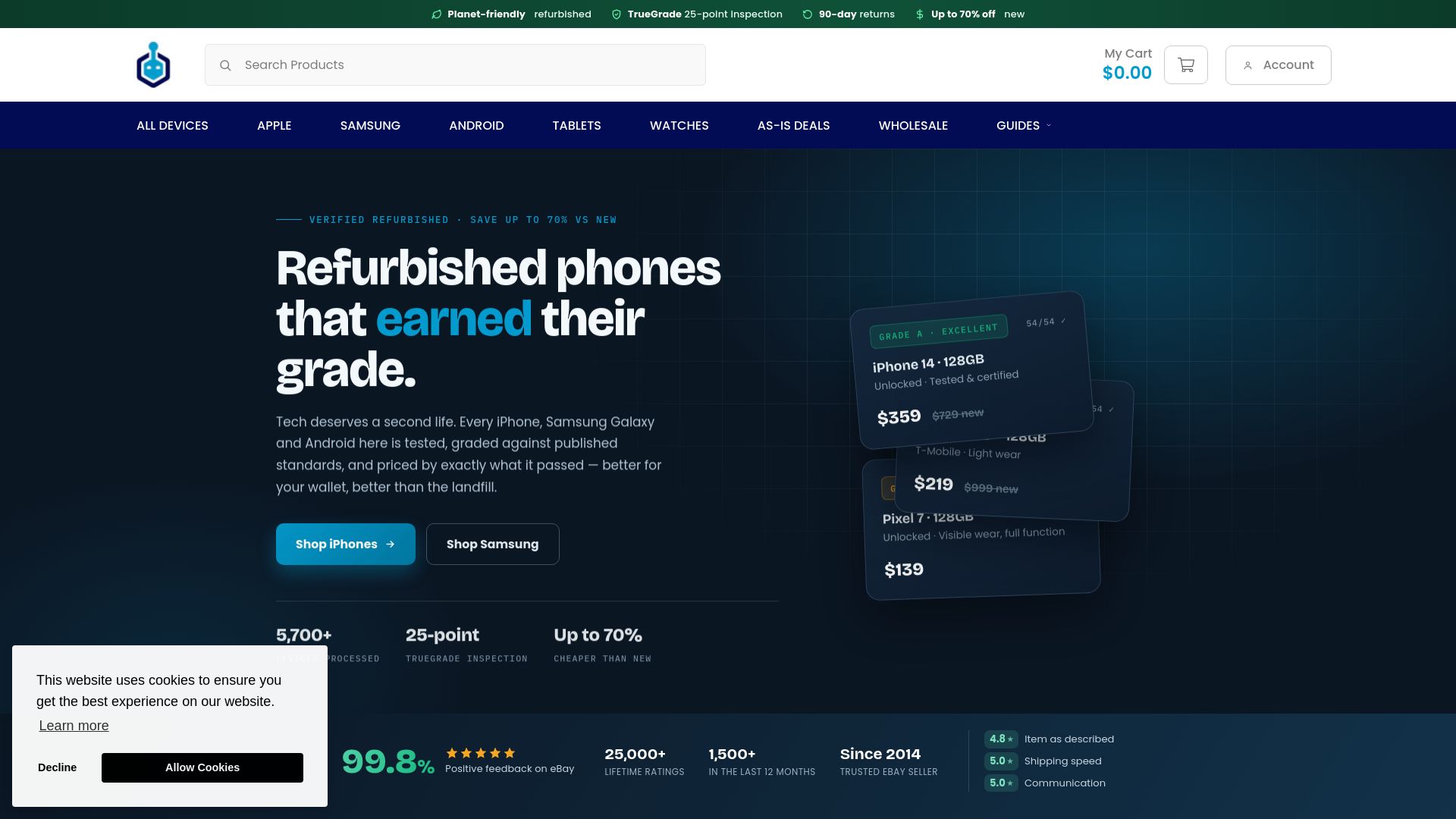
If you want inspected, ready-to-use phones without setting up a testing pipeline, Device Giant checks every device against its TrueGrade 25-point checklist and backs it with a 90-day return policy. That combination suits low-touch resellers who want to skip the sorting-lane work, everyday consumers who just want a working phone with a safety net, and eco-conscious buyers choosing refurbished over new.
- Low-touch resellers get pre-tested stock without running their own inspection process.
- Consumers get a documented grade and a return window instead of a seller’s unverified claim.
- Eco-conscious buyers get a device diverted from landfill without sacrificing a functional guarantee.
| Buyer type | What matters most | Why graded stock fits |
|---|---|---|
| Low-touch reseller | Fast turnaround | Skips testing labor |
| Everyday consumer | Reliability | 90-day return policy |
| Eco-conscious buyer | Lower environmental impact | Refurbished over new |
Before you buy from any seller, check their grade definitions and return terms against a standard like CTIA’s. Browse Device Giant’s refurbished phone lineup to see TrueGrade inspection and grading disclosures on individual listings.
Sources
- Wireless Device Grading Scales Criteria and Definitions (CTIA V5.1)
- Refurb Grading Criteria Q2-2025 (eBay)
- Electronic Pallets: Testing Checklist Before You List Online - American Bulk Pallets
FAQ
What is the best grade to get on a phone?
Grade A or “like new” gives you the closest experience to a new device, with minimal cosmetic wear and full function. If budget matters more than appearance, Grade B or C phones work identically but show more visible wear, based on CTIA’s grading definitions.
What does Grade A mean on a phone?
Grade A typically means minimal to no visible cosmetic wear alongside full function, covering battery, screen, cameras, and radios. Sellers using CTIA’s V5.1 standard or marketplace grading guides apply this label only after passing functional checks, not just a visual inspection.
Should I buy graded phones or pallets as a beginner?
Graded phones are the safer starting point because they arrive tested, inspected, and backed by a return policy. Pallets require testing skills, repair capacity, and tolerance for a mix of working, repairable, and parts-only units, so they suit resellers with existing infrastructure more than first-time buyers.
How much gold is in an old cell phone?
Cell phones contain trace amounts of gold and other precious metals in their circuit boards, but the quantity per device is small and mainly relevant to large-scale recycling operations rather than individual resale value. The functional and cosmetic condition of a phone matters far more to its resale price than any metal content.
Do most tech-focused buyers prefer iPhone or Android?
Preference varies widely by buyer and use case, and no single device brand dominates across all price points or user groups. Both Apple and Android devices appear regularly in graded and pallet inventory, and grading standards like CTIA’s apply to either brand.


