
Avoid Returns: 6 Refurbished Laptop Grade Checks to Ask Before You Buy

Grades A, B, and C describe how a refurbished laptop looks, not how it performs. Grade A means near-mint cosmetics, Grade B means light wear and the best value for most buyers, and Grade C means visible scuffs on a fully working machine. Before you buy, check the seller’s written grade definitions, ask for the battery health percentage, and confirm the return policy in writing.
TL;DR:
- Buyers should focus on verified testing and inspection reports rather than relying solely on cosmetic grade labels, to ensure functional quality.
- Refurbished laptop grades mainly indicate appearance, with grades A and B looking nearly new and grade C showing visible cosmetic flaws.
- Vague or inconsistent grading labels like “Excellent” or “Good” can vary significantly between sellers, making documented standards essential.
- Major risks stem from inaccurate listings and lack of detailed testing, not the cosmetic condition itself; always confirm return policies and inspection data beforehand.
- For daily work, invest in Grade A or high-grade B laptops with warranties, while Grade B or C models suit secondary, budget, or resale purposes.
Table of Contents
- What Refurbished Laptop Grades Actually Look Like
- Why the Grade Matters More for Price Than Performance
- How to Choose the Right Grade Before You Buy
- The Closest Thing to a Grading Standard
- What Trustworthy Refurbishment Practices Look Like
- When Each Grade Actually Makes Sense
- Where to Find Inspected Refurbished Laptops
- Sources
What Refurbished Laptop Grades Actually Look Like
A grade tells you what the laptop looks like when it lands on your desk. It says almost nothing about whether the trackpad works perfectly, how fast the SSD reads data, or whether the battery holds a charge for six hours or two. That distinction gets lost constantly, and it’s the single biggest source of buyer disappointment in the refurbished market.
Here’s how the three core grades typically break down in real listings.
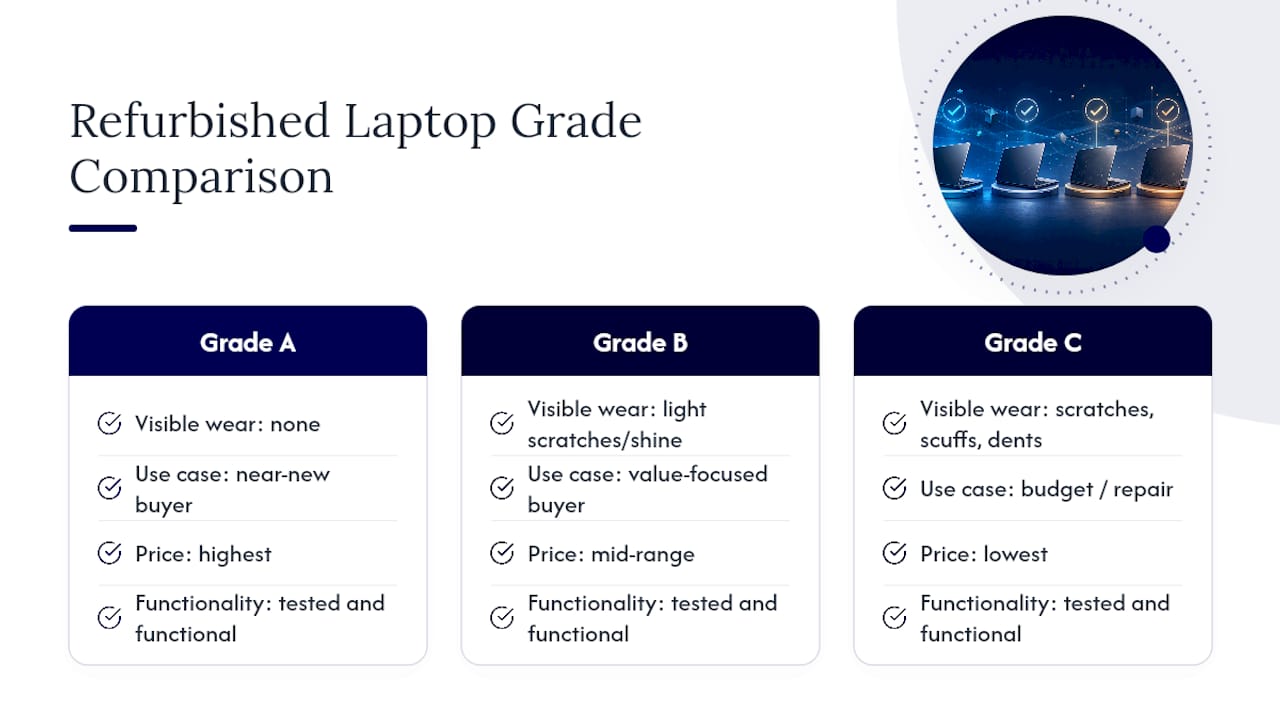
Grade A is as close to new as a used laptop gets. These units often started life as open-box returns or manufacturer-certified refurbished stock, meaning someone bought them, barely touched them, and sent them back. You’re looking at a laptop with no visible scratches, an intact hinge, a keyboard that hasn’t developed shiny keys from months of typing, and usually the original charger and box. Sellers who grade honestly will show close-up photos of the lid, the palm rest, and the screen bezel because there’s nothing to hide.
Grade B is where the real value sits for most shoppers. Expect light cosmetic wear: a few hairline scratches on the lid, maybe a slightly worn logo, or faint shine on the “A” and “S” keys from heavy use. Functionally, a Grade B laptop should work exactly like a Grade A one. The gap is purely visual, and it usually comes with a meaningful discount over Grade A pricing. Trade guides that track refurbished pricing consistently point out that resellers price laptops by specification first, then adjust the number down for cosmetic condition, which is exactly why Grade B often delivers the same processor and RAM configuration at a lower price than Grade A on the same model.
Grade C carries the most visible wear: noticeable scratches across the lid or deck, possible small dents on a corner, sometimes a scuffed screen bezel. These units are fully functional, tested, and working, just cosmetically rough. Grade C makes sense for a budget purchase, a spare machine, or a repair and resale project where appearance doesn’t matter and price does.
Mixed labels you’ll run into
Not every seller uses the plain A, B, C system, and that inconsistency is where buyers get tripped up. You’ll see:
- A+ or Premium: Typically better than standard Grade A, sometimes meaning genuinely unused open-box stock.
- Excellent: Roughly equivalent to Grade A or high Grade B, depending on the seller.
- Good: Usually lands in Grade B territory, light wear but fully functional.
- Acceptable: Comparable to Grade C, visible wear but tested and working.
- Fair or Scratch and Dent: Often below Grade C, meaning heavier cosmetic damage that some sellers still classify as functional.
The problem is there’s no universal enforcement body checking whether a seller’s “Excellent” matches another seller’s “Excellent.” A trade buyer’s guide to refurbished grading makes this point directly: one seller’s Grade B can be another seller’s Grade A, because the letters are shorthand, not law.
Pro Tip: Screenshot the seller’s written grade definition page before you buy, not after. If a return dispute comes up, you want proof of what “Grade B” meant at the moment of purchase, not what the listing says three weeks later.
Why the Grade Matters More for Price Than Performance
A Grade A and a Grade C version of the identical laptop model, same processor, same RAM, same SSD, run the same benchmarks. The grade changes what you pay and how the machine looks in your bag, not what it can do. Reseller pricing guides confirm this pattern: specs set the base price, and cosmetic grade adjusts it down from there, not the other way around.
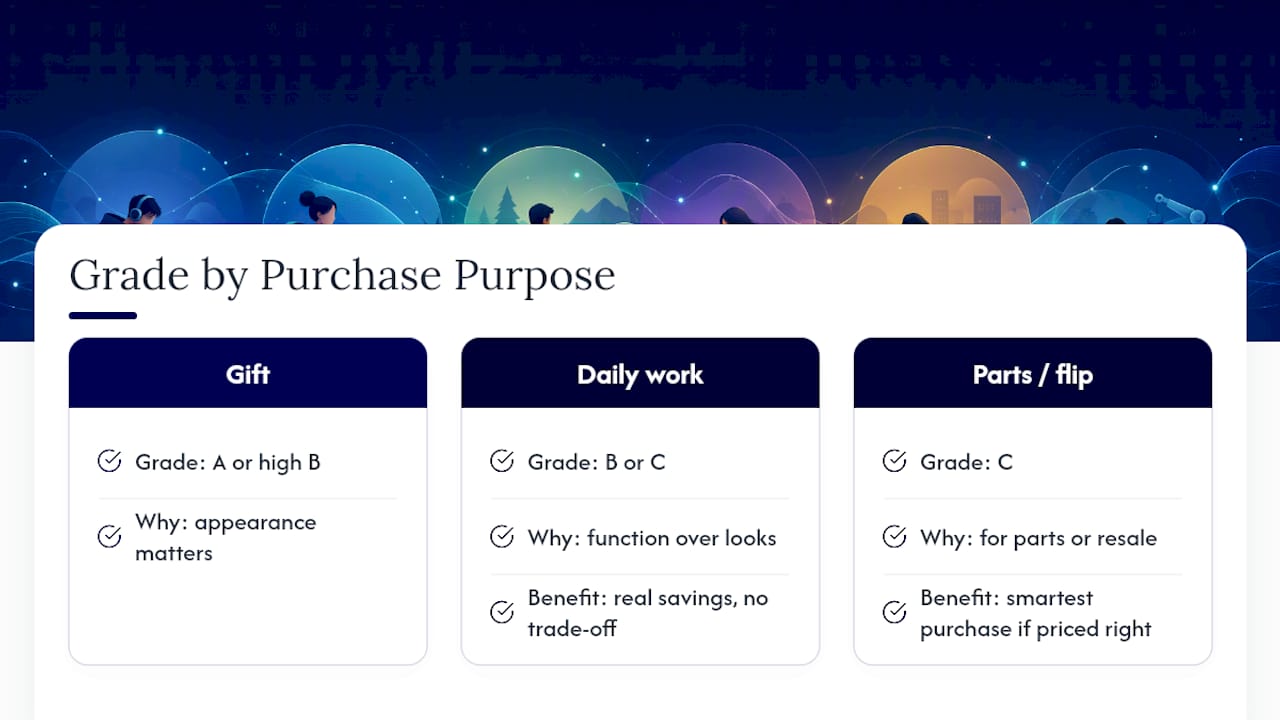
That distinction changes how you should shop. If you’re buying a gift, Grade A or high-end Grade B makes sense because appearance matters for that use case. If you’re buying a daily work laptop that lives on a desk and never gets seen by a client, Grade B or even Grade C can save real money with zero functional trade-off. If you’re buying a spare machine for parts or a resale flip, Grade C at the right price is often the smartest purchase on the list.
Where the actual risk lives is mismatch, not condition. Consumer buying guides consistently flag that returns spike when a seller’s photos and description don’t match what arrives. A Grade B laptop that shows up looking like Grade D triggers a return, a dispute, and a seller’s negative feedback, all avoidable if the listing had been accurate in the first place. Grade isn’t the danger. Vague or dishonest grading is.
How to Choose the Right Grade Before You Buy
Run through this checklist before you click purchase on any refurbished laptop listing, regardless of who’s selling it.
- Pull up the seller’s written grade definitions. Every reputable refurbisher publishes what A, B, and C mean on their site. If you can’t find one, that’s already a red flag.
- Ask for the battery health percentage. A laptop with 60% battery health behaves very differently than one at 95%, and this number has nothing to do with cosmetic grade. For guidance on proper disposal after use, consider laptop battery recycling to handle end-of-life batteries responsibly.
- Confirm whether replacement parts are OEM or disclosed aftermarket. A screen or keyboard swap using non-original parts isn’t necessarily bad, but you deserve to know before buying.
- Check activation and unlock status. For laptops with cellular modules or enterprise locks (BIOS passwords, asset tags), get written confirmation the unit is fully unlocked and wiped of prior enrollment.
- Look for actual photos of the unit you’re buying, not stock images. Real photos of the exact serial number are the strongest signal you’re dealing with a serious seller.
- Get the return policy in writing, including the window length and who pays return shipping.
Pro Tip: If a listing has zero photos of the actual laptop, no stated battery health, and grade language limited to a single vague word like “good,” treat it as a repair project price, not a working-laptop price, even if the seller calls it Grade B.
Buyer guides from outlets like IGN’s refurbished laptop advice back up nearly every item on this list, because the pattern of disappointment repeats across marketplaces: vague grading plus missing battery data plus no return policy equals buyer regret. You can dig deeper into what “worth it” actually means for your situation in our refurbished laptop buyer’s guide.
The Closest Thing to a Grading Standard
There’s no federal law standardizing refurbished laptop grades, but there’s a document that comes close. The CTIA Wireless Device Grading Scales, Criteria and Definitions lays out consumer tiers and defect-level tables that quantify exactly how many small scratches or marks are allowed at each grade level. It was built for wireless devices broadly, but the framework translates cleanly to laptops, and it’s a useful benchmark to hold any seller’s claims against.
Marketplace programs add another layer of labeling on top. Amazon Renewed, for instance, commonly uses tiers like Premium, Excellent, Good, and Acceptable rather than plain letters. Roughly:
- Premium maps close to Grade A, minimal to no visible wear.
- Excellent sits near high Grade A or low Grade B.
- Good aligns with standard Grade B, light wear, fully functional.
- Acceptable matches Grade C, visible cosmetic wear but tested working.
Sellers differ because grading isn’t regulated the same way food labeling or vehicle titles are. Use the CTIA framework as your reference point when a listing’s language feels ambiguous, and treat any seller who can point to a documented, testable standard as more trustworthy than one who just slaps a letter on a listing.
What Trustworthy Refurbishment Practices Look Like
The best protection against a bad refurbished purchase isn’t a grade letter. It’s proof of testing.
That combination matters because it addresses the two things grade letters alone can’t: verified function and buyer recourse. A written grade tells you what the laptop looks like. A per-device inspection report tells you it actually works. A real return window tells you what happens if either claim turns out wrong.
Before buying from any refurbisher, ask directly for:
- A copy of their inspection checklist, not just a marketing summary.
- The individual test report for the specific unit, not a generic category description.
- Written battery health data for that exact device.
- The return policy length and conditions, in writing, before payment.
If a seller can’t produce these on request, that hesitation tells you something the grade letter never will.
When Each Grade Actually Makes Sense
For a primary work laptop, the one you rely on for client calls and daily deadlines, spend up to Grade A or a well specified Grade B with a real warranty attached. The few extra dollars buy peace of mind you’ll use every single day.
For a student machine or a secondary laptop that mostly handles browsing, streaming, and homework, Grade B is the sweet spot. Grade C works too if the scratches don’t bother you and the price gap is meaningful, since a scuffed lid has never once slowed down a web browser.
For a repair or resale project, Grade C is often the smart buy, provided the price reflects the cosmetic damage honestly. I’ve seen plenty of secondary-market flippers build a small side business buying Grade C units cheap, cleaning them up, and reselling at Grade B prices, which only works if the original grading was accurate to begin with.
— Saad
Where to Find Inspected Refurbished Laptops
Skip the guesswork on grading. Some sellers run devices through thorough inspections before listing, so you’re not relying on a single vague adjective to know what you’re buying, and some purchases come with a return window if something doesn’t check out once it’s in your hands.

That combination, tested condition plus real recourse, is exactly what the checklist above tells you to demand from any seller. Rather than chasing down inspection reports and battery data from listing to listing, you can browse Devicegiant’s inspected inventory directly and see grade, condition notes, and return terms up front on every device. If you want a closer look at how the same grading logic applies across device categories, our phone grading explainer walks through the identical A, B, C framework. Check current stock and pick the grade that matches how you’ll actually use the machine.
Sources
- CTIA Wireless Device Grading Scales, Criteria and Definitions V5.0
- Refurbished Laptop Grades Explained: A Trade Buyer’s Guide to A, B and C
- How to buy a used or refurbished laptop (IGN)
- How to buy second-hand or refurbished laptops (Which?)


