
Used Phone Insurance: When to Buy and How to Compare

Yes, you can insure a used or refurbished phone. Most carrier-backed plans, third-party insurers, and standalone policies accept used devices as long as the phone passes a basic eligibility check. Here is a quick shortlist of your main options:
- Carrier-backed plans (Asurion via AT&T, Verizon, T-Mobile): widely available, accept used devices on active lines, convenient but pricier
- Third-party insurers (SquareTrade, AKKO, Worth Ave. Group / Progressive): enroll anytime, often accept refurbished phones, more flexible on timing
- Manufacturer care plans (AppleCare+, Samsung Care+): best for newer devices still in the manufacturer’s ecosystem; limited use for older used phones
- Credit-card phone protection: free if your card offers it, but coverage limits are lower and proof requirements are strict
- Devicegiant verified refurbished phones: not insurance, but buying a lower-cost verified replacement can be smarter than insuring an aging handset
One caveat: deductibles, claim rules, and pre-existing damage requirements vary significantly by provider. Always confirm terms before you enroll.
Key Takeaways
Most used phones qualify for insurance coverage, but the math only works in your favor when the device value, deductible, and premium align, so run the numbers before you enroll.
| Point | Details |
|---|---|
| Check existing coverage first | Your credit card may already cover your phone when you pay the wireless bill with it. |
| Run the 12-month total-cost math | Add annual premiums plus the deductible; compare that to the phone’s actual repair or replacement cost. |
| Confirm refurbished eligibility | Ask providers explicitly whether they accept used or third-party refurbished devices before enrolling. |
| Watch the deductible, not the premium | A low monthly rate with a $200 deductible can cost more than a repair out of pocket for lower-value phones. |
| Devicegiant as an alternative | For aging or low-value phones, a verified refurbished replacement from Devicegiant often beats paying premiums. |
Table of Contents
- Which used phone insurance plans should you compare?
- How do you qualify a used phone for coverage?
- What does phone insurance actually cover for used phones?
- How much does used phone insurance cost, and is it worth it?
- What should you expect when you file a claim?
- How do you pick the right plan for a used or refurbished phone?
- Should you skip insurance and use an alternative instead?
- My take on insuring a used phone
- A smarter alternative: buy a verified refurbished phone at Devicegiant
- Sources
Which used phone insurance plans should you compare?
Most plan types will cover a used or refurbished phone, but the details differ enough to matter. Comparing plans means looking at total cost, exclusions, and claims process, not just the monthly sticker price. The table below maps the main options against the dimensions that actually affect your decision.
Figures above are approximate ranges drawn from published plan data. Confirm exact terms, deductibles, and eligibility directly with each provider before enrolling.
Worth Ave. Group reports an average cell phone repair claim payout of $434.83, which puts a single cracked screen or water-damage repair in sharp perspective against a year of premiums.
How do you qualify a used phone for coverage?
Carrier and third-party plans commonly accept used and refurbished devices if the phone is in working condition and passes an IMEI or ESN eligibility check. That check confirms the device is not reported stolen, is compatible with the carrier’s network, and has no active financing holds.
Common eligibility requirements:
- Phone must power on and function normally (no pre-existing damage)
- IMEI/serial number must clear a stolen-device database
- Some plans require the device to be on an active carrier line
- Carrier plans (Asurion/AT&T/Verizon) typically require enrollment within 30 days of adding the device to your account
- Third-party plans (AKKO, Worth Ave. Group, SquareTrade) often allow enrollment at any time
Documents to have ready:
- IMEI number (dial *#06# on any phone)
- Proof of purchase if required (receipt, eBay order confirmation, etc.)
- Serial number
- Photos of the device showing its current condition
Pro Tip: Take timestamped photos of every surface of the phone the day you get it. Many insurers require proof the damage did not exist before the incident. Without those photos, a claim denial is a real risk.
What does phone insurance actually cover for used phones?
A manufacturer’s warranty covers factory defects for roughly 12 months but does not cover accidental drops, cracked screens, or water damage. Insurance fills exactly that gap.
Typical inclusions:
- Accidental damage (drops, cracked screens, bent frames)
- Liquid damage and submersion
- Theft (with police report in most cases)
- Vandalism
- Post-warranty mechanical or electrical failure
- Power surge damage
Common exclusions:
- Pre-existing damage (scratches, cracks present before enrollment)
- Cosmetic-only damage that does not affect function
- Intentional damage
- Data loss or software issues
- Accessories (cases, chargers, earbuds)
- Normal wear and tear
- Coverage caps for older or lower-value devices
Loss coverage deserves a separate note. Some plans exclude loss entirely while others include it alongside theft; the two are not the same thing. Theft requires evidence of a crime; loss does not. Always ask the provider directly whether “loss” is a covered peril before you sign up.
How much does used phone insurance cost, and is it worth it?
Typical premiums run $8–$15 per month for most common plans, with basic plans starting around $4–$5 and premium carrier plans reaching $18 or more. Deductibles commonly fall between $50 and $200 depending on device tier and claim type.
Worked example: Say you pay $12/month and hold the plan for 18 months before filing one claim with a $100 deductible. Your total cost is ($12 × 18) + $100 = $316. If the repair would have cost $434, you came out ahead by roughly $118. Flip the scenario to a $200 deductible and a $150 repair, and you paid $416 for a $150 problem.
Hidden costs to factor in:
- State taxes on premiums
- Processing or convenience fees on claims
- Downtime while your phone is being repaired or replaced (5–10 business days for mail-in)
- The hassle of filing, providing documentation, and following up
The math works in your favor when the phone is high-value, the repair cost is steep, and you actually file a claim. For a $150 used phone, the numbers rarely pencil out.
What should you expect when you file a claim?
Industry analysis flags the hassle factor as a real cost: claim filing time, a 5–10 business day replacement wait, and the risk of denial all reduce the practical value of coverage. Knowing the process in advance helps you judge whether a provider is worth it.
Typical claim steps:
- File online, through the carrier app, or by phone
- Submit photos of the damage and proof of ownership
- Pay the deductible upfront (most plans require this before repair begins)
- Receive approval (usually within 24 hours for straightforward claims)
- Choose repair or replacement: in-store same-day (where available) or mail-in with a 5–10 business day turnaround
- Receive a repaired device or a refurbished replacement
Red flags that predict friction:
- No clear policy on whether replacement devices are new or refurbished
- Requirement for pre-damage photos you were never told to take
- Claim denials citing “pre-existing wear” on a used device
- Long refurbished-replacement turnaround with no loaner option
- In-store-only claim windows that exclude used or unlocked devices
Pro Tip: Screenshot your policy’s deductible schedule and claim limits the day you enroll. Providers update terms, and having a timestamped copy protects you if a dispute arises.
How do you pick the right plan for a used or refurbished phone?
Use this checklist before you commit to any plan. Focus on total cost, exclusions, and claims speed rather than monthly price alone.
Decision checklist:
- What is the phone’s current market value? (Check eBay sold listings.)
- What does a screen repair or full replacement cost for that model?
- Does the plan accept refurbished or used devices explicitly?
- What is the total cost over 12 months (premiums + likely deductible)?
- Does the plan cover loss, or only theft and accidental damage?
- How many claims per year are allowed?
- Is the replacement device new or refurbished?
- How long does replacement take, and is same-day local repair available?
- What is the provider’s BBB rating or Consumer Reports standing?
- Can you file claims online, or must you go in-store?
Questions to ask any provider directly:
- “Does this plan accept a used or refurbished phone purchased from a third-party seller?”
- “Do you require pre-damage photos at enrollment?”
- “Is the replacement device new or certified refurbished?”
- “What is the typical turnaround time for a replacement?”
Trust signals to look for: published deductible schedules, a clear repair network list, third-party reviews on Trustpilot or the BBB, and a transparent claims process with online filing. Avoid plans with vague deductible language, point-of-sale-only enrollment that excludes used devices, or no published replacement policy.
For a broader side-by-side of plan features across providers, Brandcomparisons offers an independent comparison tool worth checking before you finalize a choice.
Should you skip insurance and use an alternative instead?
Three alternatives are worth running through before you pay a monthly premium.
Credit-card phone protection is the easiest win to check first. Many US card issuers cover your phone when you pay your wireless bill with the card. Coverage limits are typically lower than standalone plans, and loss is often excluded, but the price is zero. Check your card’s benefits guide before buying anything else.
Self-insuring means setting aside the premium amount each month in a dedicated repair fund. Independent analysis shows 65–80% of phone insurance subscribers never file a claim, which means a large share of policyholders would have been better off saving that money. If your phone is worth less than $300 and you have a modest emergency fund, self-insuring is often the smarter call.
Buying a verified refurbished replacement is the option most people overlook. If your current phone is two or three years old and already showing wear, insuring it means paying premiums on a device whose market value may be lower than the deductible. A verified refurbished phone from Devicegiant goes through a 25-point TrueGrade inspection and comes with a 90-day return policy. For many used-phone owners, the smarter move is to understand the difference between refurbished, renewed, and used devices and buy a better-condition replacement rather than insure a worn one.
Pro Tip: Run this quick test: look up your phone’s current resale value on eBay (sold listings, not asking prices). If that number is less than one year of premiums plus a deductible, the math almost never favors buying insurance.
My take on insuring a used phone
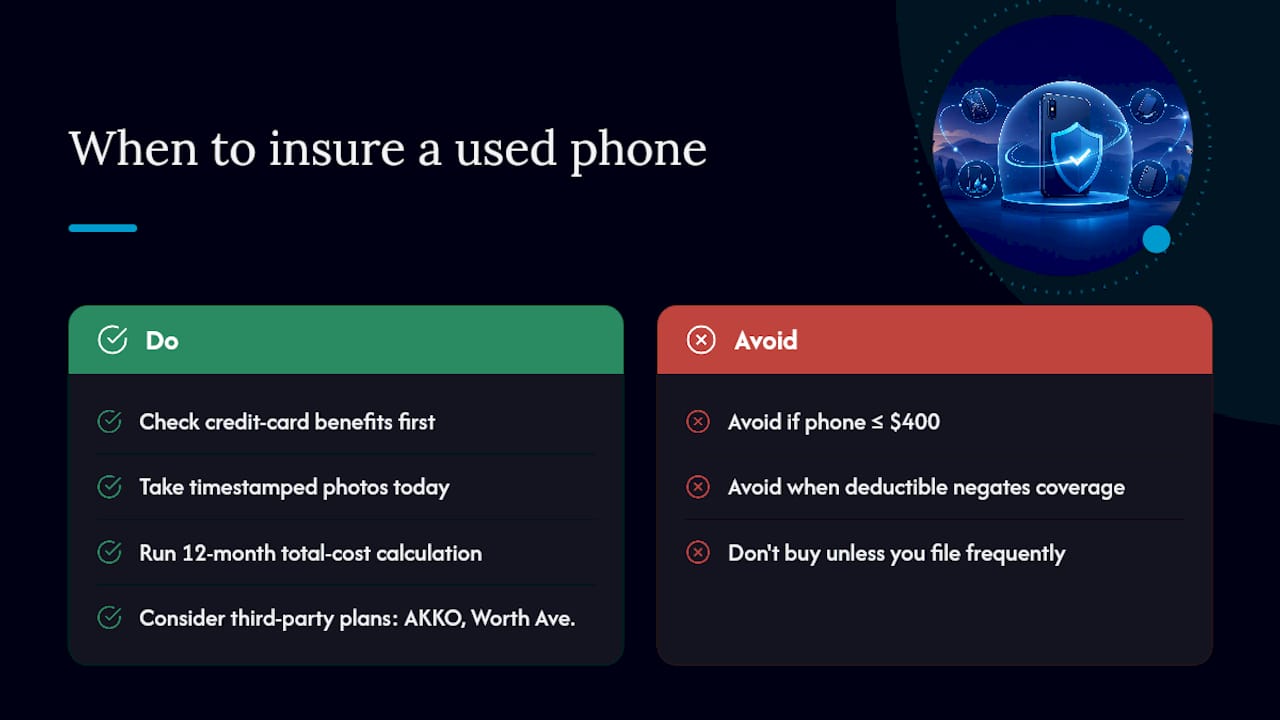
Used phone insurance makes sense in a narrow set of circumstances: the device is worth more than $400, you depend on it for work or income, and an unexpected $400+ repair bill would genuinely strain your budget. Outside that window, the math gets thin fast.
What most people miss is that the deductible is doing most of the work. A $200 deductible on a $350 used phone means insurance is covering only $150 of risk after you’ve already paid months of premiums. That is a bad trade unless you file frequently, and most people don’t.
My honest recommendation: check your credit card benefits first, take timestamped photos of your phone today regardless of what you decide, and run the 12-month total-cost calculation before signing up for anything. If the phone is genuinely high-value and irreplaceable on short notice, a third-party plan like AKKO or Worth Ave. Group often gives you more flexibility than a carrier plan. If the phone is aging and marginal, a verified refurbished replacement is usually the cleaner answer.
A smarter alternative: buy a verified refurbished phone at Devicegiant
If your current phone is old enough that insuring it no longer makes financial sense, the alternative is straightforward: replace it with a verified device that costs a fraction of new.
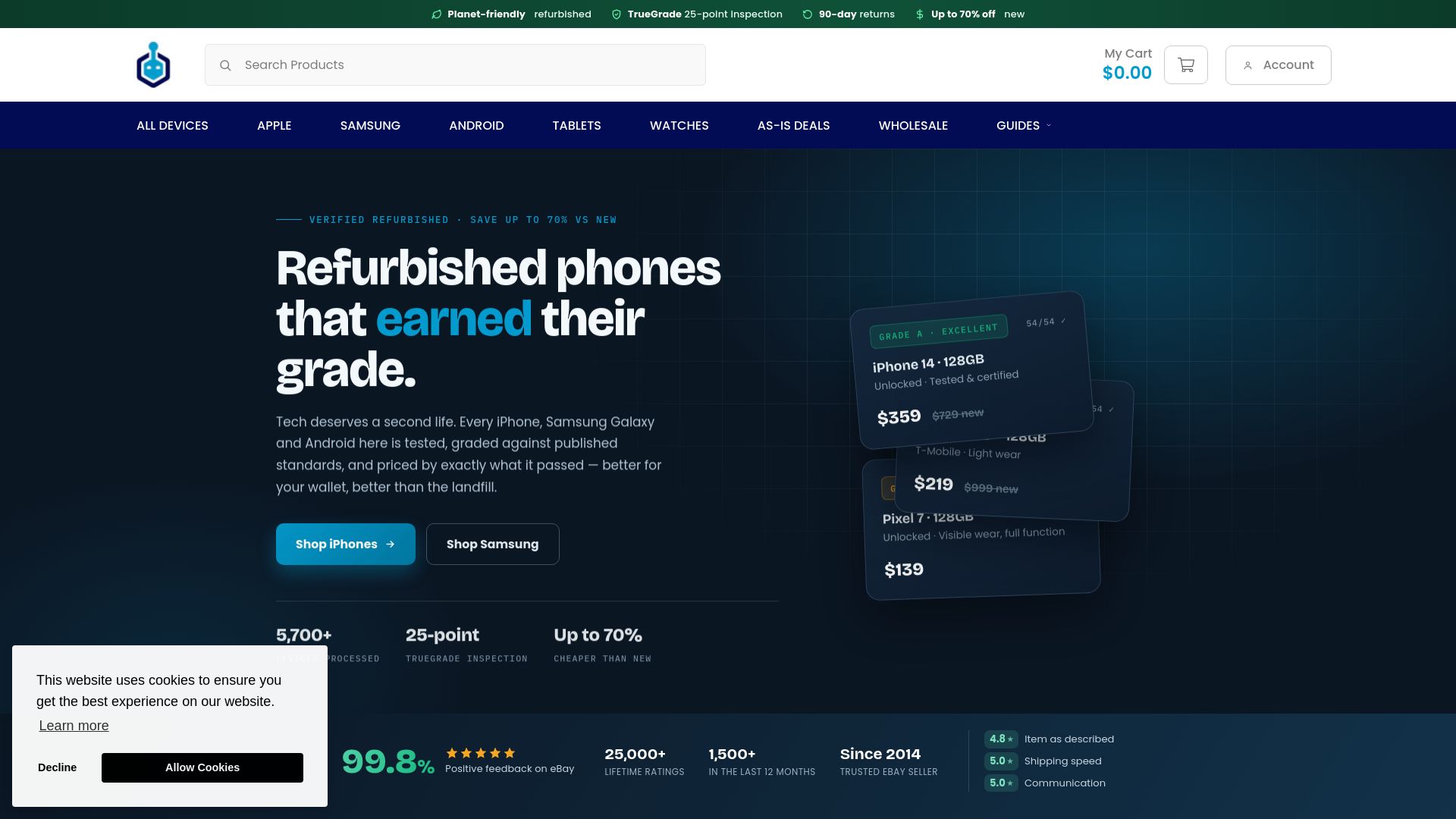
Devicegiant sells refurbished smartphones at up to 70% off new retail prices, each inspected against a 25-point TrueGrade checklist and backed by a 90-day return policy. Budget options like the Samsung Galaxy A14 5G start well under $100. Mid-range picks like the Samsung Galaxy S22 Plus 5G give you premium hardware without the premium price. Buying a verified replacement is not insurance, and it does not protect you from future damage. But for a phone that is already worn, already low in value, and already costing you premiums that exceed its worth, a fresh verified device often makes more financial sense than another year of coverage. Browse the full inventory at Devicegiant and compare the replacement cost against what you would pay in premiums and deductibles over the next 12 months.
Sources
Verify all provider terms directly before purchasing, as plan details, premiums, and deductibles change frequently.
- Is Phone Insurance Worth It? Stop Wasting Money in 2026
- Is Cell Phone Insurance Worth It? | Progressive
- What Does Phone Insurance Cover? | Insurify
- Is Cell Phone Insurance Worth It in 2026? | PureTalk Blog
- What is a device protection plan? | T-Mobile Dialed In
This article is general information, not a substitute for advice from a qualified financial advisor. Consult a qualified financial professional about your own circumstances before acting on anything here.


