
25 Point Checks Resellers Use to Verify Wholesale Phone Warranties

Wholesale phone purchases are governed by the seller’s written warranty and your wholesale contract, not federal consumer warranty protections. Require and document IMEIs and the seller’s warranty text before you release funds. Refurbished lots commonly carry shorter seller warranties, typically with limited coverage periods, so treat the contract itself as your real coverage.
TL;DR:
- Wholesale device warranties are governed by the seller’s written contract, with refurbished lots typically offering shorter coverage of 30 to 180 days.
- Clarity in warranty terms helps protect profit margins by reducing unexpected return costs and provides a clear recourse for disputes with suppliers.
- Verification of devices through IMEI checks, functional testing, and documented grading is essential before accepting shipments to avoid disputes and unnecessary expenses.
- Initiate RMAs promptly within specified windows and document all claims and evidence to strengthen your position during warranty resolution.
- Negotiating specific warranty language, testing rights, and clear claim procedures in contracts offers better protection than relying solely on lengthier or vague warranties.
Table of Contents
- Warranty types, lengths, and the legal baseline at a glance
- Why warranty clarity protects your margins and your reputation
- What each warranty type covers and how to spot it in supplier terms
- How to verify devices before you accept a shipment
- How RMAs work and where the exclusions bite
- Contract clauses worth negotiating before you sign
- A working checklist for pre-purchase, receipt, and post-receipt
- What a documented supplier program looks like in practice
- Balancing price, warranty length, and how fast your inventory turns
- Where Device Giant fits into your wholesale sourcing plan
- Primary sources for the legal and technical claims in this guide
- Sources
- FAQ
Warranty types, lengths, and the legal baseline at a glance
Before you negotiate anything, know what kind of protection you’re actually looking at. Coverage on wholesale phone lots generally falls into one of four buckets, and each behaves differently once a device ships.
- Manufacturer (OEM) warranties typically run one year on new devices and may not transfer cleanly to a reseller buying for resale.
- Distributor or reseller warranties are set entirely by contract terms and vary lot to lot.
- Refurbished-seller warranties commonly range from 30 to 180 days depending on the supplier and grading tier.
- Service contracts or extended plans are sold separately from any warranty and carry their own disclosure rules.
The Magnuson-Moss Warranty Act and related FTC guidance exist to protect consumers, not wholesale buyers. If you’re purchasing for resale, your recourse comes from the wholesale contract and applicable commercial law, not from federal consumer warranty statutes.
Why warranty clarity protects your margins and your reputation
A vague warranty clause looks harmless until a pallet of phones arrives with a higher than expected defect rate. Every unit that comes back for RMA eats into your margin twice: once in the lost sale and again in the labor to process the return. Suppliers who define remedy, timeline, and shipping responsibility up front make that cost predictable. Suppliers who don’t leave you negotiating after the fact, unit by unit.
There’s a customer trust dimension too. If you resell devices to consumers or repair shops and your own supplier’s warranty is unclear, you inherit the dispute when a buyer complains. Chargebacks and negative reviews trace back faster than most resellers expect, and a supplier with a documented, testable warranty gives you something concrete to point to when a customer asks what’s covered.
A written “as-is” disclaimer changes your legal footing entirely. Under the FTC’s guidance on federal warranty law, implied warranties under state commercial law can still apply in B2B deals unless a seller explicitly and properly disclaims them in writing. A supplier who simply says “sold as-is” without addressing grading, functionality, or known defects hasn’t necessarily eliminated their exposure, and you shouldn’t assume you’ve lost yours either. Read the disclaimer language itself, not just the label.
What each warranty type covers and how to spot it in supplier terms
Suppliers use similar sounding language for very different obligations. Learning to read the difference protects you from assuming coverage that doesn’t exist.
- Manufacturer (OEM) warranty. This applies when a device is new and unopened, and it typically follows the original purchaser rather than the reseller. Once a phone changes hands into wholesale channels, transferability becomes murky, so never assume an OEM warranty survives resale unless the supplier states it in writing.
- Distributor or reseller warranty. This is whatever the seller puts in the contract, nothing more. Watch for phrases like “at seller’s discretion” or “subject to inspection,” which give the supplier wide latitude to deny claims.
- Refurbished-seller warranty. These windows are shorter by design, often tied to the cosmetic grading tier assigned to the device. A grade A unit might carry a longer window than a grade C or D unit, and the contract should say so explicitly.
- Service contracts and extended plans. These are sold separately from any warranty and are regulated under different frameworks, including state-level models like the NAIC Service Contracts Model Act. A service contract is not a “written warranty” in the Magnuson-Moss sense, and a supplier offering one shouldn’t describe it using warranty language.
- Marketing claims versus enforceable terms. A line on a sales page or in an email thread (“all our phones are guaranteed”) is not the same as warranty text embedded in the purchase order. If it isn’t in the contract you sign, it isn’t enforceable. Ask for the actual clause, not a summary of it.
How to verify devices before you accept a shipment
Verification is the difference between a warranty you can use and one you’ll spend months arguing about. Build this into your process as a condition of payment, not an afterthought.
- Request full IMEI, MEID, or ESN lists for every unit in the lot before funds move, and check each against blacklist and activation history.
- Confirm lock status rather than assume it. Per FCC guidance on cell phone unlocking, a device is likely carrier-locked unless it’s explicitly sold as unlocked, and carriers publish their own unlocking eligibility rules.
- Pull a sample from the lot and run functional tests on battery health, display, and radios rather than trusting a grading label alone.
- Require photographic or written proof from the supplier that matches their stated grading standard for the lot you’re buying.
Pro Tip: Attach your verification results, including IMEI lists and sample test notes, directly to the purchase order so they become part of the contract record, not a side email that’s easy to dispute later.
How RMAs work and where the exclusions bite
Understanding the claims process before you buy tells you what you’re actually protected against, and what you’re not.
- Initiate the RMA within the seller’s stated window. Most wholesale contracts require notice within a set number of days of receipt, and missing that window can void your claim regardless of the defect.
- Submit documentation. Sellers typically want photos of the defect, the IMEI of the affected unit, and a copy of the original purchase invoice. Keep this evidence organized from day one rather than scrambling after a dispute starts.
- Wait for the seller’s determination. Turnaround varies by supplier, and a contract that doesn’t specify a timeline leaves you with no leverage if a decision drags on.
- Receive the remedy. This is typically repair, replacement, or credit, and the contract should specify which one applies rather than leaving it to seller discretion.
Common exclusions include water damage, physical damage, theft or loss, and cosmetic-only defects that don’t affect function. Push to narrow this language during negotiation rather than accepting a boilerplate exclusion list, since a broadly worded exclusion can swallow claims that should otherwise be covered.
Diagnostic fees, return shipping costs, and repair deductibles are where unexpected costs show up. Bake a reasonable estimate of these into your margin calculations rather than treating warranty coverage as free insurance.
Contract clauses worth negotiating before you sign
The warranty terms you accept on paper are the ones you’re stuck with, so treat the contract as your real point of leverage.
- Insist on full warranty text, not a summary, including the effective date, the remedy offered, the RMA window, inspection criteria, and who pays for shipping.
- Push back on vague “at seller’s discretion” language and on “as-is” confirmations that don’t reference a specific grading standard.
- Require seller-supplied IMEI lists and sample testing rights as a condition precedent to final payment, not a courtesy extended after the fact.
- Negotiate caps on liability and repair costs so a defective lot doesn’t turn into an open-ended expense.
Pro Tip: If a supplier won’t shorten a vague exclusion clause, ask for a price concession instead. Accepting a shorter or narrower warranty is a reasonable trade when it comes with a lower per-unit cost, as long as you’ve priced the added risk.
A working checklist for pre-purchase, receipt, and post-receipt
Turning everything above into a repeatable process is what actually reduces risk across dozens of purchase orders, not just the next one.
- Pre-purchase: obtain the full warranty text, IMEI lists, the grading rubric, sample photos, and an explicit return or credit policy before you commit funds.
- At receipt: sample-test units, confirm IMEIs and lock status, photograph and log any discrepancies, and open RMAs within the seller’s stated window rather than waiting.
- Post-receipt: track your return rate by supplier, keep a running scorecard, and use repeat problems as leverage to renegotiate terms on the next order.
| Stage | Key action | What it protects |
|---|---|---|
| Pre-purchase | Collect warranty text, IMEI lists, grading rubric | Your legal position if a dispute arises |
| At receipt | Sample-test, verify locks, document evidence | Your RMA window and claim strength |
| Post-receipt | Track returns, score suppliers | Your future negotiating leverage |
What a documented supplier program looks like in practice
Buyers evaluating a new supplier need something concrete to compare against, not just marketing language. Device Giant’s approach illustrates the kind of documentation this article recommends you look for.
- Every device goes through a TrueGrade 25-point functional checklist covering the areas most likely to generate post-sale disputes, from battery health to display and radio performance, with results tied to the device’s documented condition. Some suppliers offer a return window of around 90 days, which is within the typical 30 to 180 day range for refurbished sellers, allowing buyers time to sample-test a lot before the window closes. Positive feedback on platforms like eBay can serve as a public trust signal, but any single rating should be considered a starting point, with grading transparency and RMA responsiveness verified independently.
Balancing price, warranty length, and how fast your inventory turns
The instinct among resellers is to chase the longest warranty window available, but that’s not always the right trade. If your inventory turns in a matter of weeks, a 30 day warranty on a deeply discounted lot can outperform a 180 day warranty on a pricier one, because you’ve usually resold or identified defects well before the clock runs out anyway.

What matters more than length is transparency. A supplier with a clear 25-point grading standard and a fast RMA turnaround will save you more money over a year than a vague 12-month warranty full of discretionary exclusions. Speed and clarity beat duration almost every time, because a warranty you can’t easily invoke isn’t really protection.
Fold this into how you score suppliers over time. Track not just whether a supplier honors warranty claims, but how quickly, and how much documentation they demand before they do. That pattern tells you more about real risk than any single warranty length printed in a contract.
— Saad
Where Device Giant fits into your wholesale sourcing plan
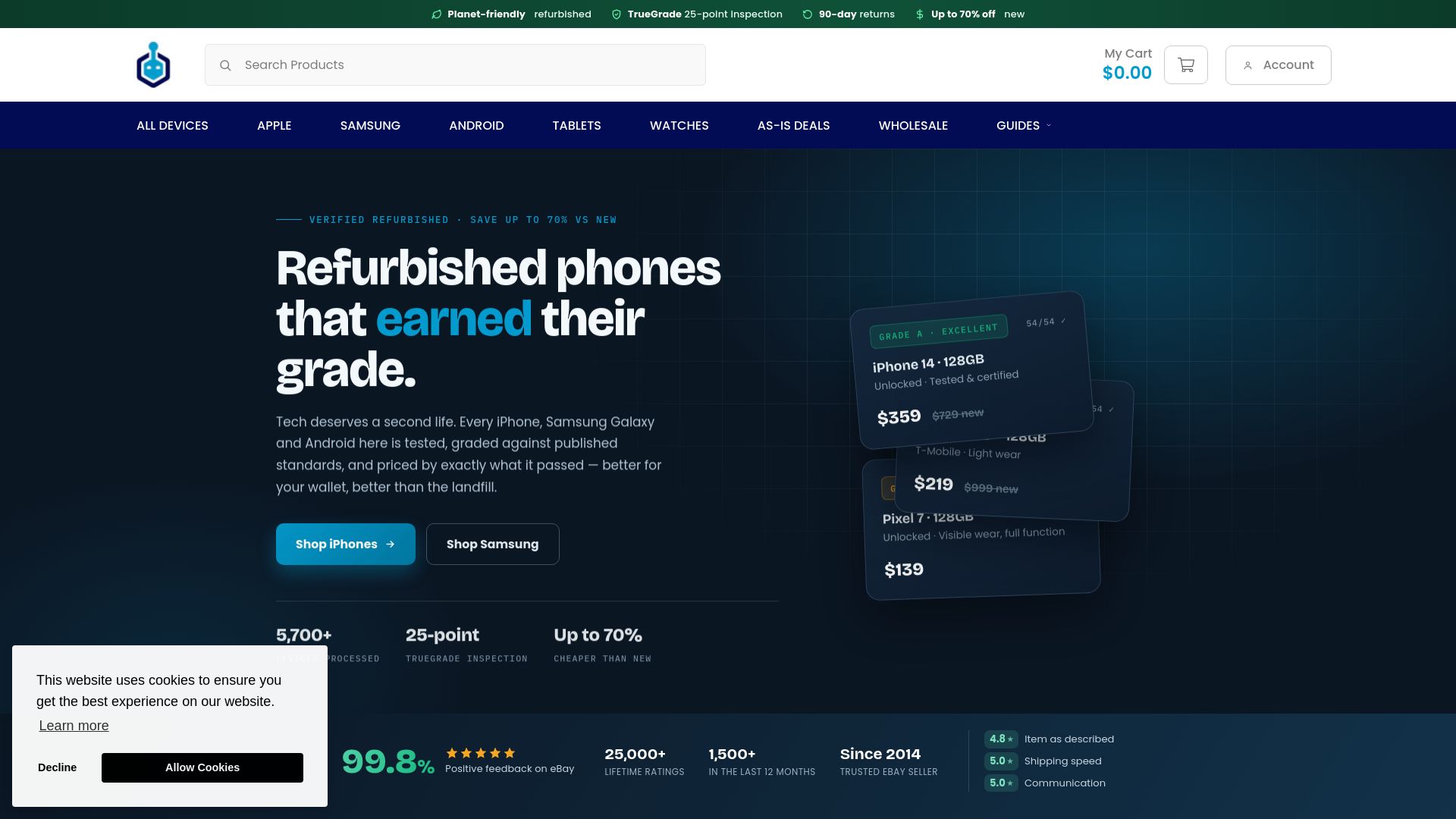
Buying at scale should not mean giving up the documentation this guide recommends. Some wholesale programs apply consistent functional inspection and return policies to bulk orders as to individual units, providing graded condition data on every device rather than a blanket “as-is” label.
- Request IMEI lists and grading reports for a lot before committing to payment, the same verification step recommended throughout this guide.
- Browse categories including Apple iPhones & iPads, Samsung Galaxy, and Android Phones available for wholesale and bulk purchase.
- Review what’s documented on arrival, including functional inspection points and battery health data, before you place a repeat order.
For buyers who also need repair support once devices are in circulation, a qualified local provider like Collett Systems can help verify repair-related warranty claims and document unit condition when a supplier’s RMA process requires third-party assessment.
Start by browsing Device Giant’s wholesale and bulk catalog to request pricing and sample lot documentation for your next order.
Primary sources for the legal and technical claims in this guide
- 15 U.S.C. § 2301 defines who counts as a consumer under the Magnuson-Moss Warranty Act and excludes buyers purchasing for resale.
- FTC’s businessperson’s guide explains disclosure requirements once a warranty is offered.
- FCC guidance on cell phone unlocking covers device identifier checks and carrier lock policies.
- NAIC’s Service Contracts Model Act sets the disclosure framework for service contracts sold separately from warranties.
Sources
- 15 U.S.C. § 2301 (Magnuson-Moss Warranty Act definition of consumer)
- Businessperson’s guide to federal warranty law — FTC
- Cell phone unlocking — FCC
- Warranties — FTC consumer information
FAQ
What is the best phone warranty for wholesale buyers?
There’s no single “best” warranty for wholesale purchases since coverage depends entirely on the seller’s written terms and your contract, not a standardized product. Look for suppliers who provide a documented grading standard, a clear RMA process, and a return window of 90 days or longer, which the FTC notes must be disclosed before sale when a written warranty is offered.
How do I buy cell phones in bulk at wholesale prices?
Buying in bulk means sourcing from a wholesale supplier that offers verified IMEI lists, cosmetic grading, and documented functional testing before you commit to a lot. Request warranty text, sample photos, and a return policy in writing before releasing payment, and confirm lock status on each device using carrier unlocking guidance from the FCC.
Where can I find a wholesale supplier of cell phone cases?
Cell phone cases and accessories are typically sourced from electronics wholesalers or distributors separate from device suppliers, and buyers should apply the same verification standard: written terms, defect rate disclosure, and a clear return policy. Ask any accessory supplier for sample units and documented quality standards before committing to a bulk order.
Which phone has the longest manufacturer warranty?
Manufacturer warranty length varies by brand and typically runs around one year for new devices, though a reseller purchasing for resale generally can’t rely on that warranty transferring to them or their buyer. For wholesale purchases, the seller’s own written warranty and your contract terms matter far more than the original manufacturer’s coverage.
Do federal warranty laws protect wholesale phone buyers?
Federal consumer warranty law, including the Magnuson-Moss Warranty Act, applies to consumers and explicitly excludes buyers purchasing for resale. Wholesale buyers’ protections come from the terms negotiated in their purchase contract, not from federal consumer statutes.

