
3 Parts That Reveal OEM vs Aftermarket in Refurbished Phones

Most refurbished phones run on a mix, not one category. Refurbishers typically keep the original mainboard, camera, and display when they still pass testing, then swap failing parts with OEM components or vetted aftermarket replacements, disclosing the grade when budget parts are used. The three components to scrutinize before you buy: the screen, the battery, and the camera module.
TL;DR:
- Most refurbished phones combine OEM, pulled, and aftermarket parts, with screens, batteries, and cameras posing the highest quality risks.
- Labels like OEM or genuine mean little without proof of sourcing or testing, making supplier transparency crucial in assessing parts.
- Aftermarket OLED screens often show significant quality gaps, such as dimmer colors or touch lag, compared to OEM components.
- Battery health percentage is the most important specification, as it predicts long-term reliability better than part origin labels.
- Reputable sellers disclose part provenance, perform multi-point testing, and offer warranties aligned with part quality to ensure trustworthy refurbishment.
Table of Contents
- OEM Parts vs Aftermarket: Defining Genuine, Pulled, and Compatible
- Which Parts Show the Biggest Quality Gaps?
- How Do You Verify Part Origin Before You Buy?
- When Should You Choose OEM Versus Aftermarket?
- What Warranty and Testing Should You Expect?
- The Case for Verified Inspection Over Blind Trust
- Where to Buy Verified Refurbished Devices With Disclosed Parts
- Sources
- FAQ
OEM Parts vs Aftermarket: Defining Genuine, Pulled, and Compatible
The terminology in phone repair is looser than it should be, and that looseness is exactly what causes buyer confusion around OEM parts vs aftermarket claims. “OEM” technically means the part was made by the original manufacturer or its licensed supplier, but sellers use it inconsistently, sometimes to describe a genuine part, sometimes to describe a high-quality clone. According to celltech’s repair parts explainer, “genuine” normally means the part came through the manufacturer’s own supply chain, while “OEM” and “OEM-grade” get applied loosely across the trade.
Here’s how the terms function in practice:
- Genuine: sourced directly from the manufacturer or an authorized supplier, with no substitution.
- OEM / OEM-grade: made to original specifications, but the label alone doesn’t guarantee manufacturer sourcing.
- Pulled (refurbished original): a real part removed from a donor device, cleaned, tested, and reused.
- Aftermarket: a third-party replacement, spanning a wide quality range from near-identical to noticeably inferior.
None of these labels mean much without provenance behind them. A listing that says “OEM screen” tells you nothing about who actually made it or whether it passed a functional test. That’s why the smarter question isn’t “is this OEM or aftermarket?” but “who supplied this part, and how was it tested?”
Which Parts Show the Biggest Quality Gaps?
Screens, batteries, and cameras carry the most risk when swapped for lower-tier aftermarket parts, and the gap is widest on OLED displays. Fixo’s comparison guide notes that premium aftermarket LCD panels can come close to OEM performance, but aftermarket OLED quality varies far more, showing up as dimmer colors, touch lag, or inconsistent brightness.
Some aftermarket screens even reuse a genuine OLED panel paired with a third-party digitizer, a hybrid approach that can deliver near-OEM feel at a lower price point. That combination is worth asking about directly rather than assuming a screen is either fully original or fully third-party.
Lower-risk components for aftermarket substitution include:
- Charging ports and flex cables
- Speakers and microphones
- Rear housings and frames
- Buttons and SIM trays
Feature loss is a real risk with mismatched parts. Devices with parts pairing, like Apple’s True Tone display calibration, may lose that function entirely unless the replacement is manufacturer-sourced or properly reprogrammed, a limitation confirmed by Cellbot’s repair shop guide. Battery safety is the other flashpoint. A poorly made aftermarket battery can swell, drain unpredictably, or trigger system warnings, which is exactly why battery health disclosure matters more than almost any other spec on a refurbished listing.
How Do You Verify Part Origin Before You Buy?
Ask direct questions and expect direct answers. A seller who can’t or won’t tell you where a part came from is telling you something too.
- Ask who made the part and through what supply route it reached the seller, not just whether it’s labeled “OEM.”
- Request the battery health percentage, since this single figure predicts more post-purchase complaints than any other spec.
- Ask whether the part is “pulled” or new aftermarket, since both are legitimate but priced and warrantied differently.
- Request photos or inspection documentation showing the actual part installed, not stock images.
- Check for a written testing checklist tied to the specific unit you’re buying, not a generic disclaimer.
KnowYourMobile’s guide to refurbished phones points out that reputable sellers volunteer exact part details and transferred features like True Tone without being asked twice.
Watch for red flags: vague labels like “high quality replacement” with no supplier name, prices dramatically below the rest of the market, no warranty at all, or a seller who deflects questions about sourcing.
Pro Tip: If a listing doesn’t mention battery health as a percentage, assume it hasn’t been tested and ask before you pay, not after.
When Should You Choose OEM Versus Aftermarket?
The right call depends on how much the device matters to you and how long you plan to keep it, not on chasing the “best” part in the abstract.
- Flagship or daily-driver phone: prioritize OEM or genuine pulled parts, especially for the screen and battery, since resale value and insurance claims often depend on original specs.
- Mid-range or older device: premium aftermarket is often the smarter budget move, particularly for LCD screens where the performance gap is small.
- Spare or temporary phone: budget aftermarket can make sense here, as long as the seller discloses the grade clearly and backs it with even a short warranty.
| Use case | Recommended part tier | What to prioritize |
|---|---|---|
| Flagship, daily driver | OEM or genuine pulled | Screen and battery originality |
| Mid-range, resale-bound | Premium aftermarket | Warranty length, tested battery health |
| Backup or short-term use | Budget aftermarket (disclosed) | Lowest price, accept shorter coverage |
Price and risk move together here. A cheaper aftermarket battery might save you $15, but if it fails in four months with no warranty, that “savings” evaporates fast. Warranty length is often a better signal of real quality than the part label itself.
What Warranty and Testing Should You Expect?
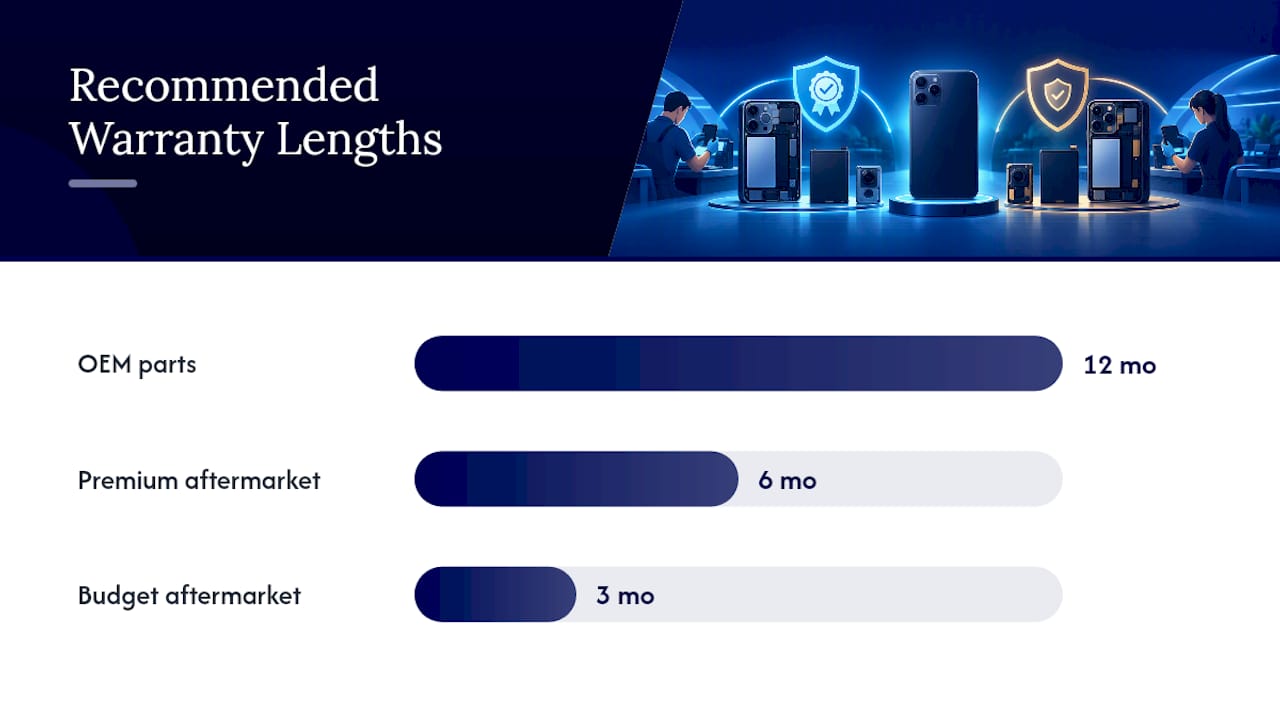
Warranty length should track part grade, and a seller who offers the same coverage regardless of part quality is either overpromising on cheap parts or underpricing good ones. Trade guidance from Cellbot recommends roughly 12 months for OEM parts, 6 months for premium aftermarket, and 3 months for budget aftermarket stock. That tiered structure gives you a quick sanity check on any quote you receive.
A transparent listing or repair quote should show:
- The part’s origin (OEM, pulled, premium aftermarket, or budget aftermarket)
- Battery health as a specific percentage
- Testing outcomes against a defined checklist, not a vague “fully tested” claim
- Any excluded features or known limitations (like lost parts-pairing functions)
If something feels off after you receive the device, inspect it immediately rather than waiting weeks. Check the battery health reading, test the camera and screen touch response, and confirm any features that depend on original parts still work. Use the return window right away if anything doesn’t match what was described. A repair service like Digiwrld’s screen repair program illustrates what that disclosure and testing workflow should look like from a repair provider’s side.
The Case for Verified Inspection Over Blind Trust
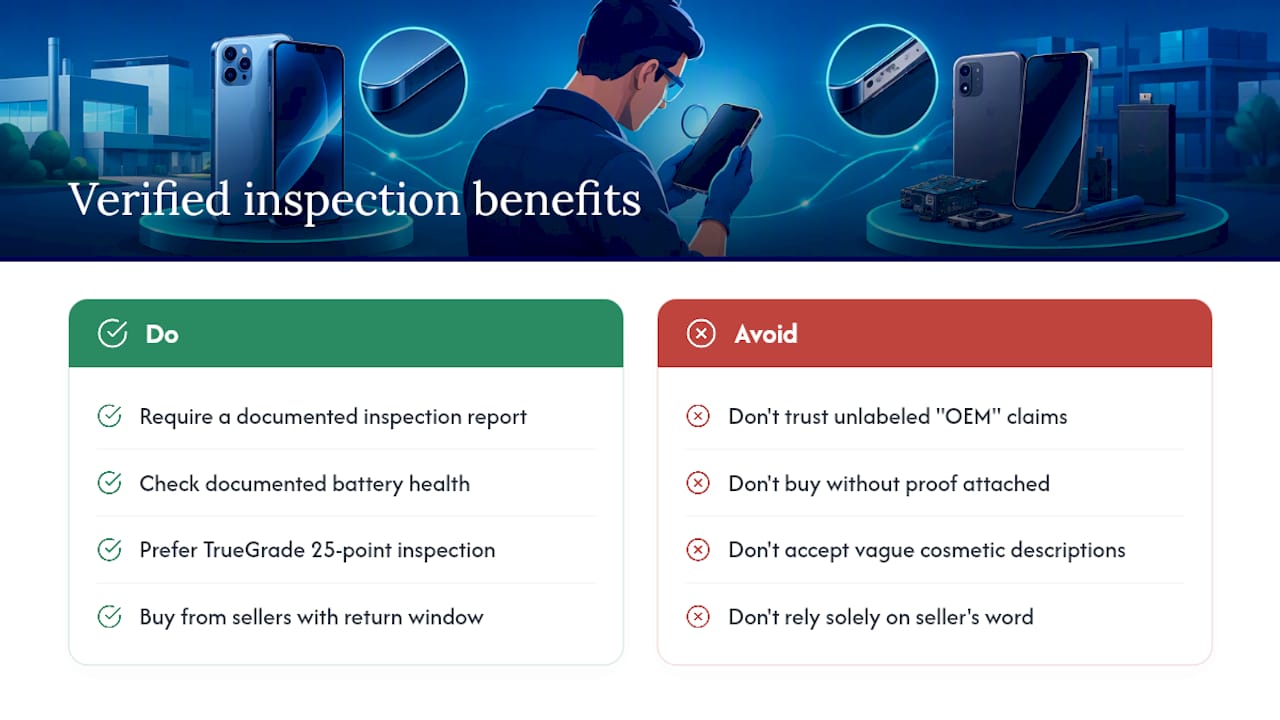
The debate over OEM screen vs aftermarket or battery sourcing misses the real point: the label matters less than the verification behind it. A phone with a disclosed premium aftermarket screen and a documented 92% battery health reading is a safer buy than one vaguely marketed as “OEM” with no proof attached.
That’s the gap a structured inspection standard closes. A TrueGrade 25-point inspection and cosmetic grading system can give buyers more confidence than just taking a seller’s word for it. Paired with a return window and positive customer feedback, that kind of transparency helps turn “trust me” into something more verifiable. Refurbished electronics remain one of the most practical ways to cut cost and e-waste, but only when the seller shows their work.
— Saad
Where to Buy Verified Refurbished Devices With Disclosed Parts
This type of seller is built for buyers who want a device that has been checked, not just cleaned and reboxed. Units typically go through a multi-point inspection, receive a disclosed cosmetic grade instead of a vague “like new” label, and may come with a return window if something doesn’t check out.
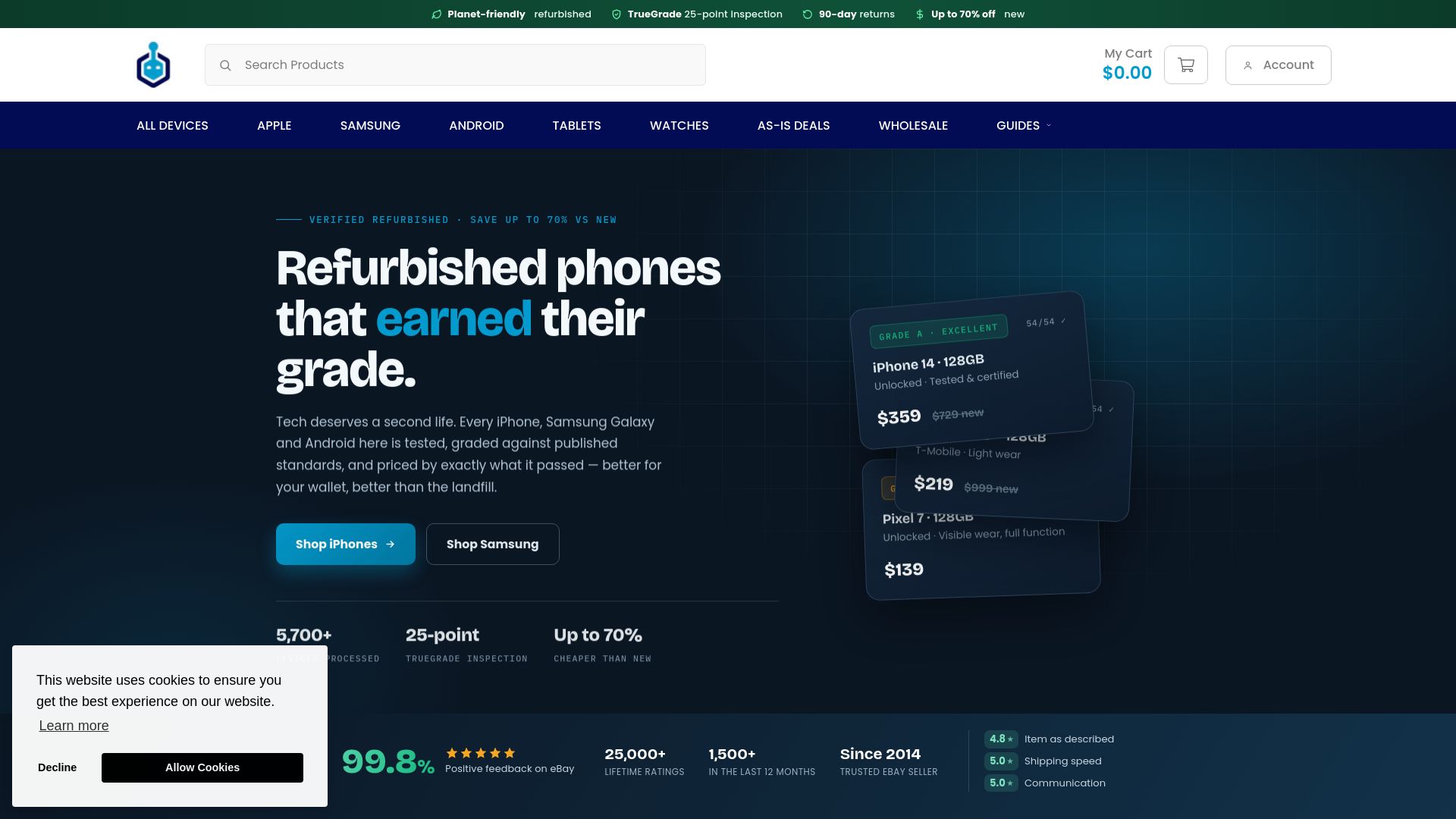
That combination matters most on the parts that fail first: batteries, screens, and cameras, which is exactly where this guide told you to focus your questions. Instead of chasing down a seller for battery health numbers or part origin, you get that disclosure up front. Browse the current lineup of refurbished phones, tablets, and smartwatches, or check a specific model like the Google Pixel 6a 128GB to see the grading and inspection details for yourself. If you have questions about a specific part or supplier before buying, reach out to support and ask directly.
Sources
- Genuine, OEM and Aftermarket Repair Parts Explained - celltech
- OEM vs Aftermarket Phone Parts Explained - Fixo
- OEM vs Aftermarket Parts: The Complete Guide for Repair Shops - Cellbot
- Are refurbished phones good? Pros & cons - KnowYourMobile
FAQ
Is It Bad If a Refurbished Phone Has Aftermarket Parts?
Not necessarily. Premium aftermarket parts, especially LCD screens and non-critical components like charging ports, can perform close to OEM standards when properly tested. The risk comes from undisclosed budget aftermarket parts, not aftermarket parts in general.
How Can I Tell if a Screen Is OEM or Aftermarket?
Ask the seller directly, since visual inspection alone often isn’t reliable, particularly on OLED displays where aftermarket variance is highest according to Fixo. A trustworthy listing states the screen’s origin and grade rather than just calling it “high quality.”
Why Does Battery Health Matter So Much in This Comparison?
The battery is usually the first component to fail and the hardest to judge by appearance alone. Reputable refurbishers disclose battery health as a specific percentage, and that number tells you more about real-world reliability than any “OEM” or “aftermarket” label.
Does Devicegiant Use OEM or Aftermarket Parts?
Devicegiant’s TrueGrade 25-point inspection checks functionality and discloses cosmetic grading on every device it sells, so you know the condition and testing outcome before buying. Pricing and specific part details vary by device and are listed on each product page.
What Warranty Should I Expect on a Repaired Phone?
Warranty length should match part grade: roughly 12 months for OEM parts, 6 months for premium aftermarket, and 3 months for budget aftermarket, per Cellbot’s repair shop guidance. Anything shorter than that on OEM parts, or a seller offering no warranty at all, is worth questioning.


