
6 Checks for Refurbished: Manufacturer vs Seller, 25 Point Example

Manufacturer refurbished means the brand itself reconditioned the device with brand-approved parts and a manufacturer warranty. Seller refurbished means a third party repaired, tested, and graded it, with standards that vary from one seller to the next. Choose manufacturer refurbished when you want certainty on battery health and warranty service; choose a vetted seller when you want a lower price or a specific carrier configuration, but verify testing and return terms before you pay.
TL;DR:
- Manufacturer refurbished devices are repaired and tested in authorized facilities using genuine parts, come with a one-year warranty, and often include a new or certified battery.
- Seller refurbished products are repaired by third-party sources with varying standards, usually have shorter warranties, and may not replace batteries or guarantee consistent quality.
- Verify specific inspection checklists, parts policies, and warranty terms in writing before purchasing any refurbished device, especially from independent sellers.
- Bulk business orders should include a clear grading rubric, documented sample inspections, and detailed device documentation to avoid significant variation and disputes.
- Price differences reflect the level of certification and certainty; manufacturer refurbishments cost more but offer greater confidence in battery health and warranty coverage.
Table of Contents
- Seller Refurbished vs. Manufacturer Refurbished: The Core Difference
- What Manufacturer Refurbished Actually Means
- What Seller Refurbished Really Covers
- Manufacturer vs. Seller Refurbished, Side by Side
- How to Verify a Refurbished Listing Before You Buy
- Buying in Bulk: What Small Businesses Need in the Contract
- What a Trustworthy Seller’s Inspection Actually Looks Like
- Which Refurbished Option Actually Fits Your Situation
- Sources
- FAQ
Seller Refurbished vs. Manufacturer Refurbished: The Core Difference
The phrase gets thrown around loosely, so it helps to nail down the two standard industry terms first: factory recertified (what people mean by “manufacturer refurbished”) and third-party renewed (what people mean by “seller refurbished”). Both describe used electronics that were tested, repaired, and resold, but who does that work, and under what rules, changes everything about what you’re actually buying.
Factory recertified devices go back through the brand’s own repair pipeline or an authorized facility working under the brand’s specifications. Third-party renewed devices pass through independent refurbishers, marketplace suppliers, or resellers who set their own testing bar. Neither label is inherently a scam or a guarantee. The difference shows up in three places: how the warranty works, whether the battery gets replaced, and how consistently the grading matches what arrives in the box.
What Manufacturer Refurbished Actually Means
When a brand refurbishes its own device, the work happens in a factory or an authorized facility following the manufacturer’s own repair specifications. That matters because the technicians have access to the original design tolerances, diagnostic software, and, in most cases, genuine replacement parts rather than aftermarket substitutes.
Apple’s Certified Refurbished program illustrates the model well. Devices go through full functionality testing, any defective module gets swapped for a genuine part where needed. The unit is repackaged, and it ships with Apple’s one-year limited warranty, the same coverage a new device gets. Samsung runs a comparable operation under its Certified Re-Newed program, which uses genuine Samsung parts, installs a certified new battery and a new IMEI, and requires devices to pass a 147-point quality inspection before they’re eligible for resale, backed by a one-year limited manufacturer warranty.
That specificity is the whole point. A vague “inspected and tested” claim tells you nothing. A published checkpoint count and a named parts policy tell you exactly what was verified.
What buyers can typically expect from a manufacturer-refurbished purchase:
- A written one-year limited warranty serviced directly by the brand or its authorized network
- Genuine parts used in repairs, not generic aftermarket components
- A battery that’s often new or certified to meet original capacity standards
- Original-style packaging and accessories, sometimes with minor cosmetic variation noted upfront
- The option to add a manufacturer service plan for extended coverage
The tradeoff is price. Manufacturer refurbished rarely matches the steepest discounts you’ll see from third-party sellers, because you’re paying for that documentation and brand-backed support.
What Seller Refurbished Really Covers
Seller refurbished, sometimes labeled “renewed” or “third-party refurbished,” covers a much wider range of actors and standards. This category includes independent refurbishing companies with their own inspection labs, marketplace suppliers who buy return and lease inventory in bulk, and individual resellers who may do minimal testing before relisting.
Marketplace platforms complicate things further by running multiple tiers under the same general label. A “standard” renewed tier and a “premium” renewed tier from the same platform can carry different guarantees and return windows, even though both use the word “renewed.” That’s why the listing’s own text controls what you’re actually entitled to, not the badge or the general program name.
Seller refurbished earns its popularity for real reasons:
- Lower prices, often the widest discounts you’ll find on a given model
- Unlocked or carrier-specific configurations that manufacturer channels don’t always stock
- Bulk availability, useful for small businesses outfitting a team on a budget
- Faster turnaround on niche or older models manufacturers have stopped reconditioning
The risks track just as closely with the savings. Battery health is the biggest unknown. Manufacturer refurbished programs frequently promise a new or certified battery, but sellers may not, so an unhealthy battery can pass a basic power-on test and still fail you within months. Grading inconsistency is the second risk. Two “excellent condition” listings from two different sellers can look nothing alike once the box opens, which is exactly why manufacturer versus seller refurbished programs tend to diverge most on documented standards rather than on the actual repair work performed.
Manufacturer vs. Seller Refurbished, Side by Side
Here’s how the two options typically stack up across the factors that actually affect your ownership experience.
| Factor | Manufacturer Refurbished | Seller Refurbished |
|---|---|---|
| Who performs the work | Brand’s own facility or authorized partner | Independent refurbisher, marketplace supplier, or reseller |
| Typical warranty | One year, serviced by the brand (Apple, Samsung) | Varies by seller; often 90 days to one year, serviced by the seller |
| Battery policy | New or certified battery often included | Varies; not always disclosed or replaced |
| Cosmetic grading | Brand-set standard, minimal variation | Grading language varies by seller and listing tier |
| Packaging | Often close to original retail packaging | Generic box; accessories vary by listing |
| Typical discount vs. new | Moderate | Often the deepest discounts available |
Samsung’s 147-point inspection and genuine-parts commitment set a useful bar for what a real certification should look like: a specific checkpoint count, a named parts policy, and a defined warranty term, all published before you buy. Apple’s model runs on the same logic, pairing full functional testing with genuine-part replacement and a one-year warranty that mirrors new-device coverage.
If warranty certainty and battery confidence matter most to you, manufacturer refurbished is the safer default. If price and configuration flexibility matter more, and you’re willing to do some homework on the specific seller, third-party renewed can be excellent value.
Pro Tip: Ask any seller, manufacturer or third party, for the exact test count and parts policy in writing before you buy. “Fully tested” with no number behind it is marketing language, not a standard.
How to Verify a Refurbished Listing Before You Buy
Documentation beats buzzwords every time. A comparison of certified labels against plain “used” listings shows the word “certified” carries no fixed legal weight. What matters is whether the seller backs it with specifics you can check.
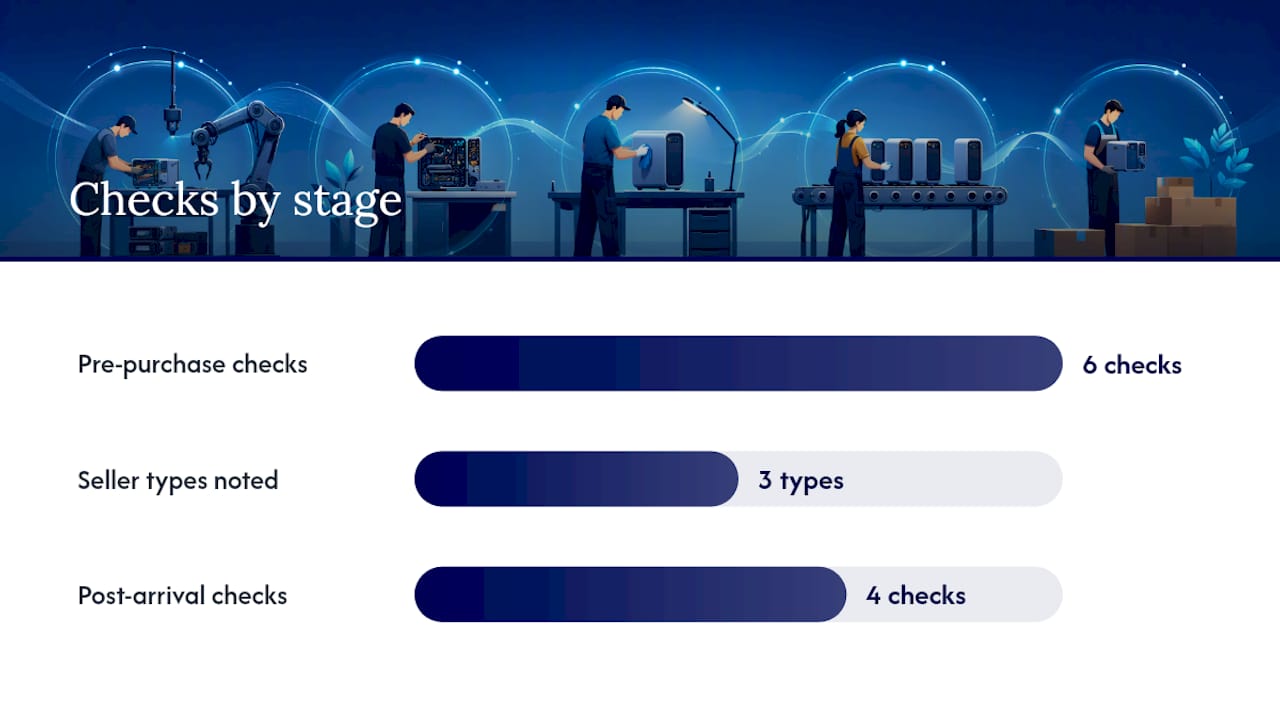
Run through these six checks before you commit to any listing:
- Identify who refurbished it. Brand facility, authorized partner, or independent reseller each carry different accountability.
- Look for a named test count. A “147-point inspection” or “25-point check” tells you more than “thoroughly tested.”
- Confirm the parts policy. Ask directly whether replaced components are genuine or aftermarket.
- Get the battery policy in writing. New battery, certified capacity, or no guarantee at all changes the device’s real lifespan.
- Read the cosmetic grade definition. “Excellent” means something different from one seller to the next.
- Pull up the warranty and return terms separately. A short return window doesn’t mean a short warranty, and a long warranty doesn’t mean an easy return.
The FTC requires warranty terms to be available before you buy, not buried in a support email after the sale. If a listing doesn’t show warranty language, ask for it directly and save the response.
Once the device arrives, and while your return window is still open, verify the IMEI or serial number matches the listing, confirm the device isn’t activation locked or tied to someone else’s cloud account, and run through calls, cameras, charging, and sensors before the clock runs out. Screenshot the listing, save the warranty text, and photograph the device and packaging on arrival. If a dispute comes up later, that paper trail is what settles it, since marketplace tiers can carry different guarantees even under the same general “renewed” program name.
Buying in Bulk: What Small Businesses Need in the Contract
Lot-level variation is the biggest risk in business purchasing, and it rarely shows up until units are already deployed. A single “excellent condition, 90% battery health” line item can hide real spread across a hundred-unit order.
Before signing off on a bulk purchase, insist on:
- A written grading rubric that defines each cosmetic tier in specific, checkable terms
- The right to inspect a representative sample before accepting full shipment
- Full IMEI or serial documentation for every unit in the lot
- A stated defect-rate ceiling and a defined replacement or refund process for units that fall outside it
- Clear acceptance criteria covering appearance, battery health, and network compatibility as separate categories, not one blended grade
Cosmetic grade and functional grade are not the same thing, and treating them as one number is where most bulk-order disputes start. Separate the two categories explicitly in your purchase agreement. For business buyers working with marketplace sellers specifically, insisting on a written rubric and replacement terms up front avoids the more common dispute pattern: a seller claiming the units matched spec while the buyer disagrees, with no documented standard to settle it.
Test a representative sample from the shipment before deploying the full order, document the results against your acceptance criteria, and stage replacements for any units that fail before they reach end users. Reviewing how refurbished return policies handle batch returns versus single-unit returns is worth doing before you place a large order, since the two often work differently.
What a Trustworthy Seller’s Inspection Actually Looks Like
Device Giant’s TrueGrade process is a working example of what buyers should demand from any seller, manufacturer-run or independent. Every device goes through a 25-point functional check covering battery performance, charging ports, cameras, sensors, activation status, and IMEI verification, the same category of checks that make Samsung’s and Apple’s programs credible, just run by a specialized independent refurbisher rather than the original brand.
The proof points worth looking for in any seller:
- Cosmetic grading that’s disclosed clearly, not buried in fine print
- Pricing that reflects real savings compared to brand-new devices
- A return window generous enough to catch problems that don’t surface on day one
- A track record you can verify independently, such as a public feedback history available from some sellers
Before buying from any refurbisher, ask for the same three things: published inspection details, a written grading rubric, and warranty text you can read before you pay, not after. You can review how Device Giant discloses battery health and grading as one model of what that transparency should look like in practice.
Which Refurbished Option Actually Fits Your Situation
The tradeoff comes down to two variables that matter more than any brand name: how much certainty you need on battery health, and how much you’re willing to pay for someone else to guarantee it. Manufacturer refurbished removes the guesswork on both fronts. Seller refurbished shifts that risk back to you in exchange for a lower price.
My rule of thumb for readers weighing the two: if you can’t get a straight answer on battery policy and warranty terms in writing before you buy, treat that silence as your answer.
— Saad
Sources
For the warranty terms behind everything above, the FTC’s guide to warranties explains what sellers must disclose before you buy, and how a warranty differs from a return policy. Apple’s and Samsung’s own refurbished program pages spell out their specific testing and parts commitments directly. Save the exact warranty text at checkout, whichever seller you choose, and ask for it in writing if a listing doesn’t already show it.
FAQ
What does “manufacturer refurbished” mean?
It means the original brand, or a facility authorized by that brand, reconditioned the device using its own repair specifications. Apple’s and Samsung’s programs typically include genuine parts, documented testing, and a one-year limited warranty matching new-device coverage.
Is factory reconditioned better than refurbished?
“Factory reconditioned” is essentially another name for manufacturer refurbished, so the two aren’t competing categories. It’s generally more consistent than generic “refurbished” listings from unspecified sellers, because it follows the brand’s own repair standards rather than a third party’s.
What does “seller refurbished” mean?
It means an independent refurbisher, marketplace supplier, or reseller repaired and tested the device using its own standards rather than the original brand’s. Quality can be excellent or inconsistent depending on the seller, which is why checking the specific listing’s terms matters more than the general label.
What is manufacturer recertified?
“Recertified” and “refurbished” are used interchangeably by most manufacturers to describe the same process: brand-run testing, repair with approved parts, and a warranty backed by the brand. Samsung’s version includes a 147-point inspection and a certified new battery as part of that recertification process.


