
Avoid Bad Batches: Buy Bulk Phones for Businesses With a 25 Point RFP

To buy phones in bulk safely, work with verified B2B refurbishers or authorized distributors who provide written grading and IMEI documentation. Auctions and open marketplaces can beat their prices, but only if you have real in-house testing capacity to catch bad units before they reach customers or employees. Start small: define your use case, then order a test lot with explicit grading terms and a full IMEI list before committing to anything larger.
TL;DR:
- Bulk phones should come from verified suppliers offering written grading reports and full IMEI lists to prevent quality and compliance issues.
- Starting with small test orders and demanding detailed proof of quality can help identify reliable vendors and avoid large-scale losses.
- Authorized distributors and trusted refurbishers are more dependable for consistent quality and warranty support than open marketplaces or liquidation auctions.
- Proper testing of battery health, IMEI status, and cosmetic grading before full payment can reduce the risk of defective units reaching customers or employees.
- Planning for additional costs like shipping, duties, compliance, and potential returns is essential to accurately calculate the total landed cost.
Table of Contents
- How to Buy Phones in Bulk: Define Your Use Case First
- Where to Source Phones in Bulk
- What Quality Checks Should You Demand Before Paying?
- How Should You Order and Test a Sample Lot?
- What Shipping and Compliance Costs Should You Plan For?
- Supplier Evaluation Checklist Before a Large Order
- What Should Your Contract Cover?
- What After-Sales Support Should You Expect?
- Why Grading Transparency Changes Everything
- Get Verified Bulk Stock Without the Guesswork
- Sources
- FAQ
How to Buy Phones in Bulk: Define Your Use Case First
Before you contact a single supplier, figure out what the phones are actually for. That answer changes everything downstream, from acceptable cosmetic grade to what paperwork you need in hand.
- Resale to consumers usually tolerates Grade B or C cosmetic condition if the price reflects it, but demands rock-solid functional testing and clean IMEI status.
- Employee devices need higher cosmetic grades (A or B) and often require enrollment in Apple Business Manager or Google Zero-Touch so IT can push configurations the moment a phone powers on.
- Repair parts sourcing flips the priority entirely. Screen and battery condition matter less than unit price per device.
Set a pilot volume (10 to 20 units) and a realistic annual target, since that number determines whether you’re negotiating with a supplier who requires a minimum order quantity in the hundreds or one that will work with dozens. Narrowing your model list to two or three SKUs also simplifies spare parts, pricing negotiations, and inventory tracking later.
Where to Source Phones in Bulk
Every supplier channel trades speed and price against verification burden. Here’s how the main options stack up for a business buyer.
- Authorized distributors offer the most consistency and often support enterprise provisioning workflows out of the box. You pay more per unit, but documentation, warranty terms, and compliance standards are usually locked in from the start. This is the right lane for corporate deployments where downtime and support tickets cost more than the price difference.
- B2B refurbishers tend to hit the sweet spot for small and medium resellers. Units arrive graded, tested, and warrantied, which lowers your inbound QA burden compared to buying raw stock and inspecting everything yourself.
- Marketplaces and liquidation auctions can produce the lowest per-unit cost, but minimum order quantities on auction lots often run 30 units or more, and you’re accepting units sight-unseen in many cases. This channel fits buyers who already run a tight inspection process and can absorb a bad batch.
- Hybrid suppliers blend sourcing models and typically allow lower minimum order quantities than pure B2B refurbishers. The flexibility is real, but they still need the same document trail (IMEI CSVs, batch photos, warranty terms) as any higher-tier vendor. Don’t relax your standards just because the MOQ is friendlier.
Match the channel to your risk tolerance. A repair shop buying parts stock can gamble on auctions. A company outfitting field employees generally shouldn’t.
What Quality Checks Should You Demand Before Paying?
Ask for the phone’s grading documentation, and refuse to move forward without a batch-level IMEI list. This one request filters out a huge share of unreliable sellers immediately.
The functional triad that actually determines whether a bulk lot is profitable comes down to three things: battery health, clean IMEI status, and agreed cosmetic grading. Everything else is secondary.
- Battery health: The industry benchmark for resale-ready or employee-deployed devices is 80% or higher. Anything below that should be priced accordingly or excluded from the lot entirely.
- IMEI and carrier status: Request the batch-level IMEI or ESN list as a CSV file and run it against GSMA blacklist and carrier databases before wiring a single dollar. A clean IMEI check confirms the device isn’t reported lost, stolen, or still financed.
- Cosmetic grading: Insist on written grading definitions, not vague terms like “good condition.” Grades should map to specific criteria (screen scratches, body dents, functional wear) that both sides agree on in writing.
- Unlock status and band compatibility: Confirm the phones are unlocked or match the carrier bands your target market actually uses, especially if you’re reselling regionally.
- Documentation: Ask for per-lot QC photos, a certificate of refurbishing where applicable, and any R2 or ISO certification the supplier holds.
Pro Tip: Before your first order, request a sample photo of the exact grading report format the supplier uses. If they can’t produce one on request, that tells you everything about how their internal QC process actually works.
How Should You Order and Test a Sample Lot?
Never place a full-scale order on a new supplier relationship. A structured test purchase protects your cash and reveals problems before they scale.
- Pay through a protected method. Credit card or an escrow arrangement gives you leverage if the lot doesn’t match what was promised. Save wire transfers and net terms for suppliers you’ve already vetted.
- Order a small pilot first. Five to 10 units is enough to judge quality consistency. If that passes, move to a validation lot of 20 to 50 units before committing to your full target volume.
- Run inbound QA on every unit. Check cosmetic condition against the agreed grade, test battery health, run functional checks (screen, cameras, charging port, buttons), and cross-reference the IMEI batch list against what physically arrived.
- Document everything. Photos and a written test log protect you if you need to escalate a dispute.
- Escalate immediately on failure. If pass rates fall below what you agreed on, open an RMA claim right away. Reputable suppliers set return windows specifically because used-device batches vary, and a slow claim process usually signals a supplier not worth scaling with.
What Shipping and Compliance Costs Should You Plan For?
The sticker price on a bulk phone lot is never the real cost. Landed cost includes unit price, shipping, duties, insurance, and the labor hours your team spends on inbound inspection.
- Lithium batteries carry shipping restrictions that limit which carriers can move bulk phone freight and add insurance costs, especially for larger pallet-sized shipments.
- Devices lacking FCC compliance, or units that turn out to be counterfeit, risk seizure at U.S. customs. Confirm compliance documentation before the shipment leaves the supplier’s warehouse, not after it’s already in transit.
- Negotiate a clear return and warranty service level agreement upfront. Allow sufficient window to catch problems; very short windows may be inadequate.
- Factor in currency and duty exposure if you’re sourcing from overseas suppliers, since these costs can erase a seemingly great per-unit price.
Supplier Evaluation Checklist Before a Large Order
Treat your first big purchase like a vendor RFP, not a casual transaction. The documentation a supplier can (or can’t) produce tells you almost everything about how they’ll perform on order 50.
- Business legitimacy: EIN or TIN, business registration, and at least two verifiable references from other bulk buyers.
- Certifications: R2 or ISO certification where available, plus proof of refurbishing origin rather than just a claim of “tested” stock.
- Operational fit: Minimum order quantity, typical lead time, sample order policy, and whether they support Apple Business Manager or Zero-Touch enrollment for direct-to-employee shipping.
- Payment structure: Escrow availability, credit card acceptance, and whether net terms open up once you’ve built a track record.
A supplier who won’t hand over batch-level IMEI numbers before payment isn’t protecting proprietary information. They’re hiding a problem you’ll discover after the money has already moved.
Red flags worth walking away from: grading descriptions that stay vague no matter how specifically you ask, refusal to share IMEI lists pre-payment, and any supplier who insists on 100% wire transfer with zero recourse.
What Should Your Contract Cover?
A handshake deal on a $15,000 phone order is a bad idea no matter how friendly the supplier sounds on the phone. Get terms in writing before the first pallet ships.
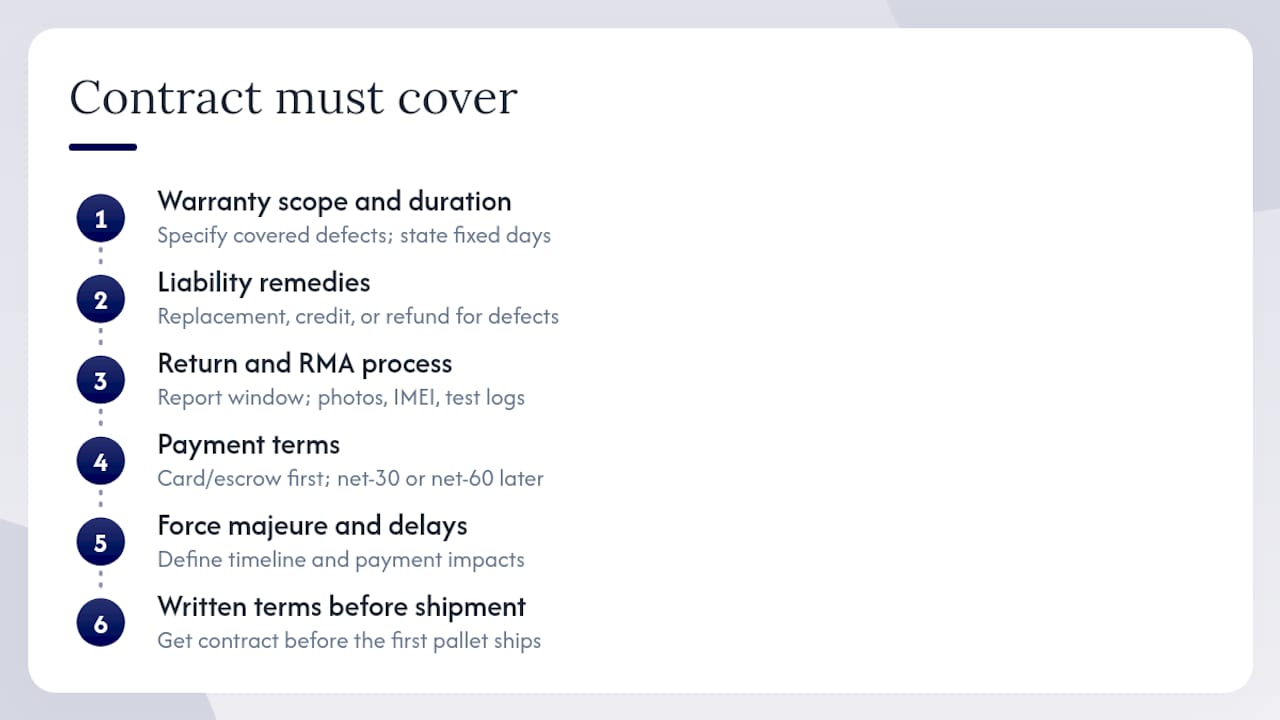
Warranty scope needs specificity: what’s covered (dead-on-arrival units, early battery failure, screen defects that surface within days) and for how long. A 90-day warranty window is a reasonable ask for graded refurbished stock, and it should be stated as a fixed number in the contract, not “a reasonable period.”
Liability caps protect both sides. If a batch arrives with mislabeled grades or blacklisted IMEIs, the contract should spell out remedies, whether that’s replacement units, credit toward the next order, or a full refund on the affected portion of the shipment.
Return windows and RMA process deserve their own clause. Specify how many days you have to report defects, what documentation you need to submit (photos, IMEI, test logs), and how fast the supplier commits to responding.
Payment terms should scale with trust. First orders typically run on credit card or escrow; net-30 or net-60 terms come later once both sides have a track record.
Force majeure and delivery delay clauses matter more than buyers expect, especially with overseas suppliers where customs delays are common. Know what happens to your order timeline and payment obligations if a shipment gets held up.
Skipping a written contract to save time on a first order is the single most common regret bulk buyers report after a batch goes wrong.
What After-Sales Support Should You Expect?
Bulk purchasing doesn’t end when the shipment clears your loading dock. The relationship that matters most starts after the first invoice, when you discover which units actually work as promised.
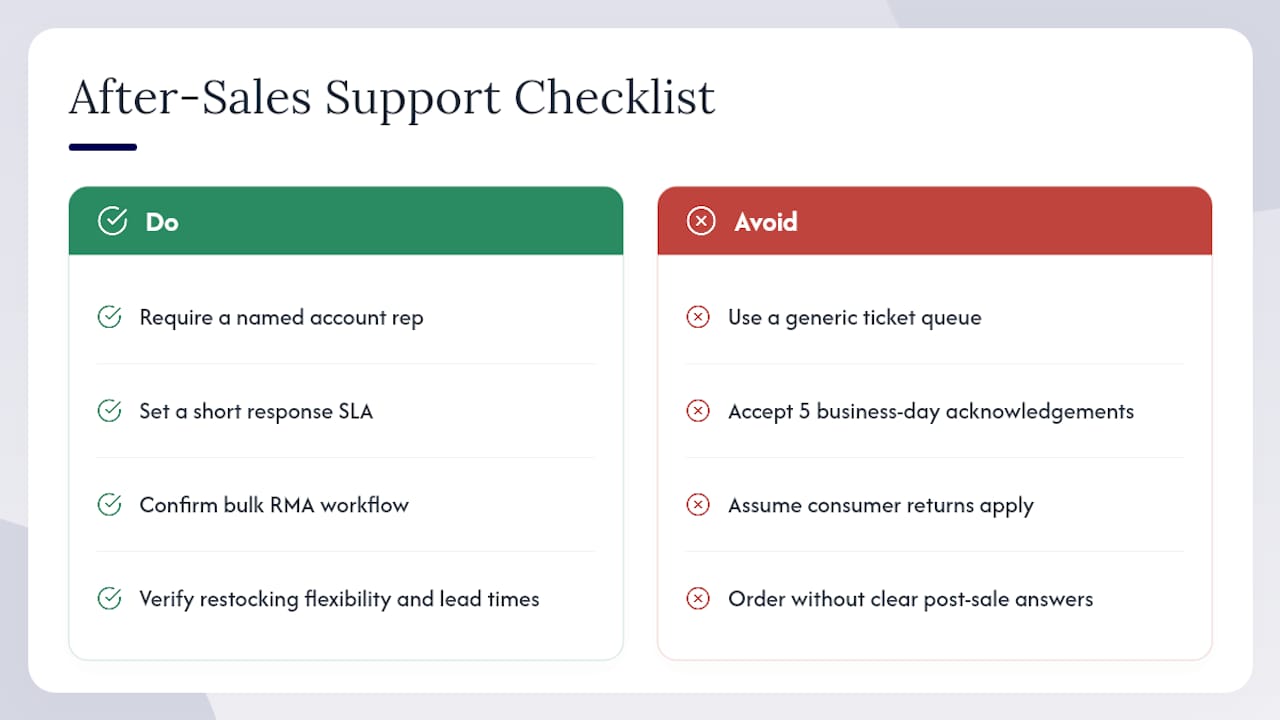
A supplier worth repeat business gives you a named contact or dedicated account rep, not a generic support ticket queue. Response time matters here: a supplier who takes five business days to acknowledge a defective-unit claim is going to cost you money in customer complaints or idle employee devices while you wait.
Ask upfront how RMA claims get processed for bulk orders specifically. Individual consumer returns and business-account bulk returns often route through different systems, and a supplier without a defined bulk RMA workflow will slow you down exactly when speed matters most.
Ongoing support also includes restocking flexibility. As you scale from a 20-unit pilot to a 200-unit standing order, your supplier should be able to tell you realistic lead times, whether pricing shifts at higher volumes, and how they handle mixed-grade orders if your needs change month to month. If a supplier can’t answer these questions clearly before you’ve placed a single order, that’s a preview of how they’ll handle you after you’re a paying account.
Why Grading Transparency Changes Everything
A reputable refurbisher runs every unit through a detailed multi-point inspection because vague condition claims are where bulk orders go wrong. Disclosed cosmetic grades and documented battery health mean a buyer knows exactly what’s arriving, not what a seller hopes looks acceptable in low-resolution photos.
Pro Tip: Cut return disputes before they start: require an IMEI CSV plus timestamped sample photos on your first lot, and negotiate a 72-hour inspection window into your return policy so problems surface fast, not after you’ve already resold half the batch.
Saad covers the refurbished device market for Device Giant’s bulk and business buyers.
— Saad
Get Verified Bulk Stock Without the Guesswork
Sourcing bulk phones from overseas liquidators or unverified marketplace sellers means absorbing the inspection risk yourself, often after money has already changed hands. Some verified refurbishers ensure every device passes a detailed multi-point inspection before shipping, with disclosed cosmetic grading to clarify condition before committing to a lot.
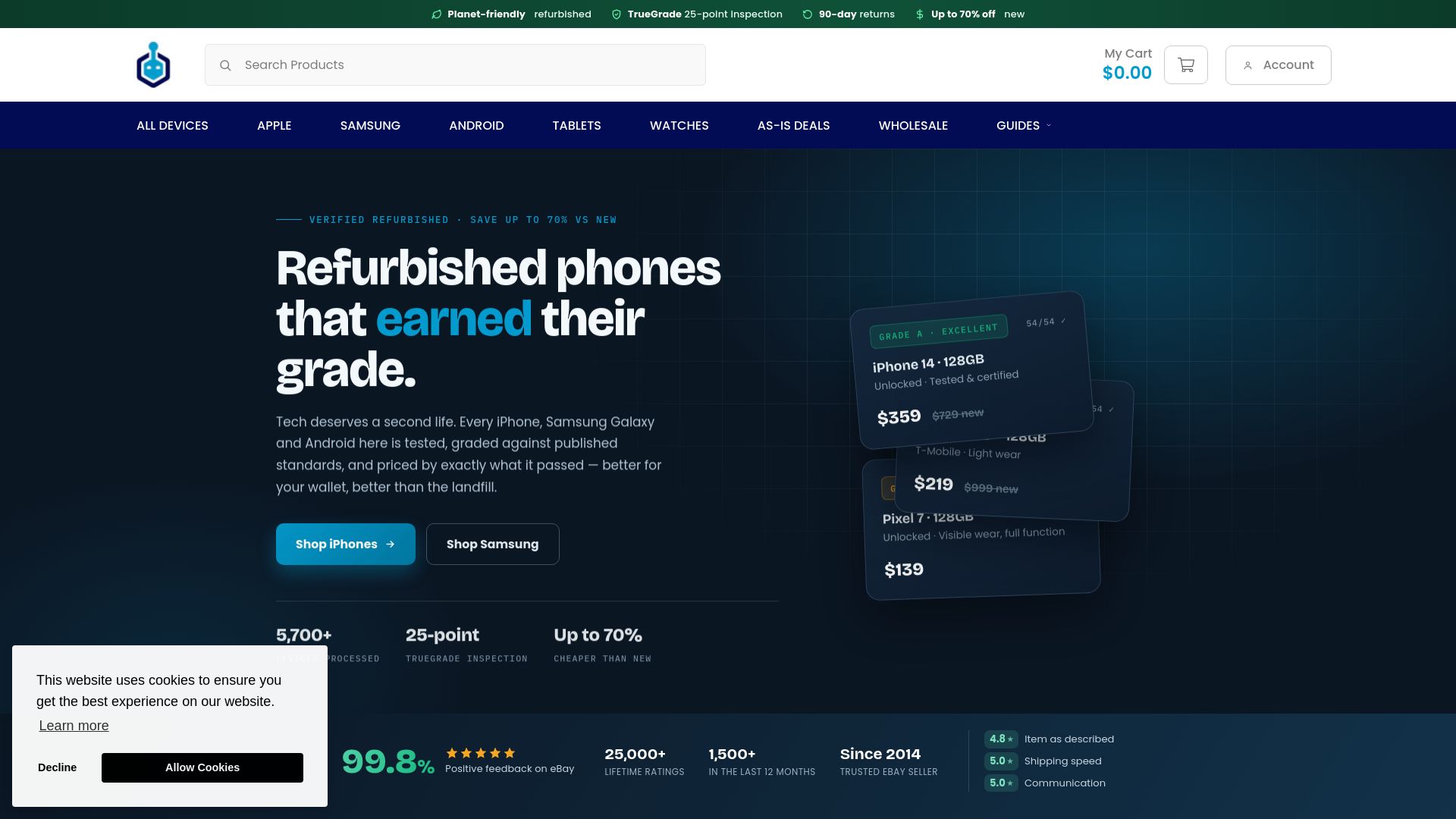
Bulk buyers get access to both unlocked and carrier-specific inventory, backed by a 90-day return policy that gives you real room to catch issues after deployment, not just at unboxing. Setting up a business account is straightforward: reach out through the Device Giant bulk ordering page to request a sample lot with full grading documentation and IMEI lists included, then scale up once that first batch checks out.
Sources
These resources back the checks and standards covered throughout this guide.
FAQ
What Is the Cheapest Way to Buy a Phone in Bulk?
Auctions and liquidation lots usually offer the lowest per-unit price, but they shift verification work onto you. B2B refurbishers cost more per unit while including grading and warranty coverage that often lowers your total cost once inbound QA labor is factored in.
Where Can I Find Bulk Suppliers for iPhones?
Authorized distributors and verified B2B refurbishers like Device Giant are the most reliable starting points, since they provide IMEI documentation, battery health data, and cosmetic grading upfront rather than requiring you to inspect blind lots.
Where Can I Buy iPhones in Bulk for a Low Price?
Marketplaces and auction platforms can beat refurbisher pricing, but minimum order quantities on auction lots often run 30 units or more with no pre-purchase inspection. A better path for most resellers is negotiating volume pricing with a graded refurbisher once your order volume climbs.
What Is the Smartest Way to Buy a Phone in Bulk?
Start with a small test lot of 5 to 10 units, demand a batch IMEI CSV and written grading definitions, and confirm battery health sits at 80% or above before scaling to a full order.
What Battery Health Level Should I Require for Resold Phones?
Industry practice sets the resale benchmark at 80% battery health or higher for devices intended for resale or employee deployment.


