
25 Point Tests, Per IMEI Logs: Wholesale Phone Grading for Resellers

Wholesale phone grading is the combination of cosmetic grade, functional classification, and data or lock status assigned to each device in a lot, and it determines whether that phone is resale-ready and what it should cost. Before you buy, insist on per-IMEI test logs, a stated battery-health threshold, and an explicit sanitization and lock-status declaration for every unit. The industry baseline for these labels comes from the CTIA Wireless Device Grading Scales, cross-referenced with R2 and REC categories for refurbished electronics.
TL;DR:
- Phone grades must be based on standard, published criteria like CTIA v5.1, not on seller judgment or appearance alone.
- Functional testing and per-IMEI logs are essential to verify that devices meet the claimed grade, with logs logged electronically to prevent disputes.
- Blacklisted, activated, or locked devices are controlled streams and cannot legally be sold as reuse-ready until those issues are cleared.
- A detailed lot sheet should include IMEI-specific grades, lock and sanitization status, and clear photos to support proper valuation and negotiations.
- Reliable wholesale sourcing requires traceability, calibrated testing equipment, and proof of sanitization, which reduce return rates and increase resale confidence.
Table of Contents
- What goes into a phone’s grade
- The standards that actually define these grades
- How functional testing and per-device logs actually work
- The facility practices that make a grade trustworthy
- What to demand on a lot sheet before you buy
- Where buyers actually get burned
- Sourcing verified wholesale stock from Device Giant
- Standards worth keeping on hand
- Sources
- FAQ
What goes into a phone’s grade
A lot sheet usually bundles four separate signals into one grade, and mixing them up is where most buyers get burned. Cosmetic condition tells you nothing about whether the phone works, and a working phone can still be legally unsellable if its data or activation status is not resolved.
- Cosmetic grade (A through E): Grade A allows only minimal signs of use, Grade B permits light scratches not visible at a short distance, Grade C shows heavier wear including scuffs and minor dents, and Grade D or E covers cracked glass, heavy denting, or other significant cosmetic flaws.
- Functional class: A device can be “fully functional,” meaning every feature tested passes, “key functions only,” meaning core calling and data features work but something secondary has failed, or a “controlled stream,” meaning it cannot be sold for reuse until an issue like a lock or failed sanitization is cleared.
- Data sanitization and lock status: A phone tied to an active iCloud or Google activation lock, or one flagged on a carrier blacklist, cannot legally change hands as a working device until that status is cleared, according to SERI’s mobile device reuse guidance.
- Battery health threshold: Battery capacity below the seller’s stated cutoff shifts a device into a lower grade or a parts-only category, and it should always be disclosed as a percentage.
Our own breakdown of what A, B, and C grades look like in practice covers the specific defects buyers tend to argue over most.
The standards that actually define these grades
Grading only means something when it ties back to a written standard, not a seller’s private judgment call. Three references do most of the work in this market.
- CTIA v5.1 sets the cosmetic defect tables, the functional classification system, battery-health thresholds, and the matrix that combines them into a single grade, and it is the schema most secondary-market sellers build their own labels around.
- R2/REC cross-referencing determines when a facility must run Appendix C testing and repair procedures before a device can be marketed as reuse-ready, according to SERI’s R2 reuse plan guidance.
- SERI’s CTIA grading guidance spells out that devices with unresolved activation locks or unverified sanitization are controlled streams, not standard reuse inventory, until a facility can prove otherwise (SERI CTIA Q&A).
Our guide to how CTIA v5.1 decodes refurbished grades walks through how listing language maps back to these clauses line by line.
How functional testing and per-device logs actually work
Cosmetic grading is a visual check. Functional testing is where a phone earns or loses its classification, and it needs to happen on every unit, not a sample of the lot.
- Power on and confirm the operating system loads without error.
- Test cellular network attach, Wi-Fi, and Bluetooth connectivity.
- Check the touchscreen and digitizer for dead zones or ghost touches.
- Test front and rear cameras, flash, microphone, and speakers.
- Verify charging port function and confirm battery health against the seller’s stated percentage threshold.
- Check proximity, accelerometer, and other onboard sensors.
Pass and fail criteria need to be specific: a battery under a stated health percentage, or a failed network attach, should automatically drop a device’s functional class. CTIA’s Appendix C testing requirements call for these results to be logged electronically by IMEI, not tracked on paper or memory, so disputes can be resolved with a record instead of an argument.
Pro Tip: Ask for a sample export of test logs before you commit to a lot size, not after the pallet arrives.
A locked or blacklisted phone is a separate problem entirely. SERI’s guidance is clear that these units are controlled streams and cannot be marketed as ready for reuse until the lock is cleared or the device is properly processed as scrap, a distinction we cover in more detail in our piece on iCloud locked versus unlocked devices.
The facility practices that make a grade trustworthy
A grading label is only as reliable as the process behind it, which is why serious buyers ask about the facility, not just the paperwork on one lot.
- Traceability: Serial numbers and IMEIs should be tracked in an ERP system from receiving through final grading, with written work instructions at each station.
- Receiving inspection and sampling: AQL-based sampling and a documented triage policy catch problems before they reach the sales floor, a practice detailed in R2’s Appendix C testing guidance.
- Calibration and audits: Test equipment calibration records and periodic audit evidence, whether from R2, e-Stewards, or NAID, show a facility’s grading claims hold up under outside scrutiny.
- Sanitization proof: Controlled sanitization software that generates a per-IMEI audit record, rather than a simple factory reset, gives buyers a defensible paper trail against chargebacks, per R2v3 sanitization guidance.
Facilities that run these checks consistently tend to produce grades that hold up on resale, which shows up directly in lower return rates.
What to demand on a lot sheet before you buy
A lot sheet is a negotiating document, not a formality, and it should give you everything you need to price the lot before the pallet ships.
- A per-IMEI grade matrix showing cosmetic grade, functional class, and battery percentage for every unit.
- Explicit lock and sanitization status for each device, not a blanket statement for the whole lot.
- Photos of any visible cosmetic defect, taken under consistent lighting.
- A description of included accessories, chargers, and original packaging where relevant.
Battery health below the seller’s stated threshold is one of the clearest signals to renegotiate price or pull a unit from the lot, since CTIA’s grading matrix ties battery percentage directly to functional class (CTIA v5.1).
Deal-killers worth walking away from include unresolved activation locks, missing sanitization proof, inconsistent or handwritten logs, and photos that do not match the stated grade. Our wholesale sourcing checklist walks through how to structure these negotiations lot by lot.
Where buyers actually get burned
Most disputes in this business come down to one gap: a phone that looks fine and tests badly, or the reverse. Sellers who grade only on appearance are setting buyers up for returns that a proper functional test would have caught before the sale.

Documentation is the difference between a professional supplier and a risky one. A device that has been through a structured, multi-point inspection with results logged per unit, rather than eyeballed on a bench, is the device that holds its grade after resale. Our own 25-point inspection process exists for exactly this reason: appearance and function are graded separately, then combined, so nothing gets papered over.
If there is one habit worth adopting from this entire standards framework, it is this: require the logs, and price in a small margin for the repairs a log alone will not always predict.
— Saad
Sourcing verified wholesale stock from Device Giant
Buying wholesale means trusting a grade you cannot inspect in person, which is exactly why the underlying process matters more than the label on the sheet. Every device we sell goes through TrueGrade, our 25-point functional inspection, paired with a disclosed cosmetic grade, so wholesale buyers get the same per-unit transparency this guide recommends demanding from any supplier.
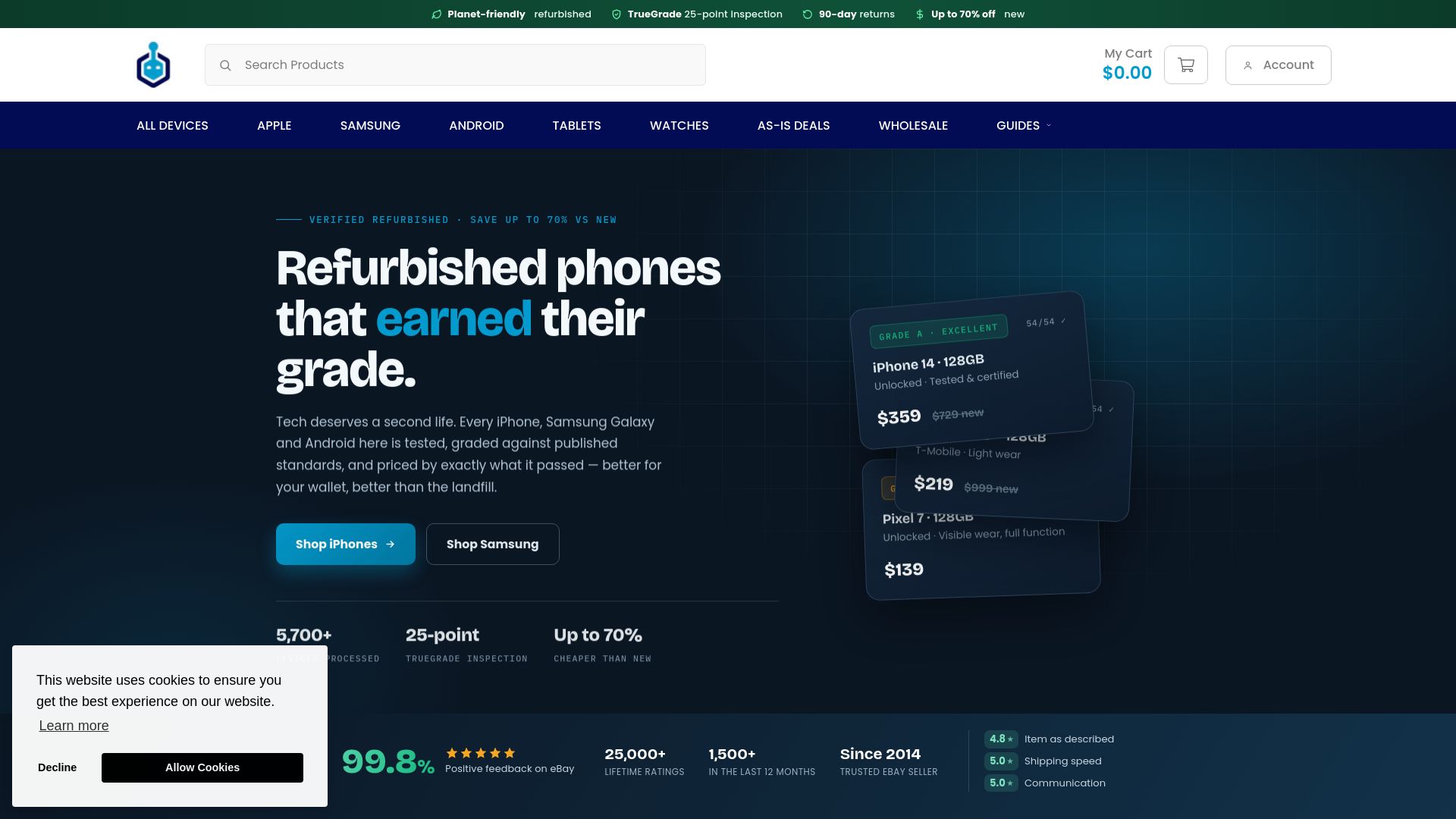
- TrueGrade’s 25-point check covers functional testing before a device is graded or listed.
- Devices are priced less than new, with condition disclosed rather than assumed.
- A 90-day return policy backs every purchase, individual or bulk.
- A 99.8% positive feedback rating on eBay reflects our order history there.
Wholesale buyers receive disclosed grades, lock and sanitization status, and per-device records instead of a single blanket description for the pallet. Browse current wholesale and bulk inventory to see verified lots available now.
Standards worth keeping on hand

For grading definitions, consult CTIA’s v5.1 grading scales. For sanitization, activation lock, and REC mapping rules, see SERI’s R2 guidance. For independent data benchmarking, FactRated compares product metrics buyers can use to sanity-check test equipment claims.
Sources
- Wireless Device Grading Scales Criteria and Definitions (CTIA v5.1)
- CTIA grading Q&A (SERI / Sustainable Electronics Recycling International)
- Guidance for Developing an R2 Reuse Plan (SERI)
FAQ
What does a Grade B phone typically look like?
A Grade B phone shows light cosmetic wear, such as minor scratches, that are not easily visible from a short distance, while remaining fully functional. Under CTIA’s grading tables, cosmetic condition and functional status are scored separately, so a Grade B label refers only to appearance, not performance.
Can a locked phone still be sold wholesale?
A phone with an active activation lock or a carrier blacklist flag is treated as a controlled stream, not standard reuse inventory, according to SERI’s mobile device guidance. It can only reenter the resale market once the lock is cleared or it is processed through an appropriate channel.
What battery health percentage should a wholesale buyer expect?
Battery health thresholds vary by seller, but CTIA’s grading matrix ties battery percentage directly to a device’s functional classification rather than treating it as a separate note. Always ask for the specific percentage per IMEI rather than a general “good battery” claim on the lot sheet.
How does Device Giant grade its wholesale phones?
Device Giant runs every device through TrueGrade, a 25-point functional inspection, and assigns a disclosed cosmetic grade before it is listed for individual or wholesale sale. Every unit also carries a 90-day return policy regardless of order size.
Why do per-IMEI logs matter more than a general condition report?
A per-IMEI log ties test results to one specific device, which lets a buyer verify claims and resolve disputes with a record instead of a seller’s word. CTIA’s Appendix C testing requirements call for exactly this kind of electronic, per-device documentation rather than a single summary for an entire lot.


